Question 1
: How Close Can You Get?
Make a pair. Each of you choose a number. Suppose, the numbers chosen are and . Share your numbers with each other. Both of you should estimate the percentage equivalent to the fraction (where ) and announce your answers by a fixed time, say, 5 seconds. The one whose estimate is the closest wins this round. Play this for 10 rounds.
We will learn a strategy to quickly estimate the percentage equivalent of a fraction using mental math.
Step 1 — Understanding Percentages
A percentage tells us a part out of one hundred. To convert a fraction to a percentage, we multiply by 100. Let be the percentage we want to estimate.
For example, if and , the percentage is:
Step 2 — Estimation Strategy: Mental Division
We need to quickly divide by and then multiply by 100. Let us use an example: Suppose and . We want to estimate as a percentage.
First, perform the division . We can think of this as .
Now, convert this decimal to a percentage by multiplying by 100.
Step 3 — Refining the Estimate with Benchmarks
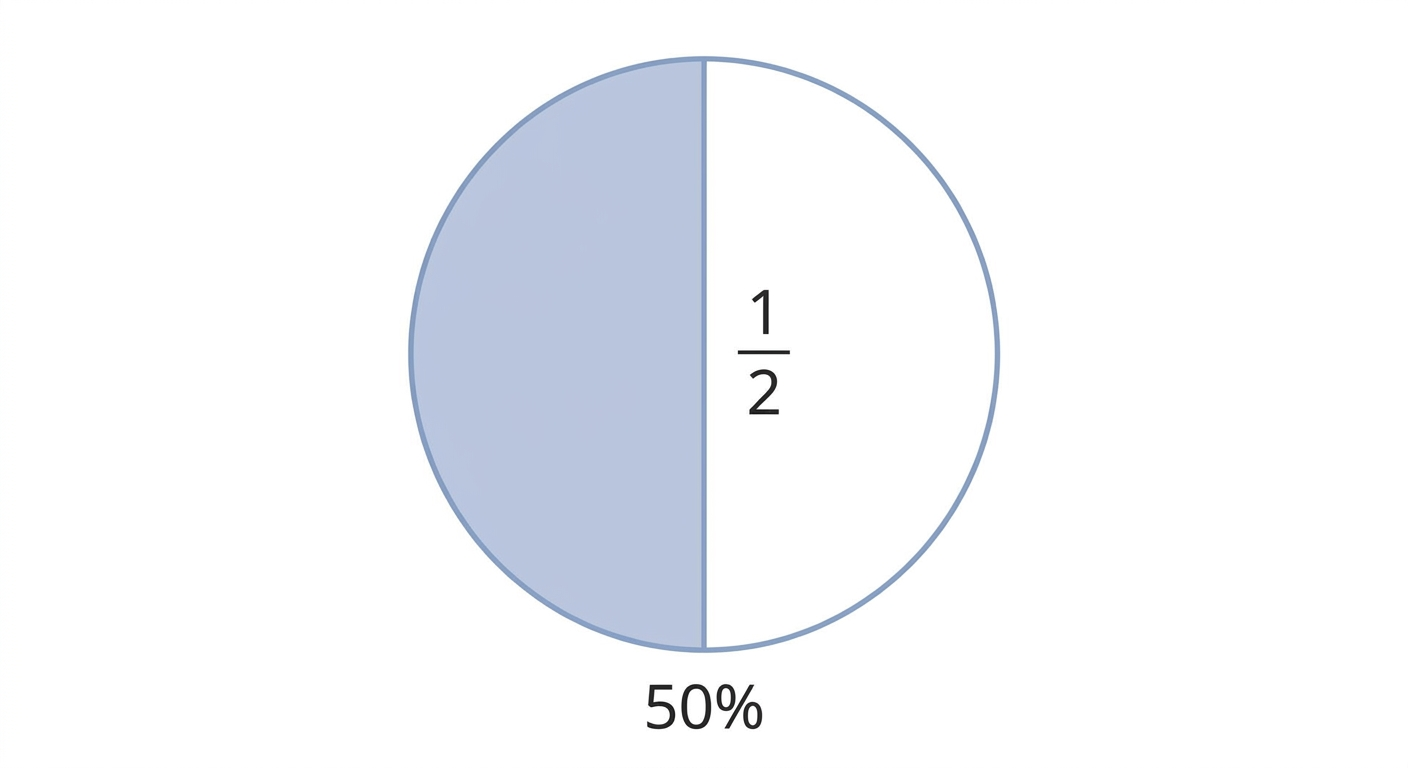
To get even closer, we use common fractions as benchmarks. These are fractions whose percentages we know by heart. For example, is . is about . is . is . is . Let us use our example . We know . Let us see how compares to .
Fraction is slightly more than . So is slightly more than . The difference is . We estimate as a percentage.
So, our estimate for is about .
This method helps refine the mental division estimate. Knowing more benchmarks helps you estimate faster.
Answer
To get the closest estimate, we follow these steps. First, perform mental division of by . This gives a decimal value. Next, round this decimal to one or two decimal places. Then, multiply the rounded decimal by 100 to find the percentage. For better accuracy, compare to common percentage benchmarks. Adjust your initial estimate based on these comparisons. For example, is . is about . is .
More questions in A
: How Close Can You Get?
Make a pair. Each of you choose a number. Suppose, the numbers chosen are and . Share your numbers with each other. Both of you should estimate the percentage equivalent to the fraction (where ) and announce your answers by a fixed time, say, 5 seconds. The one whose estimate is the closest wins this round. Play this for 10 rounds.
Peaceful Knights
Place 8 knights on the chess board so that no knight attacks another. A knight moves in an 'L-shape'. It can move either (a) two steps vertically and one step horizontally, or (b) two steps horizontally and one step vertically. Possible moves of a knight are shown below.