Question 19
What if we write as or ? Draw the figures and check the area that you get.
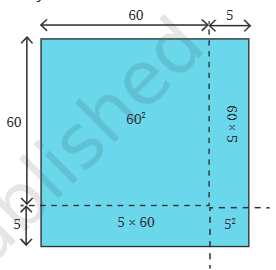
We can find the area of a square by adding the areas of its smaller parts.
Step 1 — Calculate for
Let us find the value of . We can write as the sum of and . So, we need to calculate . We use the algebraic identity for squaring a sum. This identity is: . Here, is and is .
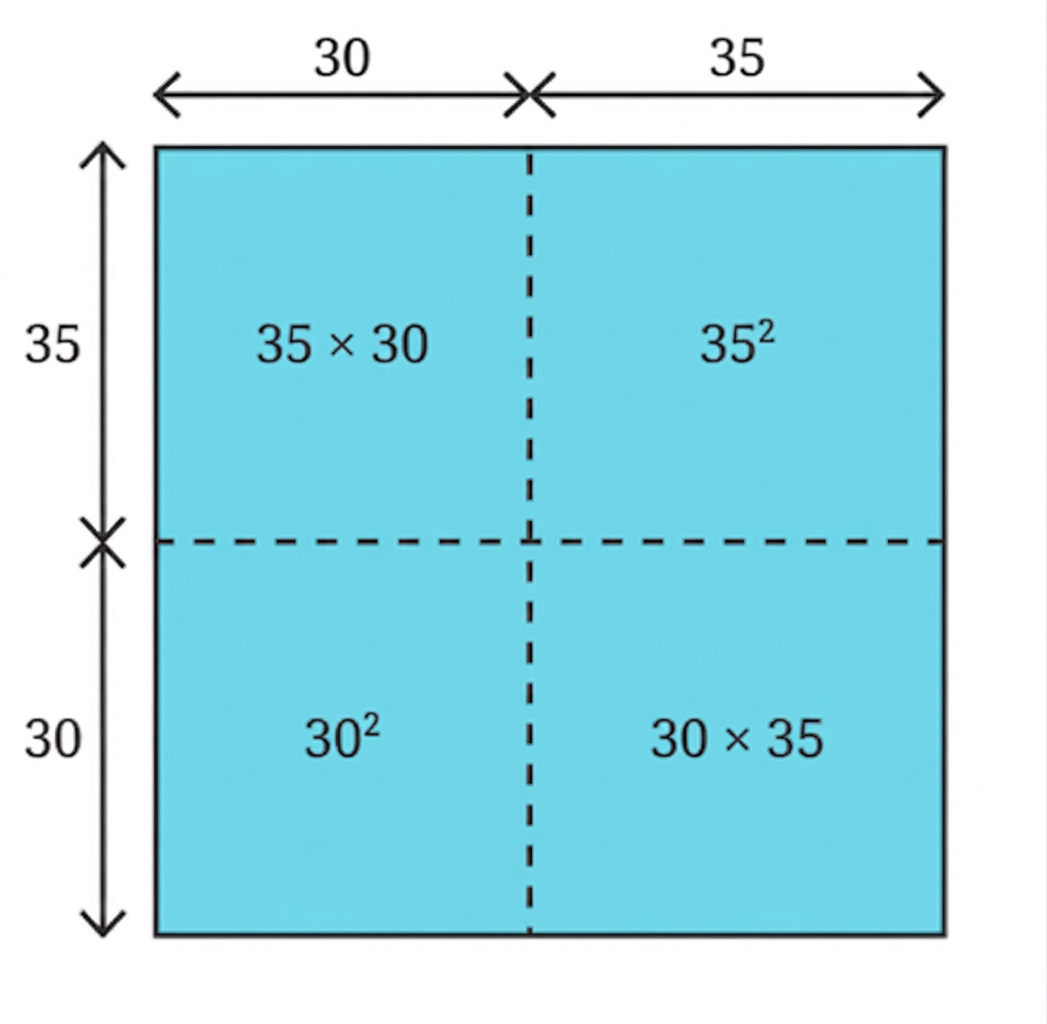
Step 2 — Calculate for
Let us find the value of . We can also write as the sum of and . So, we need to calculate . We use the same algebraic identity for squaring a sum. This identity is: . Here, is and is .
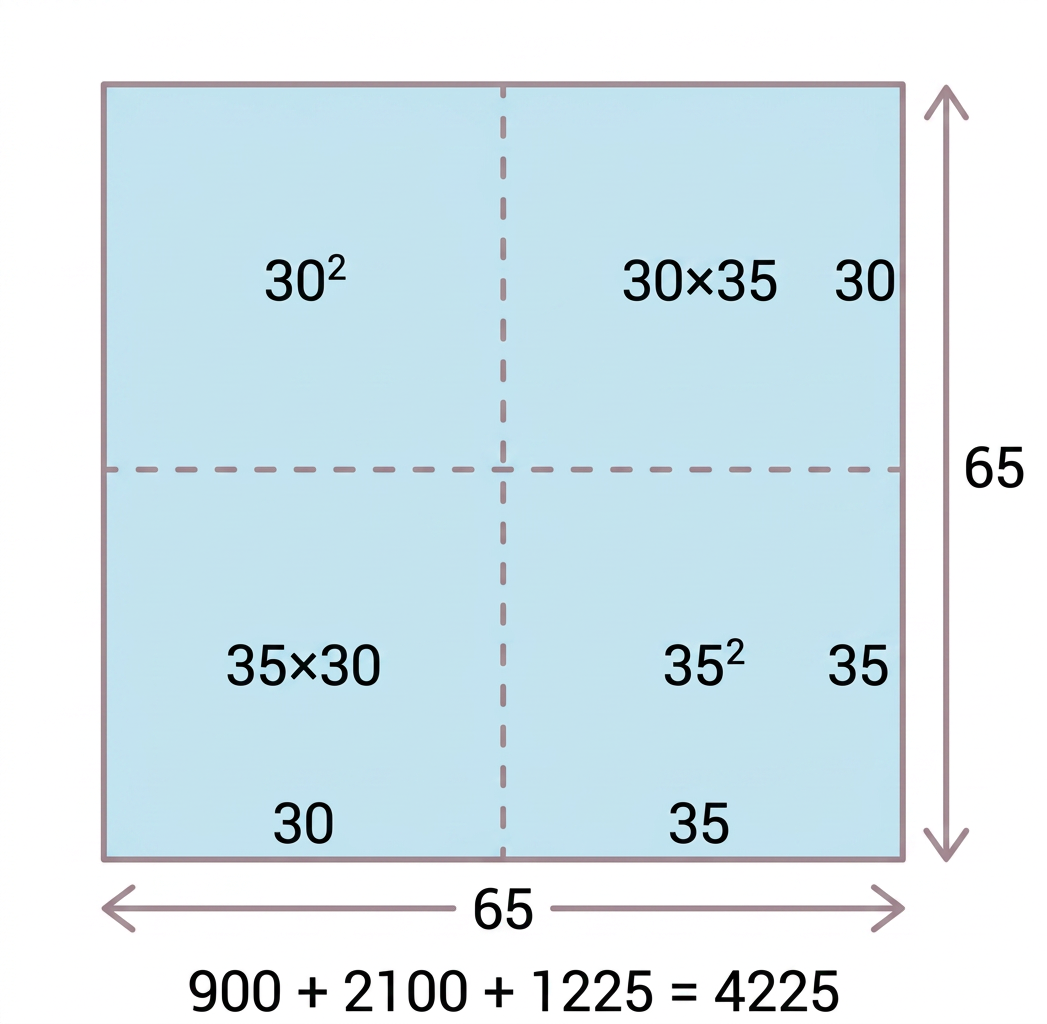
Answer
No matter how we split into two parts, the square of will always be the same. Using the formula , we found that:
(i) (ii) (iii) So, square units, regardless of the split.
More questions in IT
Context: Consider the multiplication of two numbers, say, 23 × 27.
Q. By how much does the product increase if the first number (23) is increased by 1?
Context: Consider the multiplication of two numbers, say, 23 × 27.
Q. What if the second number (27) is increased by 1?
Context: Consider the multiplication of two numbers, say, 23 × 27.
Q. How about when both numbers are increased by 1?
Context: Consider the multiplication of two numbers, say, 23 × 27.
Q. Do you see a pattern that could help generalise our observations to the product of any two numbers?
What would we get if we had expanded by first taking as a single term? Try it!
Will the product always increase? Find 3 examples where the product decreases.
What happens when and are negative integers?
Check by substituting different values for and in each of the above cases. For example, ; etc.
Use Identity 1 to find how the product changes when
(i) one number is decreased by 2 and the other increased by 3;
(ii) both numbers are decreased, one by 3 and the other by 4.
Verify the answers by finding the products without converting the subtractions to additions.
Expand (i) , (ii) .
Use the following multiplications to find the product of a number with 11 in a single step.
(a) (b)
Describe a general rule to multiply a number (of any number of digits) by 11 and write the product in one line.
Evaluate: (i) (ii) (iii) (iv)
Can we come up with a similar rule for multiplying a number by 101?
Multiply 3874 by 101.
Use this to multiply in one line.
What could be a general rule to multiply a number by 101 and write the product in one line? Extend this rule for multiplication by 1001, 10001, ...
Use this to find (i) , (ii) , (iii) , (iv) , (v) and (vi) .
The area of a square of sidelength 60 units is 3600 sq. units () and that of a square of sidelength 5 units is 25 sq. units (). Can we use this to find the area of a square of sidelength 65 units?
What if we write as or ? Draw the figures and check the area that you get.
If and are any two integers, is always greater than ? If not, when is it greater?
Use Identity 1A to find the values of , . (Hint: Decompose 104 and 37 into sums or differences of numbers whose squares are easy to compute.)
Use Identity 1A to write the expressions for the following.
(i)
(ii)
Expand using both the identity and by applying the distributive property.
Find the general expansion of using geometry, as we did for .
Use the identity to find the values of (a) and (b) .
Expand the following using both Identity 1B and by applying the distributive property
(i) (ii) (iii)
Take a pair of natural numbers. Calculate the sum of their squares. Can you write twice this sum as a sum of two squares?
Try this with other pairs of numbers. Have you figured out a pattern?
Notice that .
Do the identities below help in explaining the observed pattern?
Adding the like terms , and , we get
Pattern 2
Here is a related pattern. Try to describe the pattern using algebra to determine if the pattern always holds.
Use Identity 1C to calculate , and .
Show that geometrically.
Context: Sridharacharya (750 CE) gave an interesting method to quickly compute the squares of numbers using Identity 1C! Consider the following modified form of this identity —
Q. Why is this identity true?
6.3 Mind the Mistake, Mend the Mistake
We have expanded and simplified some algebraic expressions below to their simplest forms.
(i) Check each of the simplifications and see if there is a mistake. (ii) If there is a mistake, try to explain what could have gone wrong. (iii) Then write the correct expression.
6.4 This Way or That Way, All Ways Lead to the Bay
Observe the pattern in the figure below. Draw the next figure in the sequence. How many circles does it have? How many total circles are there in Step 10? Write an expression for the number of circles in Step k.
Context: The expression gives the number of circles at Step of a pattern.
Q. Use this formula to find the number of circles in Step 15.
Consider the pattern made of square tiles in the picture below.
(i) How many square tiles are there in each figure? (ii) How many are there in Step 4 of the sequence? What about Step 10? (iii) Write an algebraic expression for the number of tiles in Step . Share your methods with the class. Can you find more than one method to arrive at the answer?
Context: Consider the pattern made of square tiles in the picture below.
Q. How many square tiles are there in each figure?
Context: Consider the pattern made of square tiles in the picture below.
Q. How many are there in Step 4 of the sequence? What about Step 10?
Context: Consider the pattern made of square tiles in the picture below.
Q. Write an algebraic expression for the number of tiles in Step . Share your methods with the class. Can you find more than one method to arrive at the answer?
By expanding both expressions, check that .
By expanding the expressions, verify that all three expressions are equivalent. If and , find the area of the shaded region.
Write an expression for the area of the dashed region in the figure below. Use more than one method to arrive at the answer. Substitute , , and , and calculate the area.