Question 17
I run a small dosa cart and my expenses are as follows:
- Rent for the dosa cart is ₹5000 per day.
- The cost of making one dosa (including all the ingredients and fuel) is ₹10.
(i) If I can sell 100 dosas a day, what should be the selling price of my dosa to make a profit of ₹2000?
(ii) If my customers are willing to pay only ₹50 for a dosa, how many dosas should I aim to sell in a day to make a profit of ₹2000?
We will use the idea that Profit is the money earned from sales (Total Revenue) minus the total money spent (Total Cost).
Step 1 — Calculate Total Cost
First, let us find the total cost for making dosas. The total cost has two parts: fixed cost and variable cost. Fixed cost is the rent, which is constant every day. Variable cost depends on how many dosas we make.
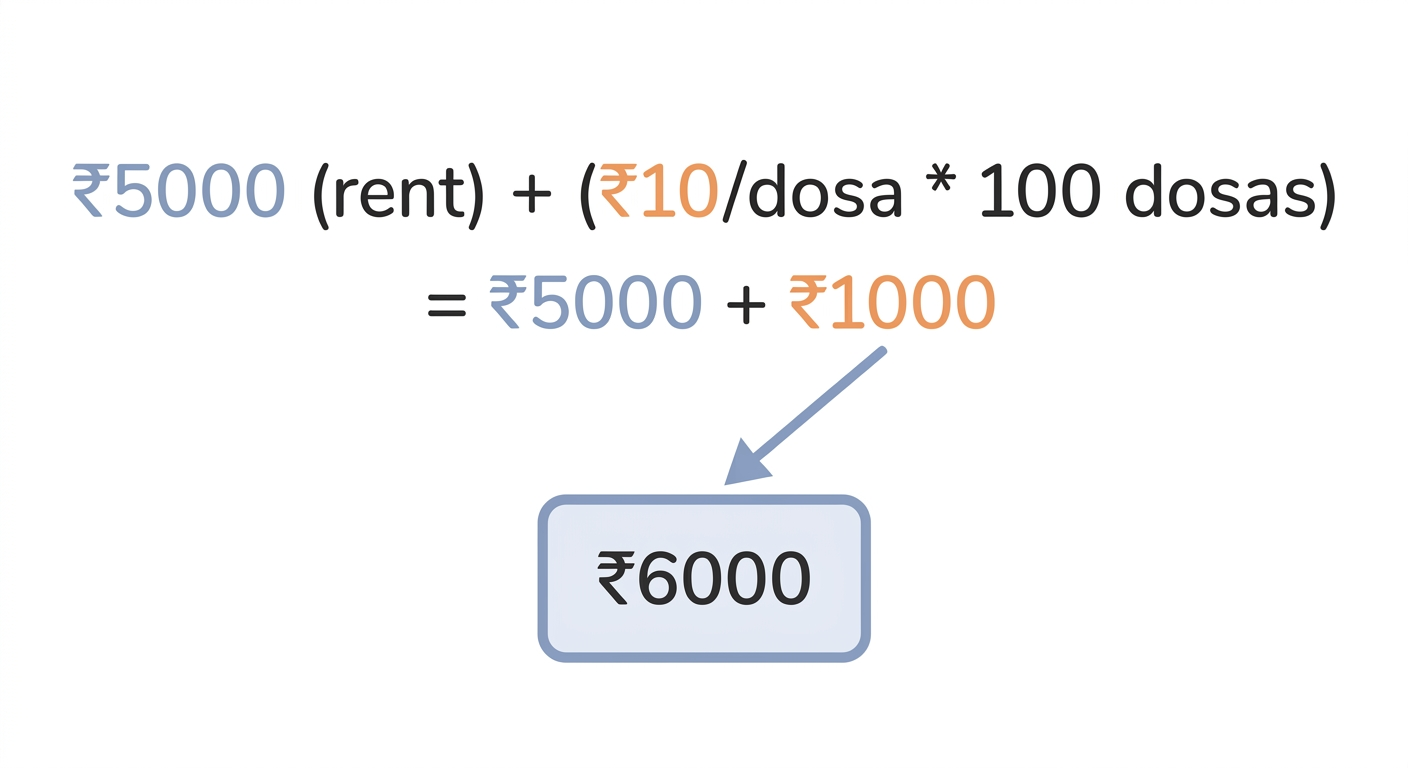
Daily fixed cost (rent) = ₹5000 Cost to make one dosa = ₹10
(i) If we sell 100 dosas a day: Total variable cost for 100 dosas = Cost per dosa Number of dosas
Total cost for the day = Daily fixed cost + Total variable cost
This is the total money spent in a day.
Step 2 — Find Selling Price per Dosa (Part i)
We want to make a profit of ₹2000. Profit is calculated as Total Revenue minus Total Cost. Total Revenue is the total money earned from selling dosas.
Let be the selling price of one dosa. Total Revenue = Number of dosas
We know that: Profit = Total Revenue - Total Cost So, Total Revenue = Profit + Total Cost
Now, we can find the selling price of one dosa. Selling price per dosa = Total Revenue Number of dosas
Step 3 — Find Number of Dosas to Sell (Part ii)
Now, let us consider the second situation. Customers are willing to pay ₹50 for a dosa. We still want to make a profit of ₹2000.
Let be the number of dosas we need to sell. Total Revenue = Selling price per dosa Number of dosas
Total Cost = Daily fixed cost + (Cost per dosa Number of dosas)
We know that Profit = Total Revenue - Total Cost. We want the profit to be ₹2000.
We need to solve this equation for . Add 5000 to both sides of the equation.
Now, divide both sides by 40 to find .
Answer
(i) The selling price of my dosa should be ₹80. (ii) I should aim to sell 175 dosas in a day.
More questions in FIO
Without building the entire pyramid, find the number in the topmost row given the bottom row in each of these cases.
Write an expression for the topmost row of a pyramid with 4 rows in terms of the values in the bottom row.
Without building the entire pyramid, find the number in the topmost row given the bottom row in each of these cases.
If the first three Virahāṅka-Fibonacci numbers are written in the bottom row of a number pyramid with three rows, fill in the rest of the pyramid. What numbers appear in the grid? What is the number at the top? Are they all Virahāṅka-Fibonacci numbers?
What can you say about the numbers in the pyramid and the number at the top in the following cases?
(i) The first four Virahāṅka-Fibonacci numbers are written in the bottom row of a four row pyramid. (ii) The first 29 Virahāṅka-Fibonacci numbers are written in the bottom row of a 29 row pyramid.
If the bottom row of an row pyramid contains the first Virahāṅka-Fibonacci numbers, what can we say about the numbers in the pyramid? What can we say about the number at the top?
Fill the digits 1, 3, and 7 in to make the largest product possible.
Fill the digits 3, 5, and 9 in to make the largest product possible.
In the trick given above, what is the quotient when you divide by 9? Is there a relationship between the two numbers and the quotient?
In the trick given above, instead of finding the difference of the two 2-digit numbers, find their sum. What will happen? For example:
- We start with 31. After reversing we get 13. Adding 31 and 13, we get 44.
- We start with 28. After reversing we get 82. Adding 28 and 82, we get 110.
- We start with 12. After reversing we get 21. Adding 12 and 21, we get 33.
Observe that all these numbers are divisible by 11. Is this always true? Can we justify this claim using algebra?
Consider any 3-digit number, say (). Make two other 3-digit numbers from these digits by cycling these digits around, yielding and . Now add the three numbers. Using algebra, justify that the sum is always divisible by 37. Will it also always be divisible by 3? [Hint: Look at some multiples of 37.]
Consider any 3-digit number, say . Make it a 6-digit number by repeating the digits, that is . Divide this number by 7, then by 11, and finally by 13. What do you get? Try this with other numbers. Figure out why it works. [Hint: Multiply 7, 11 and 13.]
There are 3 shrines, each with a magical pond in the front. If anyone dips flowers into these magical ponds, the number of flowers doubles. A person has some flowers. He dips them all in the first pond and then places some flowers in shrine 1. Next, he dips the remaining flowers in the second pond and places some flowers in shrine 2. Finally, he dips the remaining flowers in the third pond and then places them all in shrine 3. If he placed an equal number of flowers in each shrine, how many flowers did he start with? How many flowers did he place in each shrine?
A farm has some horses and hens. The total number of heads of these animals is 55 and the total number of legs is 150. How many horses and how many hens are on the farm?
Can you solve this without letter-numbers?
[Hint: If all the 55 animals were hens, then how many legs would there be? Using the difference between this number and 150, can you find the number of horses?]
A mother is 5 times her daughter's age. In 6 years' time, the mother will be 3 times her daughter's age. How old is the daughter now?
Two friends, Gauri and Naina, are cowherds. One day, they pass each other on the road with their cows. Gauri says to Naina, "You have twice as many cows as I do". Naina says, "That's true, but if I gave you three of my cows, we would each have the same number of cows". How many cows do Gauri and Naina have?
I run a small dosa cart and my expenses are as follows:
- Rent for the dosa cart is ₹5000 per day.
- The cost of making one dosa (including all the ingredients and fuel) is ₹10.
(i) If I can sell 100 dosas a day, what should be the selling price of my dosa to make a profit of ₹2000?
(ii) If my customers are willing to pay only ₹50 for a dosa, how many dosas should I aim to sell in a day to make a profit of ₹2000?
Evaluate the following sequence of fractions:
What do you observe? Can you explain why this happens?
[Hint: Recall what you know about the sum of the first odd numbers.]
Karim and the Genie
Karim was taking a nap under a tree. He had a dream about a magical lamp and a genie. He heard a voice saying, “I have come to serve you, Oh master”. He woke up and to his surprise, it was a genie!
“Do you want to make money?”, asked the genie. Karim nodded dumbly in bewilderment. The genie continued, “Do you see the banyan tree over there? All you have to do is go around it once. The money in your pocket will double”.
Karim immediately started towards the tree, only to be stopped by the genie. “One moment!”, said the genie. “Since I am bringing you great riches, you should share some of your gains with me. You must give me 8 coins each time you go around the tree.”
Thinking that was a trifling amount, Karim readily agreed.
He went around the tree once. Just as the genie had said, the number of coins in his pocket doubled! He gave 8 coins to the genie. He made another round. Again the number of coins doubled. He gave 8 more coins to the genie. He went around the tree for the third time. The number of coins doubled again, but to his horror, he was left with only 8 coins, exactly the number of coins he owed the genie!
As Karim began to wonder how the genie tricked him, the genie let out a loud laugh and disappeared.
(i) How many coins did Karim initially have?
(ii) For what cost per round should Karim agree to the deal, if he wants to increase the number of coins he has?
(iii) Through its magical powers, the genie knows the number of coins that Karim has. How should the genie set the cost per round so that it gets all of Karim's coins?