Question 5
Context: In the date trick, the final answer is given by , where is the month and is the day.
Q. Can you change the steps in this trick and still find the original date? Instead of subtracting 165 from the final answer, you might have to subtract some other number.
Different trick steps lead to a new constant, but the date can still be found.
Step 1 — Understanding the original trick Let be the month number and be the day number. The trick gives a final answer. The final answer is . To find the date, we subtract 165. This leaves us with . For example, if . Then and . So, the date is March 25. The number 165 is a constant value. It is added during the trick's steps.
Step 2 — Changing the trick's steps Let us create a new version of the trick. We will change some numbers in the steps. Let's see how this affects the final answer. Here are the new steps we will follow:
- Take the month number .
- Multiply it by 5.
- Add 10 to the result.
- Multiply this new result by 20.
- Add the day number .
- Add 30 to the total.
Step 3 — Calculating the new final answer Let us write down the expression after each step. We start with the month . After step 1, the value is . After step 2, we multiply by 5: After step 3, we add 10: After step 4, we multiply by 20: After step 5, we add the day : After step 6, we add 30:
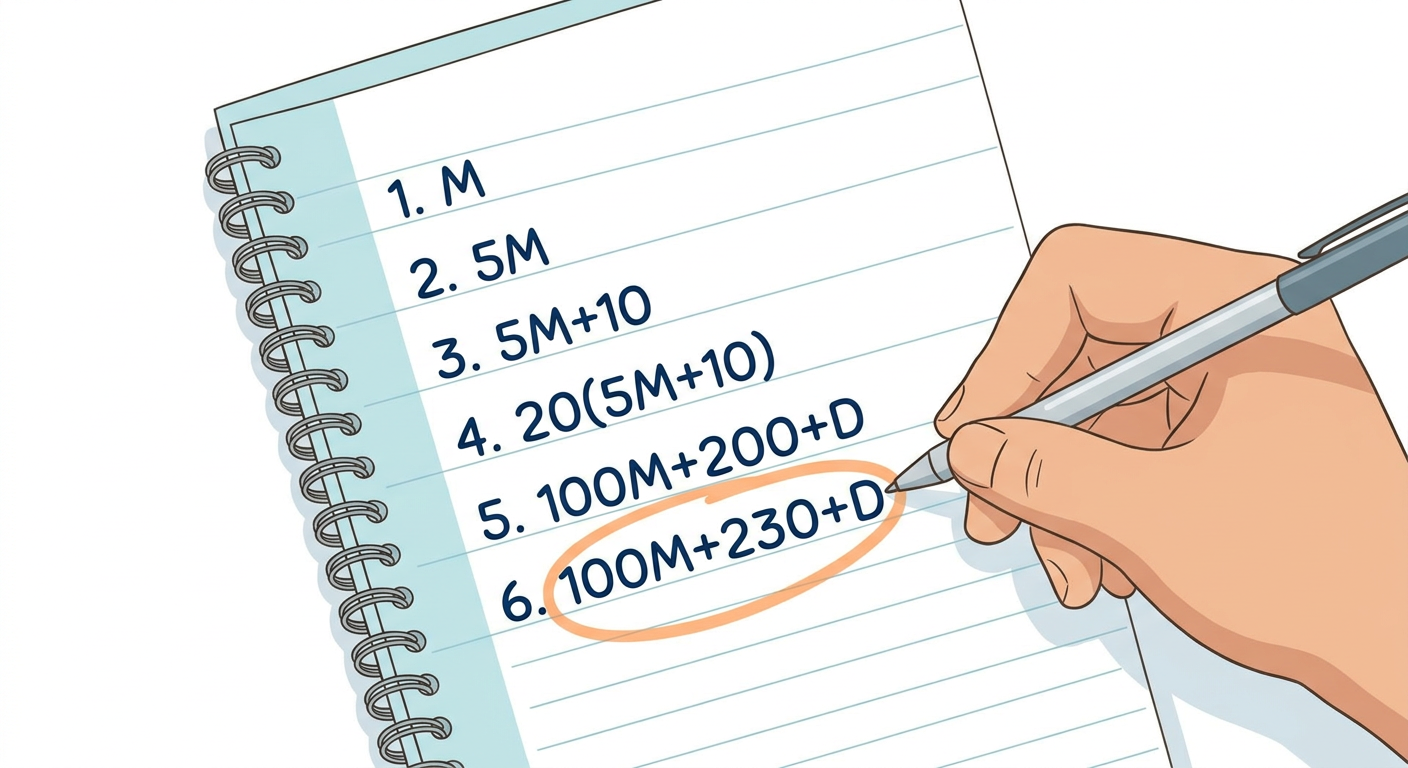
Step 4 — Finding the date with the new trick The new final answer is . Let us call this new final answer . So, . To find , we must subtract 230.
This value will give us the month and day. The month is the number of hundreds. The day is the remaining number. So, we can still find the original date.
Answer
(i) Yes, we can change the steps in this trick and still find the original date. (ii) For example, we can change the steps to: (1) Take month , (2) Multiply by 5, (3) Add 10, (4) Multiply by 20, (5) Add day , (6) Add 30. (iii) In this new trick, we would have to subtract 230 from the final answer instead of 165 to find the original date.
More questions in IT
Context: Think of a number trick:
- Think of a number.
- Double it.
- Add four.
- Divide by two.
- Subtract the original number you thought of.
Q. I predict you get 2. Am I right? Try it out with different starting numbers. Do you always end up with the same value, 2? Why?
Context: Consider the following number trick:
- Think of a number.
- Double it.
- Add four.
- Divide by two.
- Subtract the original number you thought of. (This trick always results in 2).
Q. How would you change this game to make the final answer 3? What about 5?
Context: Consider the following number trick:
- Think of a number.
- Double it.
- Add four.
- Divide by two.
- Subtract the original number you thought of. (This trick always results in 2).
Q. Can you come up with more complicated steps that always lead to the same final value?
Context: In the date trick, the final answer is given by , where is the month and is the day.
Q. Find the dates if the final answers are the following:
(i) 1269 (ii) 394 (iii) 296
Context: In the date trick, the final answer is given by , where is the month and is the day.
Q. Can you change the steps in this trick and still find the original date? Instead of subtracting 165 from the final answer, you might have to subtract some other number.
Try to devise your own 'Think of a Number' trick.
Use the same rule to fill these pyramids:
Fill the following pyramids:
What is the relationship between the numbers in the bottom row and the number at the top?
Let us start with the simplest pyramid.
What about a pyramid with three rows?
Using letter numbers for the bottom row, we can write an expression for the top row.
In the following grids, find the values of the shapes and fill in the empty squares:
Context: 6.5 The Largest Product
Q. Fill the digits 2, 3, and 5 in , using each digit once. What is the largest product possible?
Context: Mukta's trick: Choose a 2-digit number of different digits, reverse the digits to get another number, find their difference, and divide the result by 9.
Q. If we choose other 2-digit numbers, and follow the steps, will there always be no remainder?
Context: Suppose a two-digit number is . When it is reversed, the new number is . If , the difference is , which is divisible by 9.
Q. Can you work out what happens if ?