Question 1
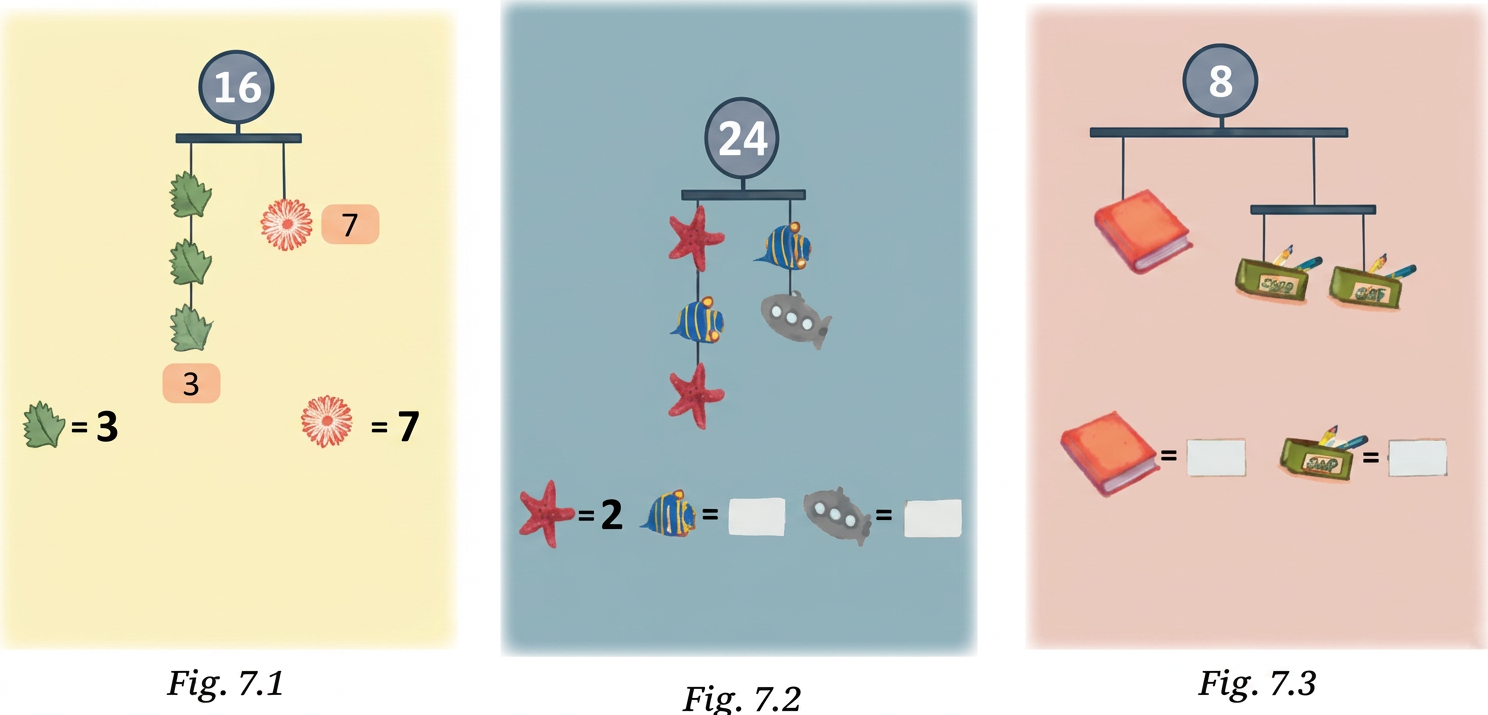
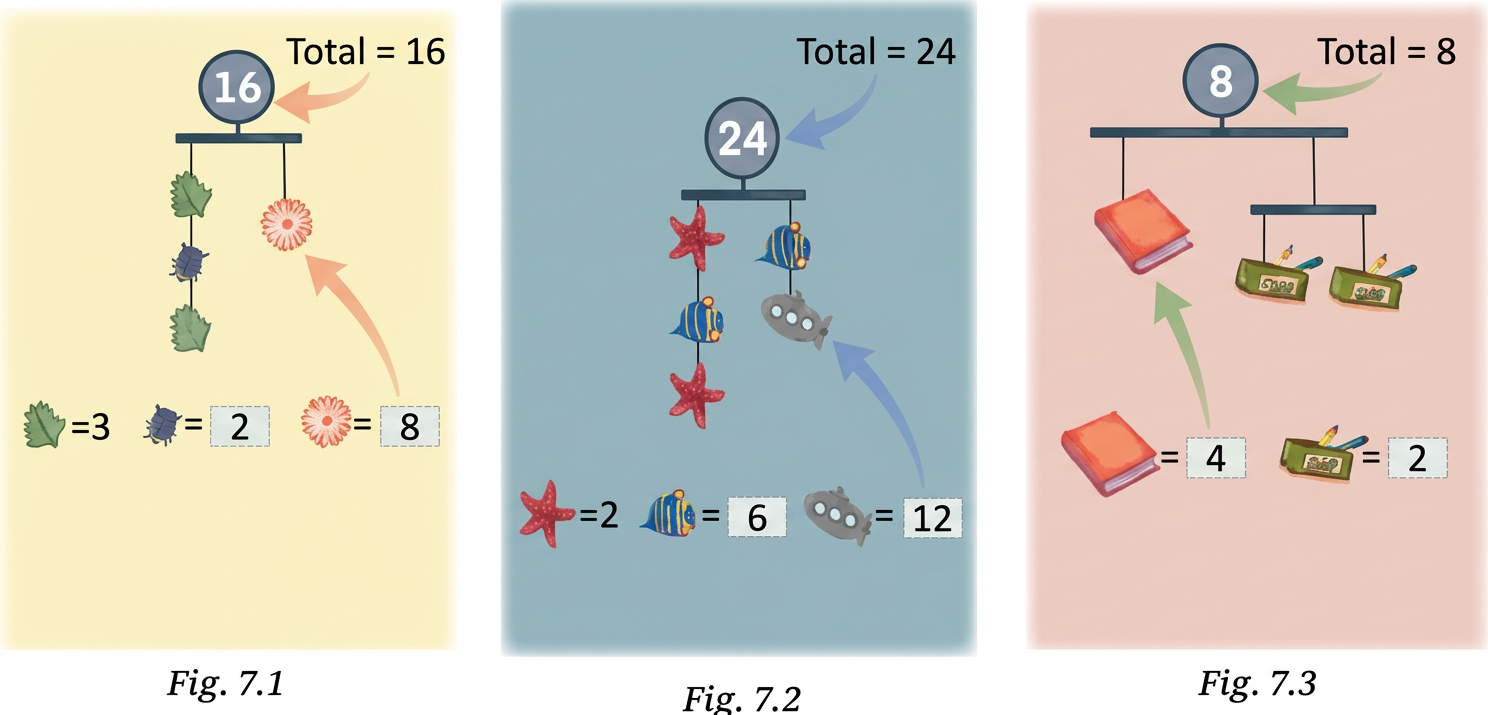
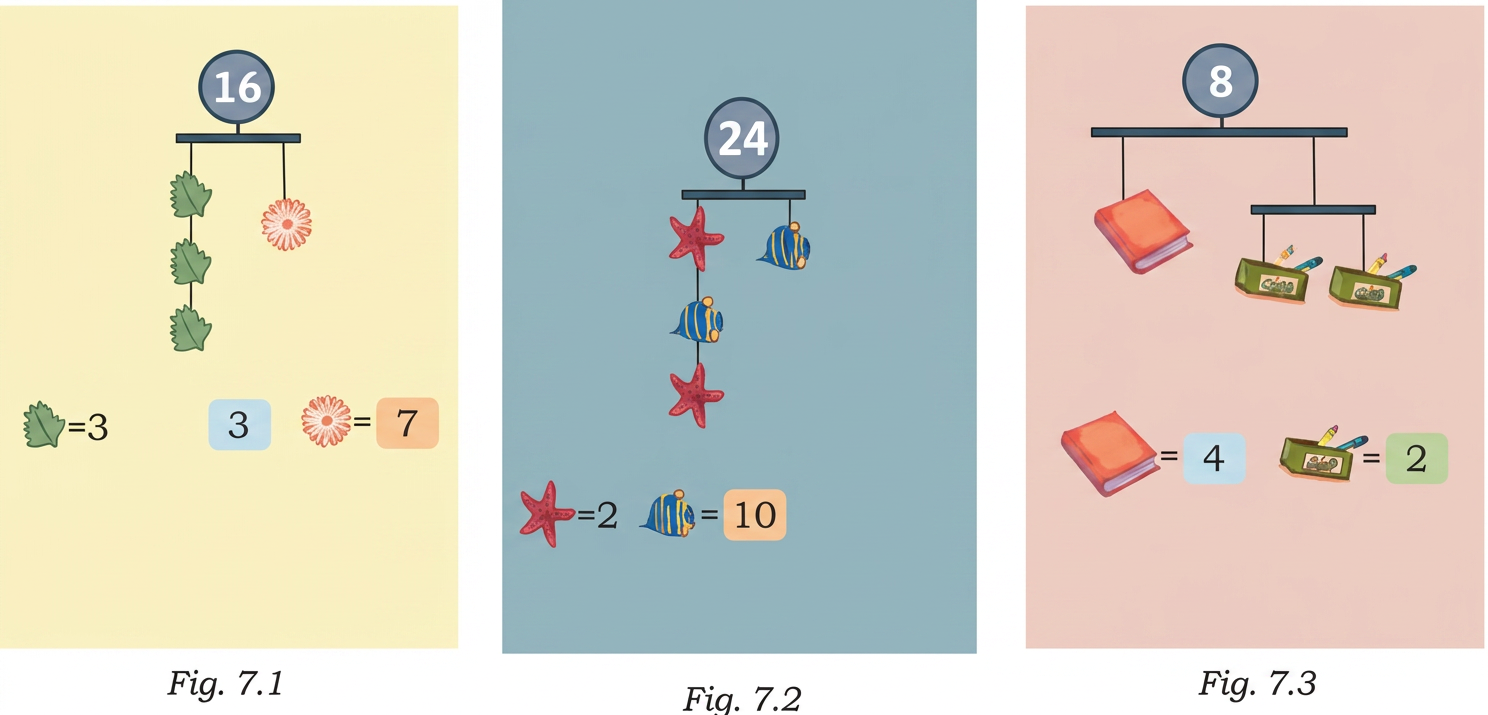
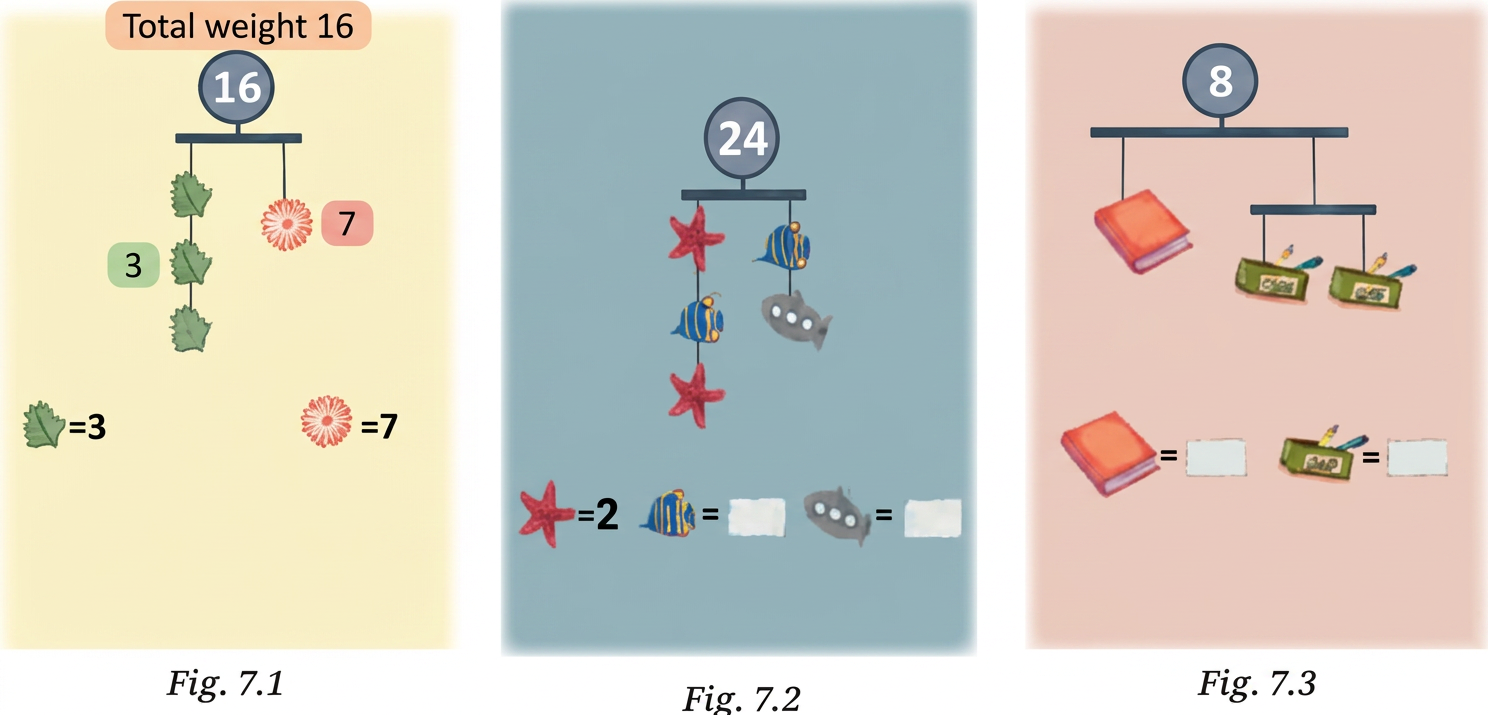
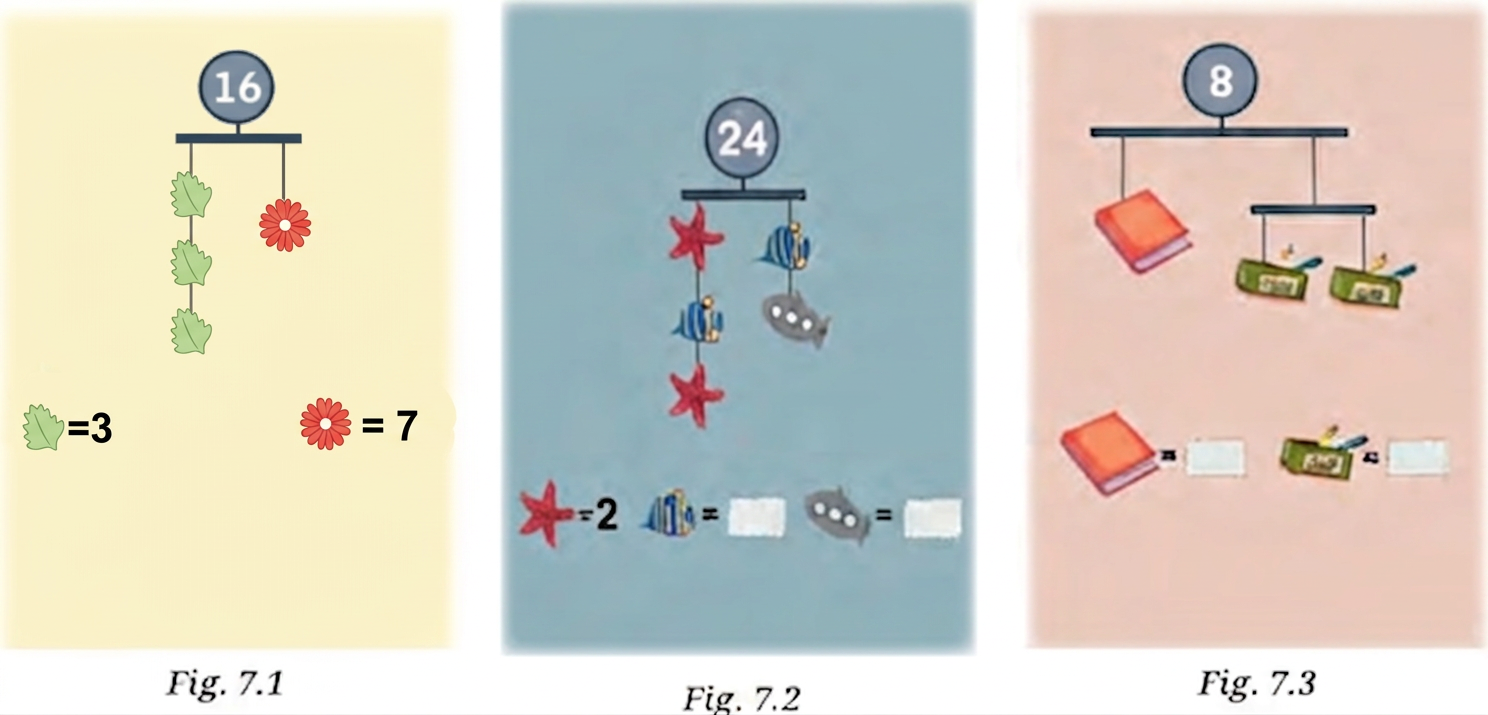
Find the unknown weights in the following cases:
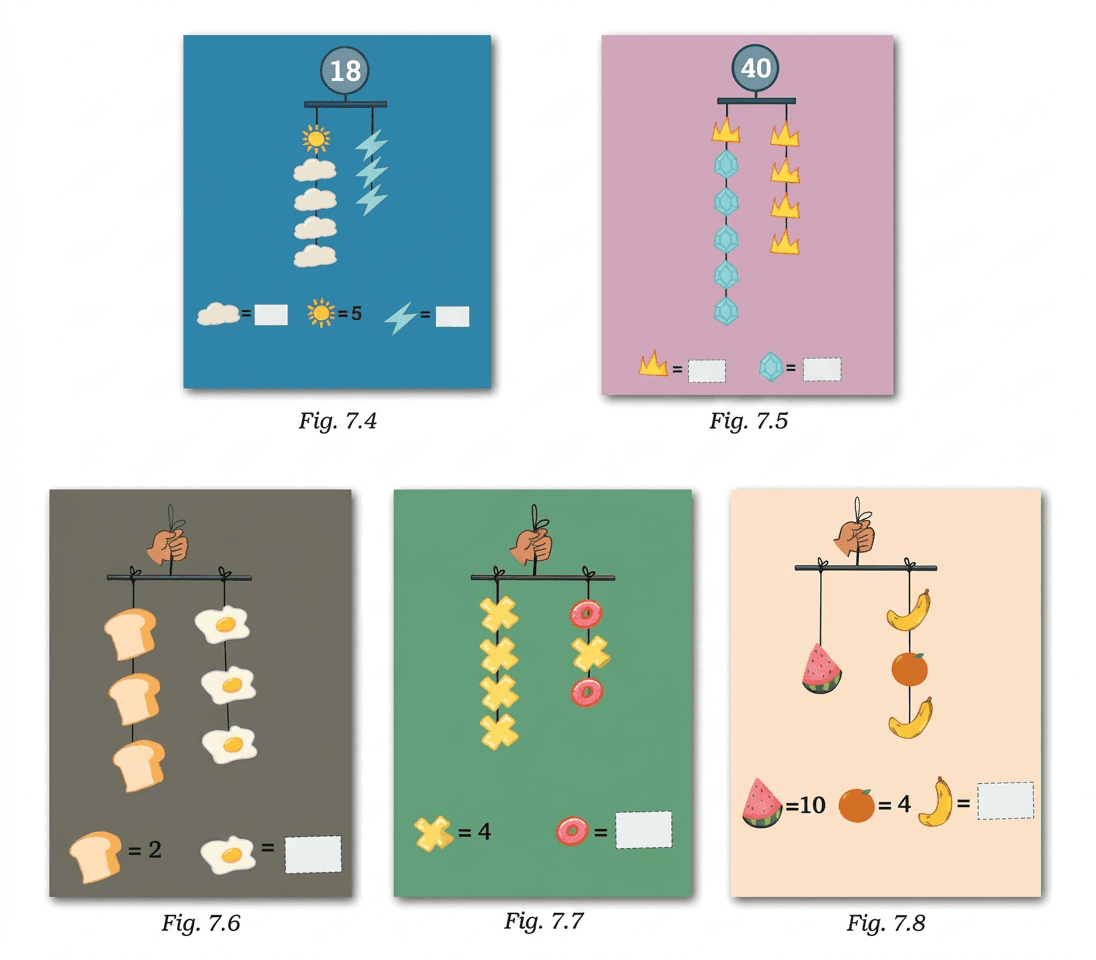
We will use the principles of balanced mobiles and total weights to find the unknown values.
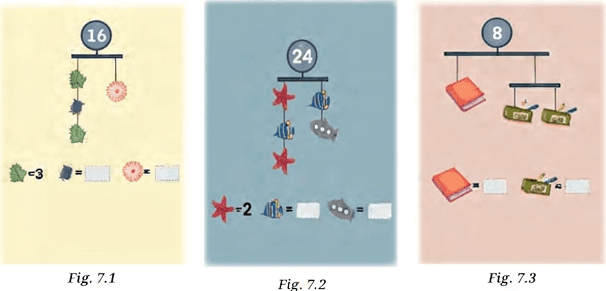
Step 1 — Calculate the weight of the red flower
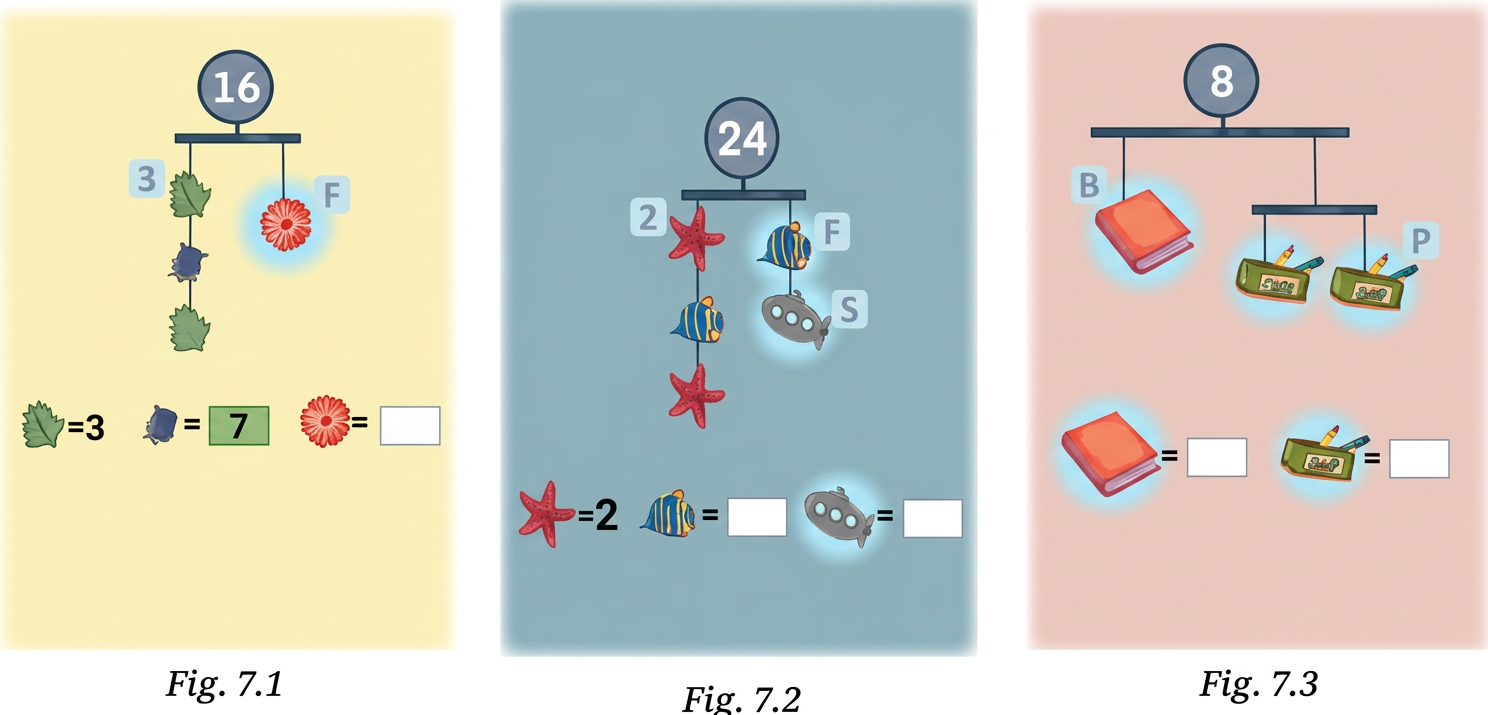
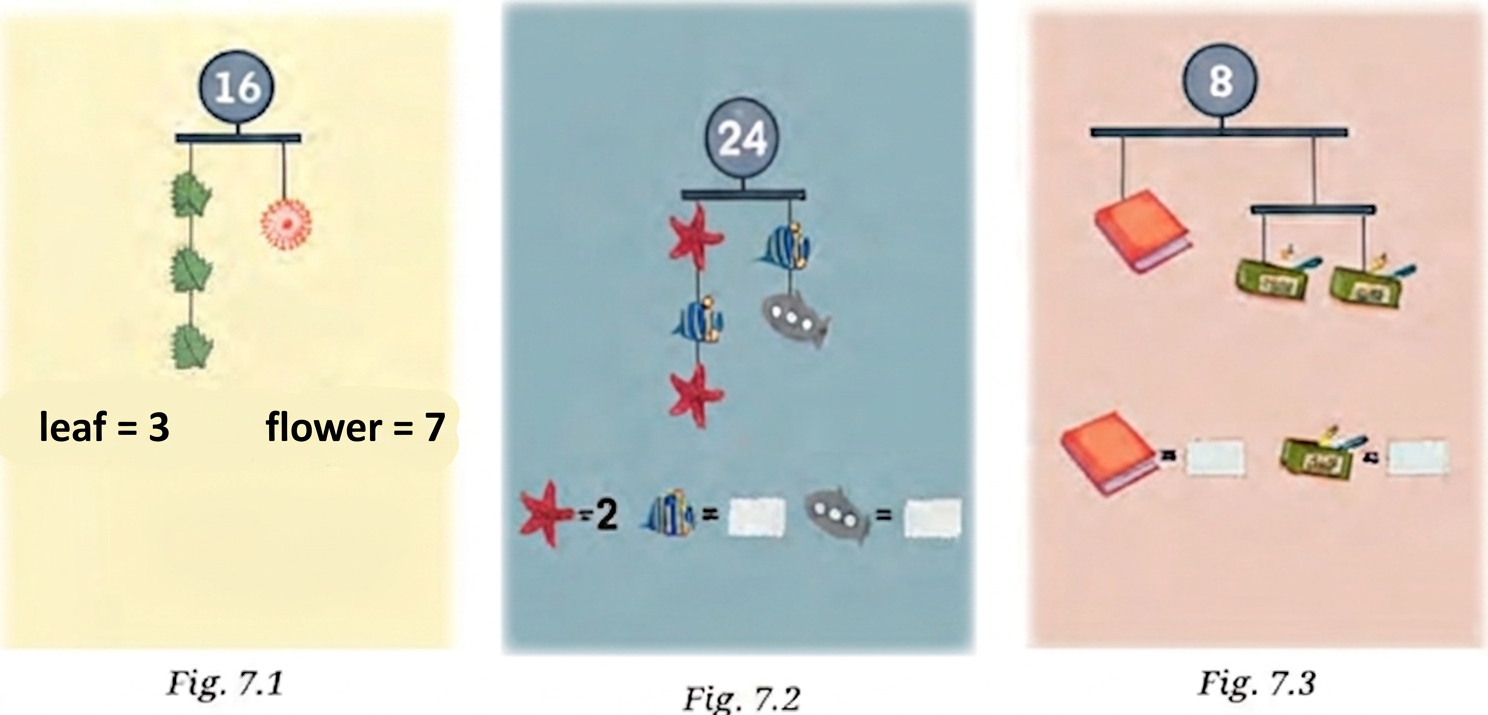
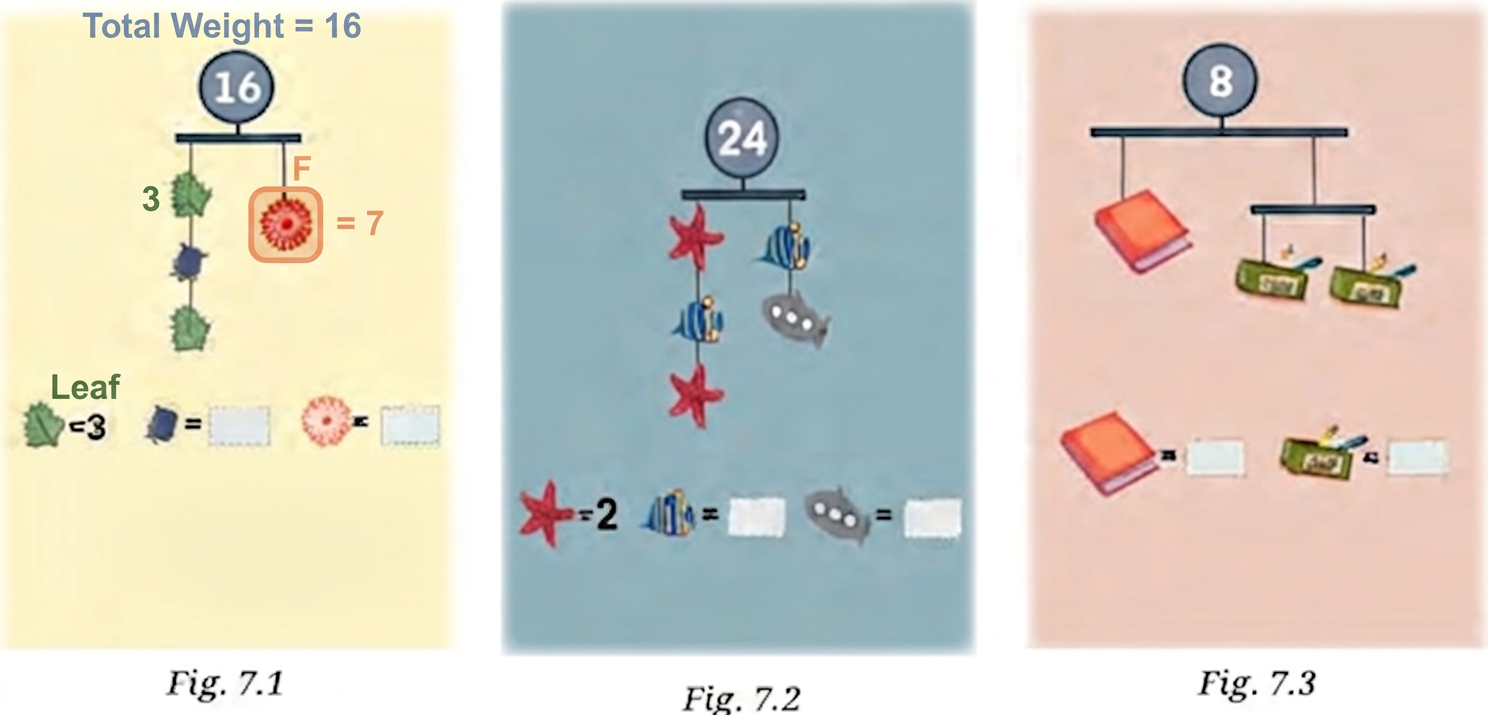
We are given that the total weight of all objects in Fig. 7.1 is 16. We know that one green leaf weighs 3. There are 3 green leaves. Let us find the total weight of the green leaves.
The total weight of the green leaves is 9. Let be the weight of one red flower. The total weight is the sum of the weights of the leaves and the flower.
Step 2 — Calculate the weights of the fish and submarine
We are given that the total weight of all objects in Fig. 7.2 is 24. The mobile is balanced. Let be the weight of one starfish. We are given . Let be the weight of one fish. Let be the weight of one submarine.
The left side of the mobile has one starfish, then a fish, then another starfish. So, the left side weight is . The right side of the mobile has one starfish, then a fish, then a submarine. So, the right side weight is . Since the mobile is balanced, the weights on both sides are equal.
Since , the weight of one submarine is 2. Now, let us use the total weight. The total weight is the sum of the weights on the left and right sides.
Let us substitute and into the equation.
Step 3 — Calculate the weights of the book and money bag
We are given that the total weight of all objects in Fig. 7.3 is 8. The mobile is balanced. Let be the weight of one red book. Let be the weight of one green money bag.
The left side of the mobile has 2 red books. The right side of the mobile has 2 green money bags. Since the mobile is balanced, the weights on both sides are equal.
The total weight is the sum of the weights on the left and right sides.
Let us substitute with in the equation.
Since , the weight of one money bag is 2.
Step 4 — Calculate the weights of the cloud and lightning bolt
We are given that the total weight of all objects in Fig. 7.4 is 18. The mobile is balanced. Let be the weight of one cloud. Let be the weight of one sun. We are given . Let be the weight of one lightning bolt.
The left side of the mobile has 3 clouds and 1 sun. So, the left side weight is . The right side of the mobile has 1 sun and 2 lightning bolts. So, the right side weight is . Since the mobile is balanced, the weights on both sides are equal.
The total weight is the sum of the weights on the left and right sides.
Let us substitute into the equation.
Now we have two equations:
- Let us substitute from equation (1) into equation (2).
Now, let us find using equation (1).
Step 5 — Calculate the weights of the crown, water drop, and diamond
We are given that the total weight of all objects in Fig. 7.5 is 40. The mobile is balanced. We assume all weights are integers. Let be the weight of one crown. Let be the weight of one water drop. Let be the weight of one diamond.
The left side of the mobile has 3 crowns and 1 water drop. So, the left side weight is . The right side of the mobile has 1 crown, 2 water drops, and 2 diamonds. So, the right side weight is . Since the mobile is balanced, the weights on both sides are equal.
The total weight is the sum of the weights on the left and right sides.
From Equation 1, we can write . Let us substitute into Equation 2.
Let us divide the entire equation by 2.
From Equation 3, we can express in terms of .
Let us substitute this expression for into Equation 1.
For weights to be positive, and . So, must be an integer between 4 and 6.66.... The possible integer values for are 5 and 6. We also need to be an integer. If : . . This is not an integer. If : . . These are integers. So, the unique integer solution is , , .
Step 6 — Calculate the weight of the egg
The mobile in Fig. 7.6 is balanced. Let be the weight of one toast. We are given . Let be the weight of one egg.
The left side of the mobile has 3 toasts. So, the left side weight is . The right side of the mobile has 2 eggs. So, the right side weight is . Since the mobile is balanced, the weights on both sides are equal.
Let us substitute into the equation.
Step 7 — Calculate the weight of the 'O' shape
The mobile in Fig. 7.7 is balanced. Let be the weight of one 'X' shape. We are given . Let be the weight of one 'O' shape.
The left side of the mobile has 3 'X' shapes. So, the left side weight is . The right side of the mobile has 2 'O' shapes. So, the right side weight is . Since the mobile is balanced, the weights on both sides are equal.
Let us substitute into the equation.
Step 8 — Calculate the weight of the banana
The mobile in Fig. 7.8 is balanced. Let be the weight of one watermelon. We are given . Let be the weight of one orange. We are given . Let be the weight of one banana.
The left side of the mobile has 1 watermelon and 1 orange. So, the left side weight is . The right side of the mobile has 1 banana. So, the right side weight is . Since the mobile is balanced, the weights on both sides are equal.
Let us substitute and into the equation.
Answer
Fig 7.1: Red flower = 7 Fig 7.2: Blue fish = 8 Fig 7.2: Grey submarine = 2 Fig 7.3: Red book = 2 Fig 7.3: Green money bag = 2 Fig 7.4: Cloud = 4/3 Fig 7.4: Lightning bolt = 2 Fig 7.5: Crown = 6 Fig 7.5: Water drop = 2 Fig 7.5: Diamond = 5 Fig 7.6: Egg = 3 Fig 7.7: 'O' shape = 6 Fig 7.8: Banana = 14
More questions in IT
Find the unknown weights in the following cases:
Context: Finding the Unknown
Q. Discuss the answers with your classmates. Give reasons why you think your answer is right.
Find the unknown weight of the sack in the following cases. In Fig. 7.10, all the sacks have the same weight.
[Hint: If we remove equal weights from both the plates, will the weighing scale still be balanced? Remove one sack from each plate for Fig. 7.10.]
Jasmine decides to make a matchstick arrangement that appears in this sequence, using exactly 99 sticks. What will be the position number of this arrangement in the sequence?
Can you find ways to get the value of n, such that 2n + 1 = 99?
Is it possible to make a matchstick arrangement that appears in this sequence using exactly 200 sticks?
For the weighing scale problems in figures 7.6, 7.7, 7.8, 7.9, 7.10, and 7.11, frame equations by using letter-numbers to denote the unknown weight.
Context: For the problem in Fig. 7.6, let us denote the weight of one fried egg as . Since each slice of bread is 2, we have on one side and on the other side. Since they are equal, we have , or .
For the problem in Fig. 7.7, , and we can denote the weight of one as . So, we have 16 on one side, and on the other side. Thus, we have the equation .
Q. Solve the equations that you frame and check if you get the same value for the unknown weight as you got previously.
Context: For the problem in Fig. 7.6, let us denote the weight of one fried egg as . Since each slice of bread is , we have on one side and on the other side. Since they are equal, we have:
For the problem in Fig. 7.7, [flower] , and we can denote the weight of one [donut] as . So, we have on one side, and on the other side. Thus, we have the equation:
Q. Frame 5 equations. Find methods to solve them.
Context: Consider the equation .
Q. Can this equation have any other solution?
Try solving using trial and error.
Consider an equation . If we add, subtract, multiply or divide the same number on both sides, will it still preserve the equality of LHS and RHS?
Context: It is known that . To find the value of the expression , we can divide by .
Q. Is this the same as dividing both sides by 7, which removes the factor 7 and leaves only the expression to be evaluated on the LHS?
Ranjana creates a sequence of arrangements with square tiles as shown below. Can she extend the sequence and make an arrangement using 100 tiles? If yes, which step in the sequence will it be?
We have the expression which gives the number of tiles needed to make an arrangement in Step . To check whether an arrangement is possible using 100 tiles at some Step , we can solve the equation: . Find the value of .
We have the expression which gives the number of tiles needed to make an arrangement in Step .
To check whether an arrangement is possible using 100 tiles at some Step , we can solve the equation: . Find the value of .
Context: Example 11: Riyaz created a math trick, which he tries out on his friend Akash.
Riyaz asked Akash to perform the following steps without revealing the answer to any of the intermediate steps.
- Think of a number.
- Subtract 3 from the number.
- Multiply the result by 4.
- Add 8 to the product.
- Reveal the final answer.
The final answer revealed by Akash was 24. Using this, Riyaz correctly figured out the starting number that Akash had thought of. Find this number.
Q. Try the steps using different numbers as the starting number. Do you see any relation between the starting number and final answer?
Context: Since Akash's final answer was 24, we have the equation: Thus, Akash thought of the number 7.
Q. Can you think of a simple rule that you can use to get the starting number from the final answer?
Context: Ramesh and Suresh have 60 marbles between them. Ramesh has 30 more marbles than Suresh. If the number of marbles with Suresh is , then the number of marbles with Ramesh is . Since the total number of marbles is 60, we have the equation:
Q. Use this to find both the unknowns.
Write equations whose solution is . Share the equations you made with each other and discuss the methods used.
Can you form a chain going from the bottom equation to the top? Compare the operations used when going from the top to the bottom and from the bottom to the top.
Without calculating, can you find the value of the unknown in each equation in the chains above?
[Hint: We have seen that the value that satisfies an equation also satisfies the new equation obtained by performing the same operation on both sides of the original equation.]
7.3 Mind the Mistake, Mend the Mistake
The following are some equations along with the steps used to solve them to find the value of the letter-number. Go through each solution and decide whether the steps are correct. If there is a mistake, describe the mistake, correct it and solve the equation.
Context: Consider the equations and .
Q. Can we come up with a formula to solve these equations? That is, for the first equation, can we perform some operations using 5, 4, 3, and 8 that will directly give us the solution? Using a similar method, can you solve the second equation using the numbers 3, – 6, 2 and 4?
Context: Brahmagupta's formula for solving equations of the form is .
Q. Using this formula can you solve this equation ?
There are some children and donkeys on a beach. Together they have 28 heads and 80 feet. How many donkeys are there? How many children are there?