Question 14
A cowherd took all his cows to graze in the fields. The cows came to a crossing with 3 gates. An equal number of cows passed through each gate. Later at another crossing with 5 gates again an equal number of cows passed through each gate. The same happened at the third crossing with 7 gates. If the cowherd had less than 200 cows, how many cows did he have? (Based on the folklore mathematics from Karnataka.)
The total number of cows must be divisible by the number of gates at each crossing.
Step 1 — Find the Least Common Multiple
The cows passed through 3 gates. An equal number went through each gate. So, the total cows must be divisible by 3.
Then, the cows passed through 5 gates. An equal number went through each gate. So, the total cows must also be divisible by 5.
Finally, the cows passed through 7 gates. An equal number went through each gate. So, the total cows must also be divisible by 7.
This means the total cows must be a multiple of 3, 5, and 7. We need the smallest common multiple. This is called the Least Common Multiple (LCM). Let us find the LCM of 3, 5, and 7.
Numbers 3, 5, and 7 are all prime numbers. The LCM of prime numbers is their product. Let us calculate the LCM of 3, 5, and 7.
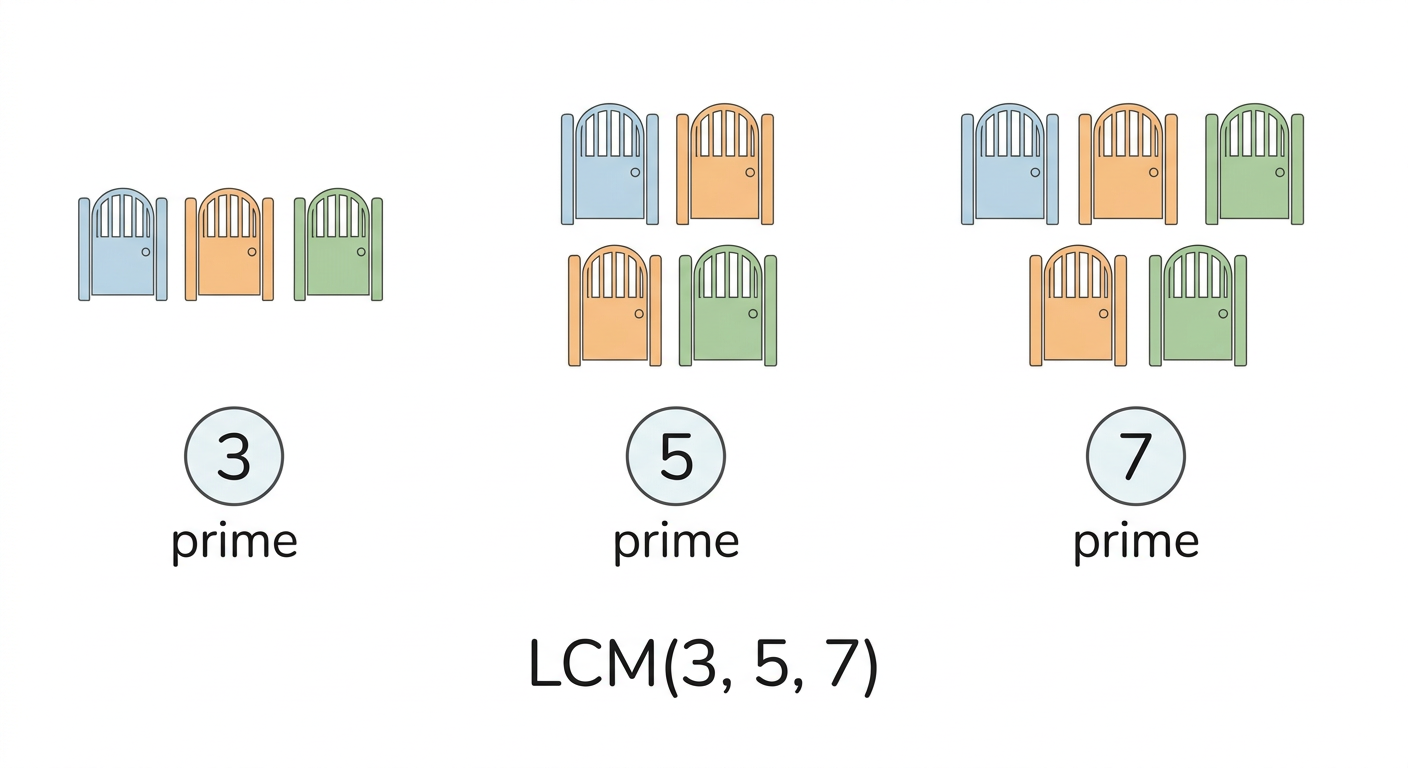
Step 2 — Use the total cow limit
The total number of cows must be a multiple of 105. Let us list the multiples of 105.
The first multiple is . The second multiple is .
The problem says the cowherd had less than 200 cows. Let us check which multiple fits this rule.
The number 105 is less than 200. The number 210 is greater than 200. So, the only possible number of cows is 105.
Answer
(i) The cowherd had 105 cows.
More questions in FIO
List all the factors of the following numbers:
(a) 90
(b) 105
(c) 132
(d) 360 (this number has 24 factors)
(e) 840 (this number has 32 factors)
Find the common factors and the HCF of the following numbers:
(a) 50, 60
(b) 140, 275
(c) 77, 725
(d) 370, 592
(e) 81, 243
How do we directly find the HCF without listing all the factors?
Find the HCF of the following numbers:
(a) 24, 180
(b) 42, 75, 24
(c) 240, 378
(d) 400, 2500
(e) 300, 800
Consider the numbers 72 and 144. Suppose they are factorised into composite numbers as: 72 = 6 × 12 and 144 = 8 × 18. Seeing this, can one say that these two numbers have no common factor other than 1? Why not?
Find the LCM of the following numbers:
(a) 30, 72
(b) 36, 54
(c) 105, 195, 65
(d) 222, 370
Make a general statement about the HCF for the following pairs of numbers. You could consider examples before coming up with general statements. Look for possible explanations of why they hold.
(a) Two consecutive even numbers
(b) Two consecutive odd numbers
(c) Two even numbers
(d) Two consecutive numbers
(e) Two co-prime numbers
Share your observations with the class.
The LCM of 3 and 24 is 24 (it is one of the two given numbers).
(a) Find more such number pairs where the LCM is one of the two numbers.
(b) Make a general statement about such numbers. Describe such number pairs using algebra.
Make a general statement about the LCM for the following pairs of numbers. You could consider examples before coming up with these general statements. Look for possible explanations of why they hold.
(a) Two multiples of 3
(b) Two consecutive even numbers
(c) Two consecutive numbers
(d) Two co-prime numbers
In the two rows below, colours repeat as shown. When will the blue stars meet next?
(a) Is a multiple of ?
(b) Is a factor of ?
Find the HCF and LCM of the following (state your answers in the form of prime factorisations):
(a) and
(b) 45 and 36
Find two numbers whose HCF is 1 and LCM is 66.
A cowherd took all his cows to graze in the fields. The cows came to a crossing with 3 gates. An equal number of cows passed through each gate. Later at another crossing with 5 gates again an equal number of cows passed through each gate. The same happened at the third crossing with 7 gates. If the cowherd had less than 200 cows, how many cows did he have? (Based on the folklore mathematics from Karnataka.)
The length, width, and height of a box are 12 cm, 18 cm, and 36 cm respectively. Which of the following sized cubes can be packed in this box without leaving gaps?
(a) 9 cm
(b) 6 cm
(c) 4 cm
(d) 3 cm
(e) 2 cm
Among the numbers below, which is the largest number that perfectly divides both 306 and 36?
(a) 36
(b) 612
(c) 18
(d) 3
(e) 2
(f) 360
Find the smallest number that is divisible by 3, 4, 5 and 7, but leaves a remainder of 10 when divided by 11.
Children are playing ‘Fire in the Mountain’. When the number 6 was called out, no one got out. When the number 9 was called out, no one got out. But when the number 10 was called out, some people got out. How many children could have been playing initially?
(a) 72
(b) 90
(c) 45
(d) 3
(e) 36
(f) None of these
Tick the correct statement(s). The LCM of two different prime numbers () can be:
(a) Less than both numbers
(b) In between the two numbers
(c) Greater than both numbers
(d) Less than
(e) Greater than
A dog is chasing a rabbit that has a head start of 150 feet. It jumps 9 feet every time the rabbit jumps 7 feet. In how many leaps does the dog catch up with the rabbit?
What is the smallest number that is a multiple of 1, 2, 3, 4, 5, 6, 8, 9, 10? Do you remember the answer from Grade 6, Chapter 5?
Here is a problem posed by the ancient Indian Mathematician Mahaviracharya (850 C.E.). Add together , , , and . What do you get? How can we find this sum efficiently?