Question 3
Connect the Dots...
A number lock has a 3-digit code. Find the code using the hints below.
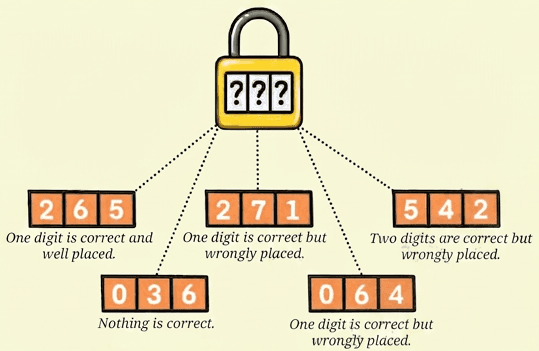
We will use the given hints to find the three-digit code for the lock.
Step 1 — Eliminate impossible digits
We first look at the hint that says "Nothing is correct". The hint "0 3 6 - Nothing is correct" means these digits are not in the code. So, the digits 0, 3, and 6 are not part of the secret code. Let the code be .
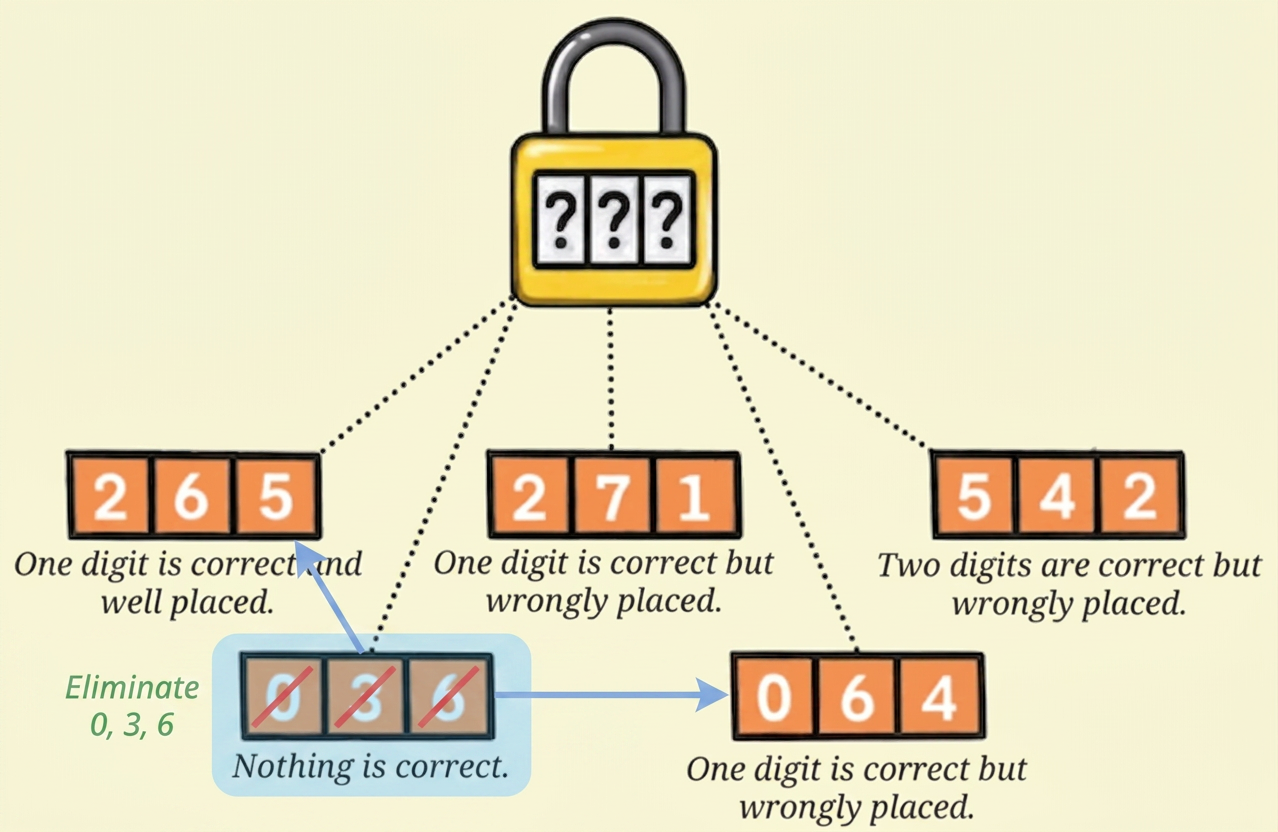
Step 2 — Identify a certain digit and its position rule
Next, we use the hint "0 6 4 - One digit is correct but wrongly placed". We already know that 0 and 6 are not in the code from Step 1. So, the only possible correct digit from "0 6 4" must be 4. This digit 4 is in the second position in "0 6 4". The hint says this digit is wrongly placed. So, 4 is in the code, but it is not in the second position.
Step 3 — Deduce more digits and their positions
Now we use the hint "5 4 2 - Two digits are correct but wrongly placed". We know from Step 2 that 4 is in the code. So, 4 is one of the two correct digits in this hint. The other correct digit must be either 5 or 2. Also, all correct digits in this hint are wrongly placed.
Let us consider two possibilities for the second correct digit:
Possibility A: The correct digits are 4 and 5. This means that 2 is NOT in the code. Let us check Hint 1: "2 6 5 - One digit is correct and well placed". We know 2 is not in the code, and 6 is not in the code (from Step 1). So, 5 must be the correct and well-placed digit. This means . However, from Hint 3, if 5 is a correct digit, it must be wrongly placed. This means , , and . This contradicts our finding that . So, Possibility A is incorrect.
Possibility B: The correct digits are 4 and 2. This means that 5 is NOT in the code. Let us check Hint 1: "2 6 5 - One digit is correct and well placed". We know 6 is not in the code (from Step 1), and 5 is not in the code (from this possibility). So, 2 must be the correct and well-placed digit. This means . Now, let us check this with Hint 3 ("5 4 2 - Two digits are correct but wrongly placed"). The correct digits are 4 and 2. They are both wrongly placed. For 4: . This is consistent with Step 2. For 2: . We have . This does not contradict . So, Possibility B is consistent.
From this step, we have found:
- 5 is NOT in the code.
- 2 IS in the code.
- .
- .
Step 4 — Place the third digit
We know the first digit of the code is 2 (). We also know that 4 is in the code, and (from Step 2). Since , 4 cannot be . Since , 4 cannot be . So, 4 must be in the third position. We now have the first and third digits of the code: 2 _ 4. We also confirmed because .
Step 5 — Find the middle digit
We need to find the digit for . The digits not in the code are 0, 3, 5, 6. The digits we have placed are and . So, must be one of the remaining digits: {1, 7, 8, 9}.
Let us use the hint "2 7 1 - One digit is correct but wrongly placed". We know 2 is in the code (). If 2 was the correct digit from "2 7 1", it would have to be wrongly placed. But 2 is in the first position in "2 7 1", and . So 2 is well placed. Therefore, 2 is not the "one digit correct but wrongly placed" from this hint. This means the correct digit from "2 7 1" must be either 7 or 1. And it must be wrongly placed.
Let us check if 7 is the correct digit. If 7 is correct, it must be wrongly placed. 7 is in the second position in "2 7 1". So, . If 7 is in the code, it must be or . But we know and . So, 7 cannot be in the code.
Let us check if 1 is the correct digit. If 1 is correct, it must be wrongly placed. 1 is in the third position in "2 7 1". So, . We know , so is true. Since 1 is in the code, and and , 1 must be . So, the middle digit is 1.
The code is 2 1 4.
Answer
The 3-digit code is 214.
More questions in A
How long is a minute?
Two groups of children were asked to estimate the length of 1 minute. They start by closing their eyes and then open them when they think 1 minute has passed. Of course, they are not supposed to count while their eyes are closed. The dot plots below show after how many seconds the children opened their eyes.
Discuss how well both the groups fared at this activity. Describe and compare the variability in data and their central tendency.
Spend sufficient time observing the data presented in this table. Share your findings with the class.
These are some prompts for you to probe —
- Changes in the heights of boys or girls of a certain age from 1989 to 2019.
- The heights of boys vs. girls at different ages in a particular year.
- Changes in height between successive ages in boys and girls in 2019.
Connect the Dots...
A number lock has a 3-digit code. Find the code using the hints below.