Question 4
Context: Does adding the terms of an expression in any order give the same value? Take some more expressions and check. Consider expressions with more than terms also.
Q. Can you explain why this is happening using the Token Model of integers that we saw in the Class 6 textbook of mathematics?
The sum of integers stays the same. This is true even if we change their order. It is also true if we group them differently.
Step 1 — Checking with an example
Let us take an expression with four terms. We will use both positive and negative integers. Let the expression be . We will add these numbers in different ways.
First way: Add from left to right.
Second way: Group the middle terms first.
Third way: Rearrange terms and group them. We group positive numbers together. We group negative numbers together.
All three ways give the same answer. So, adding terms in any order gives the same value.
Step 2 — Explaining with the Token Model
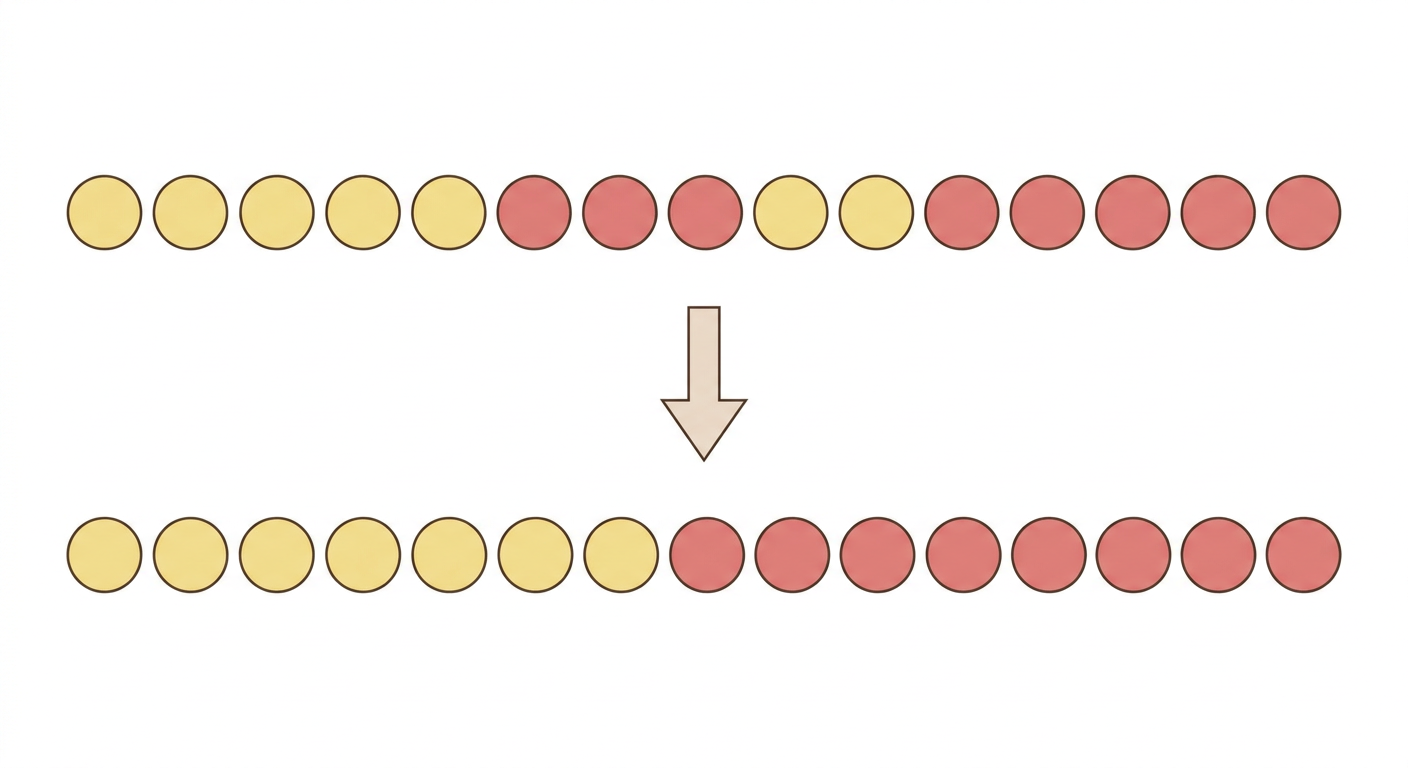
Let us use tokens to understand this. We use yellow tokens for positive integers. We use red tokens for negative integers. Adding integers means putting all tokens together. One yellow token and one red token cancel each other. They form a zero pair. The final tokens show the sum.
Let us use the expression . This expression means we have: Five yellow tokens for . Three red tokens for . Two yellow tokens for . Six red tokens for .
Let us put all these tokens together. We have a total of yellow tokens. We have a total of red tokens.
Now, we cancel out the zero pairs. Seven yellow tokens cancel out seven red tokens. We are left with red tokens. So, the final sum is -2.
The total number of yellow and red tokens does not change. It does not matter how we combine them. The total collection of tokens is always the same. So, the final tokens left will be the same. This is why the sum is always the same.
Answer
Yes.
More questions in A
Context: In an expression having two terms, swapping them does not change the value:
Q. Can you explain why this is happening using the Token Model of integers that we saw in the Class 6 textbook of mathematics?
Context: Let us consider the expression again. What happens when we change the order and add and first, and then add this sum to ? Will we get the same sum as before? We see that adding the terms of the expression in any order gives the same sum of .
Q. Does adding the terms of an expression in any order give the same value? Take some more expressions and check. Consider expressions with more than 3 terms also.
Context: Does adding the terms of an expression in any order give the same value? Take some more expressions and check. Consider expressions with more than terms also.
Q. Can you explain why this is happening using the Token Model of integers that we saw in the Class 6 textbook of mathematics?
What happens to the value of an expression if we increase or decrease the value of one of its terms?
Some expressions are given in following three columns. In each column, one or more terms are changed from the first expression. Go through the example (in the first column) and fill the blanks, doing as little computation as possible.
Expression Engineer!
Using three 3's along with the four operations (addition, subtraction, multiplication, and division) and brackets as needed we can create several expressions. For example, , , , and so on.
- Using four 4's, create expressions to get all values from 1 to 20.
- Using the numbers 1, 2, 3, 4, and 5 exactly once in any order get as many values as possible between and .
- Using the numbers 0 to 9 exactly once in any order, make an expression with a value 100.
- What other similar interesting questions can you ask?