Question 1
Investigate how traditional calendars in India managed to consistently align the days in the calendar with astronomical events like the Earth going around the Sun or even the positions of the stars in the sky accurately.
Traditional Indian calendars used careful observations and clever calculations to match calendar days with the movements of the Sun, Moon, and stars.
Step 1 — Watching the Sky
Ancient people watched the sky very closely. They observed the Sun, Moon, and stars every day. They noticed how these objects moved in patterns. These patterns helped them understand time.
Step 2 — The Solar Year
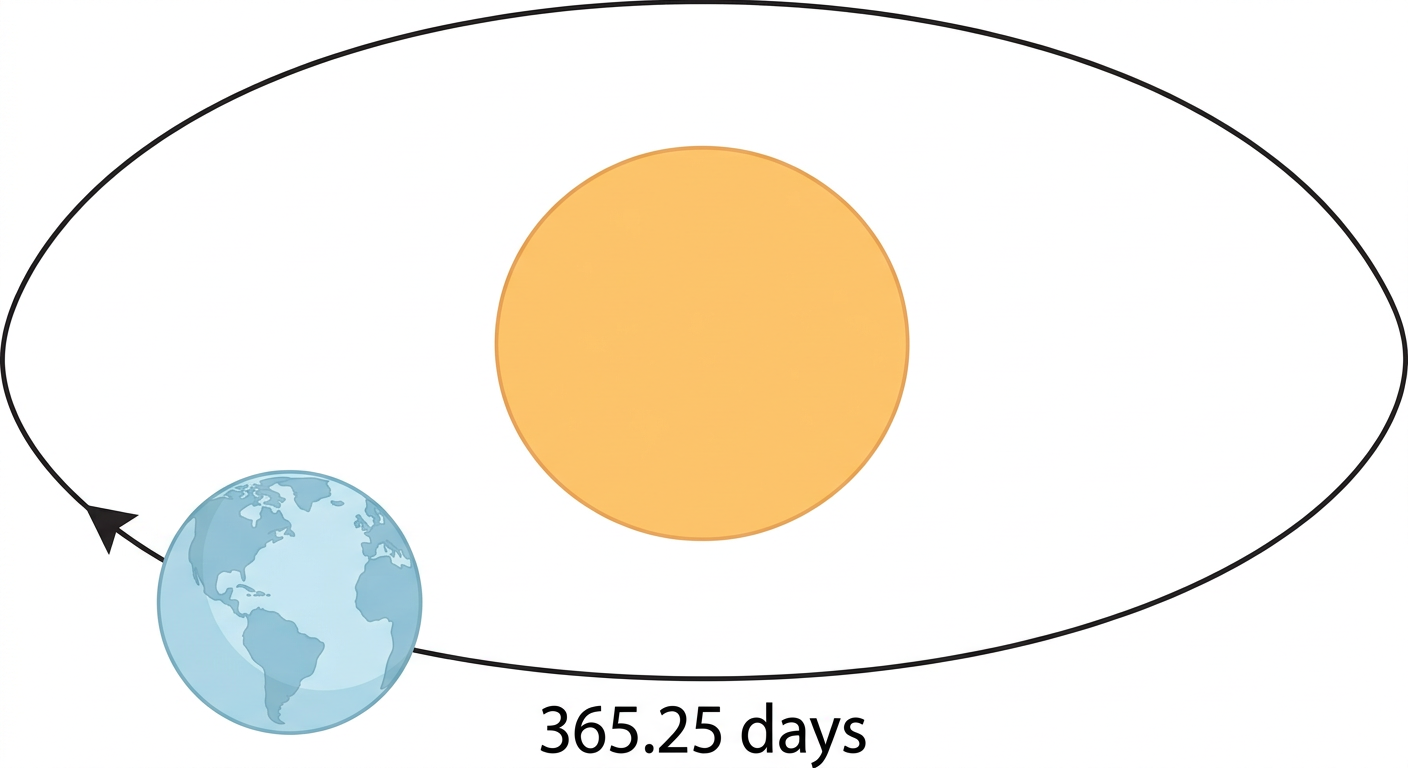
The Earth goes around the Sun. This journey takes a specific time. We call this time a solar year. It is about 365.25 days long. This cycle brings the seasons. Indian calendars used this for the year's length.
Step 3 — The Lunar Month
The Moon goes around the Earth. This causes the Moon's phases to change. From one new moon to the next is a lunar month. It is about 29.5 days long. Indian calendars used this for the month's length.
Step 4 — The Calendar Challenge
A year has 12 lunar months. Let us find the total days in 12 lunar months. The solar year is about 365.25 days. So, 12 lunar months are shorter than a solar year. The difference is:
This difference would make seasons shift. The calendar would not match the seasons.
Step 5 — Adding an Extra Month
To fix this difference, an extra month was added. This extra month is called 'Adhik Maas'. It means 'additional month'. It was added about every 2 to 3 years. This kept the lunar calendar aligned. It matched the solar year and seasons.

Step 6 — Tracking Stars (Nakshatras)
People also tracked the stars. They divided the sky into 27 star groups. These groups are called 'Nakshatras'. The Moon passes through these Nakshatras. This helped track the Moon's exact position. It also helped predict auspicious times.
Step 7 — Precise Calculations
Ancient Indian astronomers were very skilled. They used mathematics to predict movements. They made detailed charts of the sky. These calculations were very accurate. This ensured the calendar stayed correct. It aligned with all astronomical events.
Answer
Traditional Indian calendars used a combination of careful sky observations, understanding of solar and lunar cycles, and advanced mathematical calculations. They added an extra month (Adhik Maas) every few years to align the lunar months with the solar year and seasons. They also tracked star groups (Nakshatras) to precisely match the calendar with the Moon's movement and other celestial events.