Question 7
Dwarakanath purchases notebooks at a wholesale price of ₹23.6 per piece and sells each notebook at ₹30/-. How much profit does he make if he sells 50 books in a week?
We will first find the profit on one notebook. Then we will find the total profit for all notebooks.
Step 1 — Find profit per notebook
Dwarakanath buys each notebook at a certain price. This is the wholesale price. He sells each notebook at a higher price. This is the selling price. The profit on one notebook is the selling price. We subtract the wholesale price from it. Let the wholesale price be . Let the selling price be . Let the profit per notebook be .
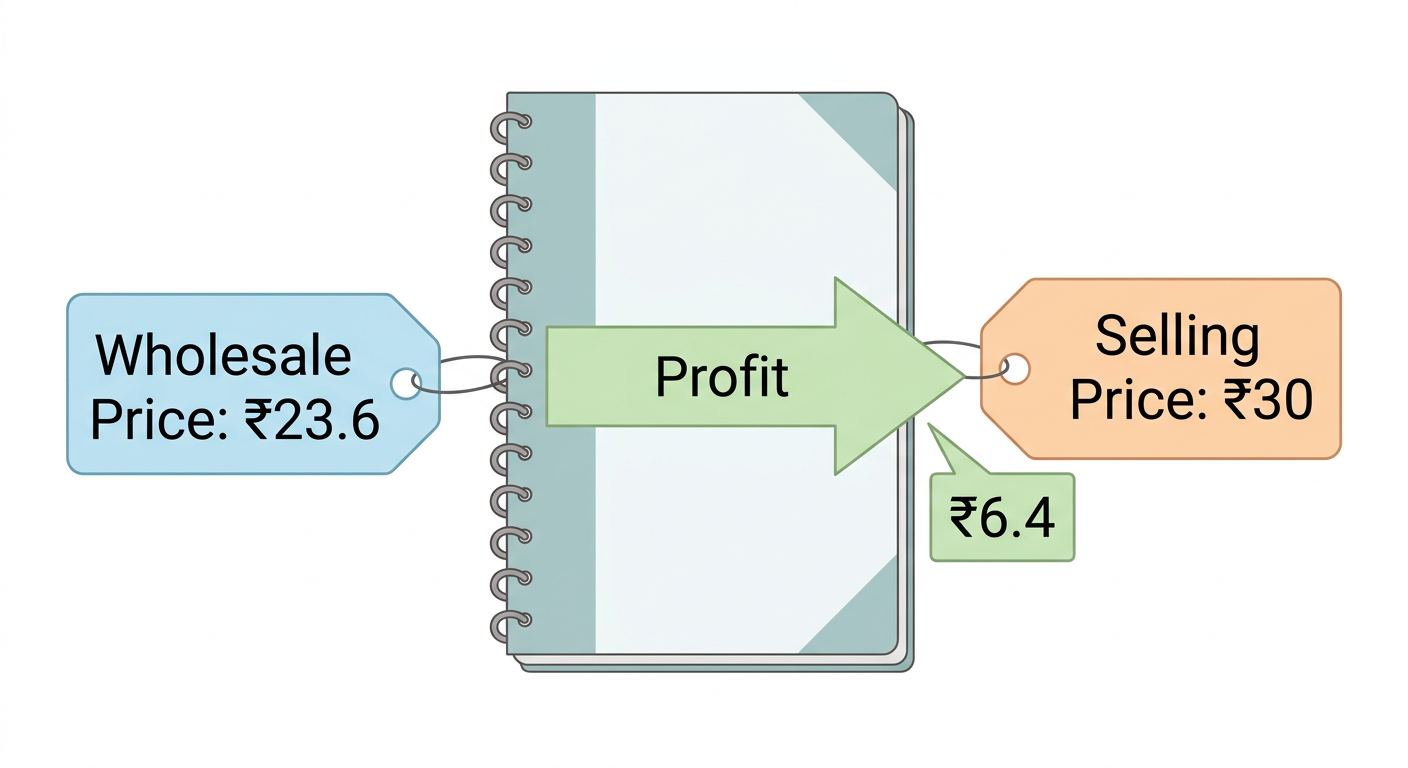
Step 2 — Calculate total profit
Dwarakanath sells many notebooks. We know the profit for one notebook. To find the total profit, we multiply. We multiply profit per notebook by notebooks sold. Let the number of notebooks sold be . Let the total profit be .
Answer
(i) Profit per notebook = ₹6.4 (ii) Total profit = ₹320
More questions in FIO
Recall that a tenth is 0.1, a hundredth is 0.01, and so on. Find the following products in tenths, hundredths and so on:
(a) 6 × 4 tenths = 24 tenths (b) 7 × 0.3 (c) 9 × 5 hundredths
Find the products:
(a)
(b)
(c)
Thejus needs 1.65 m of cloth for a shirt. How many metres of cloth are needed for 3 shirts?
Meenu bought 4 notebooks and 3 erasers. The cost of each book was ₹15.50 and each eraser was ₹2.75. How much did she spend in all?
The thickness of a rupee coin is 1.45 mm. What is the total height of the cylinder formed by placing 36 rupee coins one over the other? Write the answer in centimeters.
The price of 1 kg of oranges is ₹56.50. What is the price of 2.250 kg of oranges? Can we write 56.50 as 56.5 and 2.250 as 2.25 and multiply? Will we get the same product? Why?
Dwarakanath purchases notebooks at a wholesale price of ₹23.6 per piece and sells each notebook at ₹30/-. How much profit does he make if he sells 50 books in a week?
Given that 18 × 12 = 216, find the products:
(a) 18 × 1.2 (b) 18 × 0.12 (c) 1.8 × 1.2 (d) 0.18 × 0.12 (e) 0.018 × 0.012 (f) 1.8 × 12
In which of the cases above is the product less than 1?
In which of the following multiplications is the product less than 1? Can you find the answer without actually doing the multiplications?
(a)
(b)
(c)
(d)
Multiplying the following numbers by 10, 100 and 1000 to complete the table.
Find the quotient by converting the denominator into 1, 10, 100 or 1000 and verify the solution by the long division method (division by place value).
(a) (b) (c) (d)
Choose the correct answer:
(a)
(i) 38.15
(ii) 380.15
(iii) 381.5
(iv) 381.05
(b)
(i) 4458.75
(ii) 44.5875
(iii) 445.875
(iv) 4458.75
What is the quotient?
(a)
(b)
(c)
(d)
What is the quotient?
(a)
(b)
(c)
(d)
(e)
Express the following fractions in decimal form:
(a)
(b)
(c)
(d)
Find the quotients:
(a)
(b)
Evaluate the following using the information :
(a)
(b)
(c)
(d)
Evaluate the following:
(a)
(b)
(c)
(d)
(e)
(f)
Find the quotient:
(a)
(b)
(c)
Is the quotient obtained in the same as the quotient obtained in ?
A 4 m long wooden block has to be cut into 5 pieces of equal length. What is the length of each piece?
If the perimeter of a regular polygon with 12 sides is 208.8 cm, what is the length of its side?
3 litres of watermelon juice is shared among 8 friends equally. How much watermelon juice will each get? Express the quantity of juice in millilitres.
A car covers 234.45 km using 12.6 litres of petrol. What is the distance travelled per litre?
5 kg of flour (aata) was distributed equally among 15 students. How much flour did each student receive?
A 210 gram packet of peanut chikki costs ₹70.5, while a 110 gram packet of potato chips costs ₹33.25. Which is cheaper?
Write the decimal number at the arrow mark:
Shyamala bought 3 kg bananas at ₹30/- per kg. She counted 35 bananas in all. She sells each banana for ₹5/-. How much profit does she make selling all the bananas?
A teacher placed textbooks that are 2.5 cm thick on a bookshelf. The teacher wanted to place 80 textbooks on the shelf. The bookshelf is 160 cm long. How many books could be placed on the shelf? Was there any space left? If yes, how much?
Fill in the following blanks appropriately:
(a)
(b)
(c)
(d)
(e)
(f)
The following problem was set by Sridharacharya in his book, Patiganita. “ is divided by , and is divided by . Tell the quotients separately.” Can you try to solve it by converting the fractions into decimals?
Fill the boxes in at least 2 different ways:
(a)
(b)
Find the following quotients given that :
(a)
(b)
(c)
(d)
(e)
(f)
Find the missing cells if each cell represents a÷b:
Using the digits 2, 4, 5, 8, and 0 fill the boxes to get the:
(a) maximum product
(b) minimum product
(c) product greater than 150
(d) product nearest to 100
(e) product nearest to 5
Sort the following expressions in increasing order:
(a)
(b)
(c)
(d)
(e)
(f)