Question 7
For the objects shown below, write their lengths in two ways and read them aloud. An example is given for the USB cable. (Note that the unit length used in each diagram is not the same).
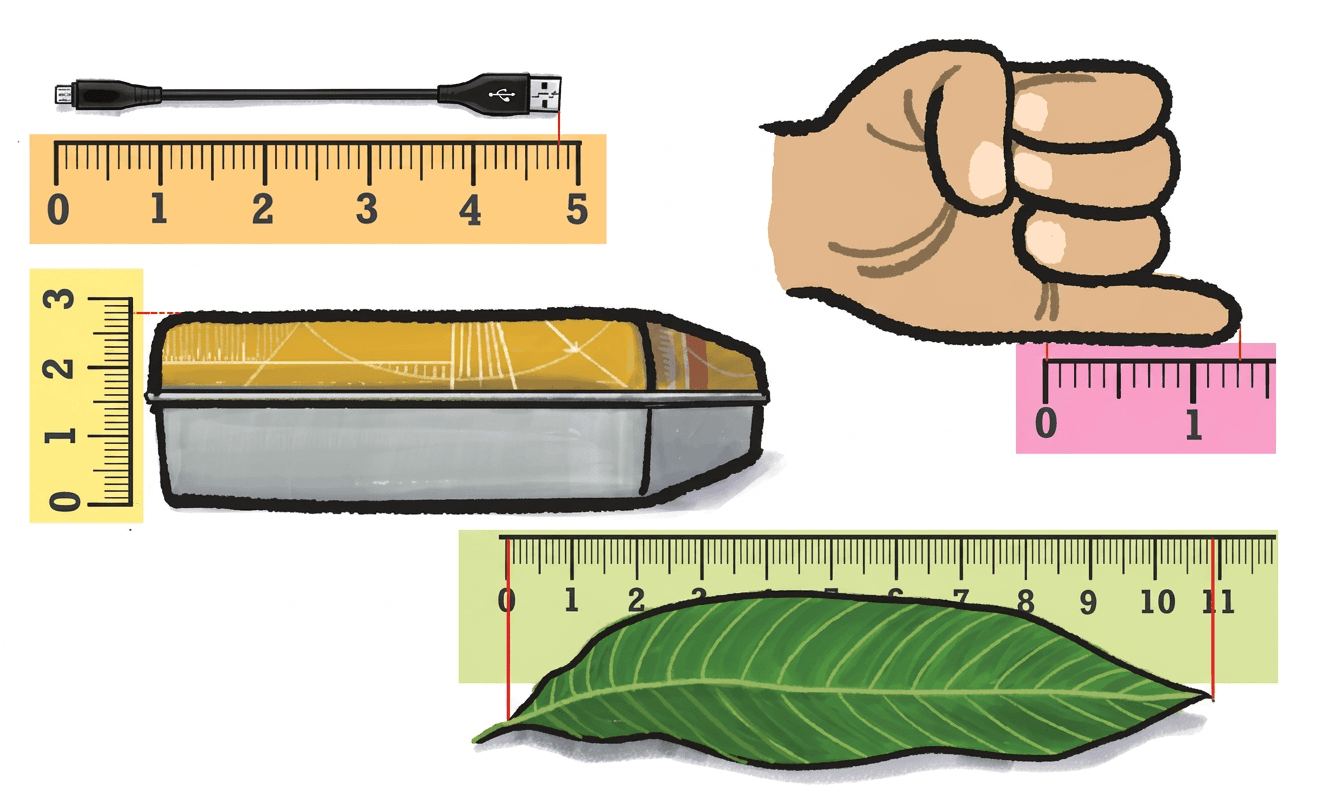
We will carefully read the measurement shown on each ruler for the given objects.
Step 1 — Little Finger Length
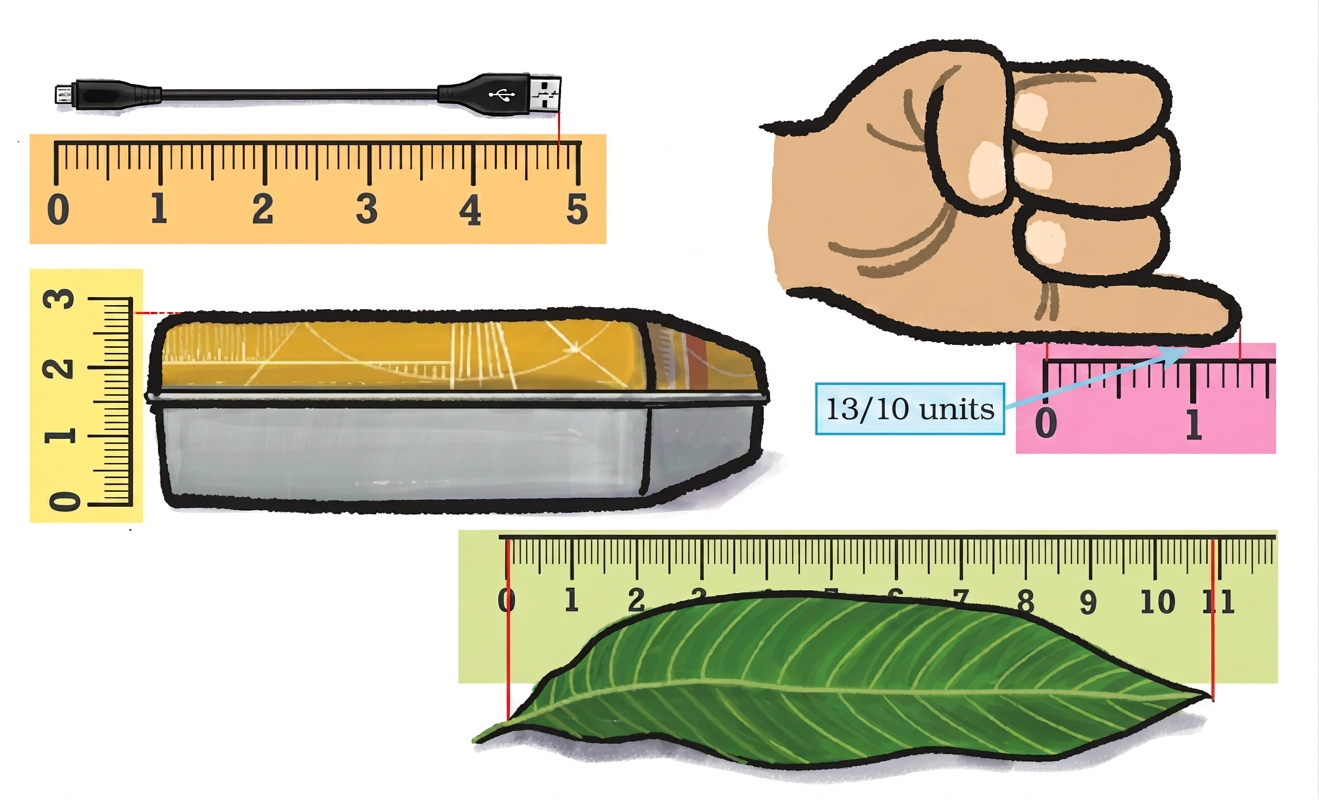
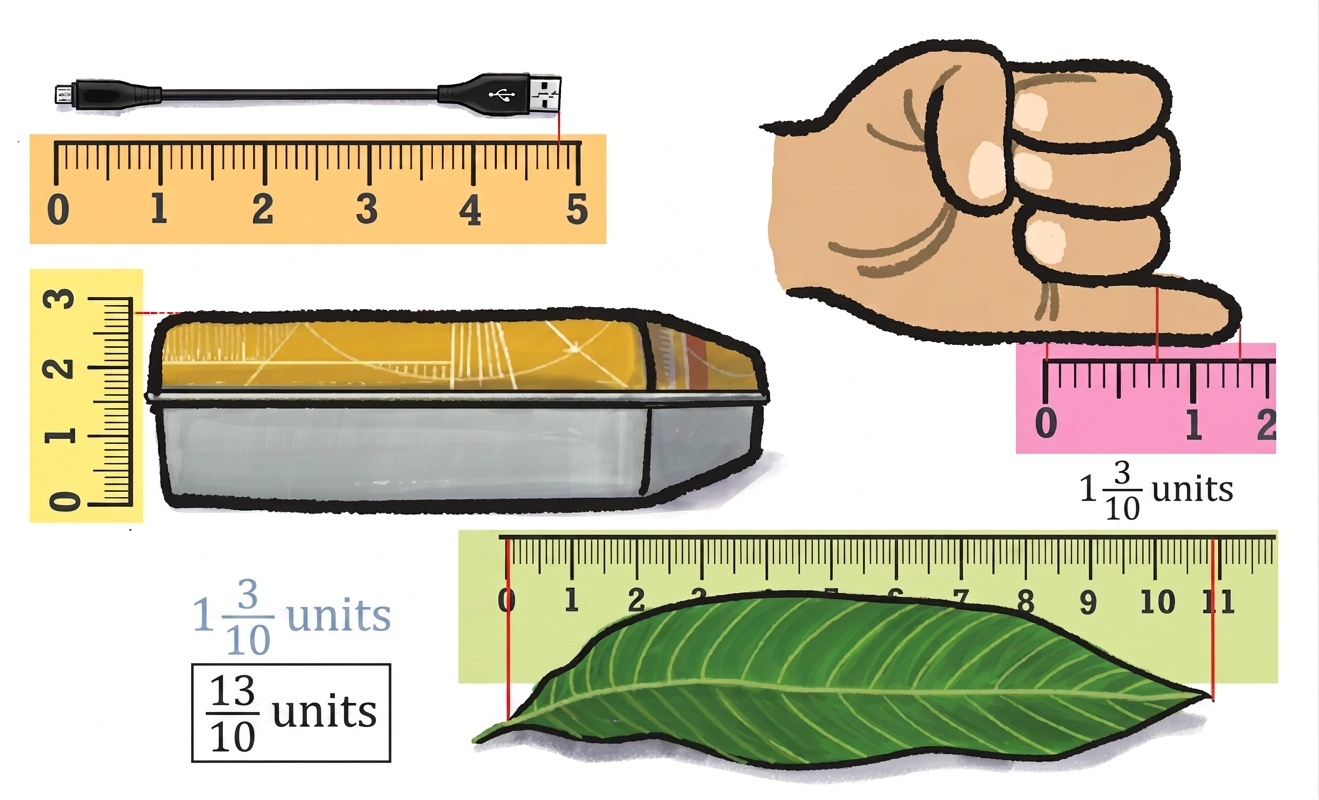
We look at the pink ruler measuring the little finger. The ruler shows units and smaller divisions. Each main unit is divided into 10 smaller parts. The little finger starts at 0 and ends past the 1-unit mark. It ends at the third small mark after 1. So, the length is 1 whole unit and 3 small parts.
Length of little finger in mixed number form:
To convert this to an improper fraction, we multiply the whole number by the denominator and add the numerator. Then we put this over the original denominator.
Step 2 — Geometry Box Height
We look at the yellow ruler measuring the height of the geometry box. Each main unit on this ruler is also divided into 10 smaller parts. The height of the box starts at 0 and goes past the 2-unit mark. It reaches the eighth small mark after 2. So, the height is 2 whole units and 8 small parts.
Height of geometry box in mixed number form:
To convert this to an improper fraction, we multiply the whole number by the denominator and add the numerator. Then we put this over the original denominator.
Step 3 — Leaf Length
We look at the green ruler measuring the length of the leaf. Each main unit on this ruler is also divided into 10 smaller parts. The leaf starts at 0 and extends past the 10-unit mark. It ends at the ninth small mark after 10. So, the length is 10 whole units and 9 small parts.
Length of leaf in mixed number form:
To convert this to an improper fraction, we multiply the whole number by the denominator and add the numerator. Then we put this over the original denominator.
Answer
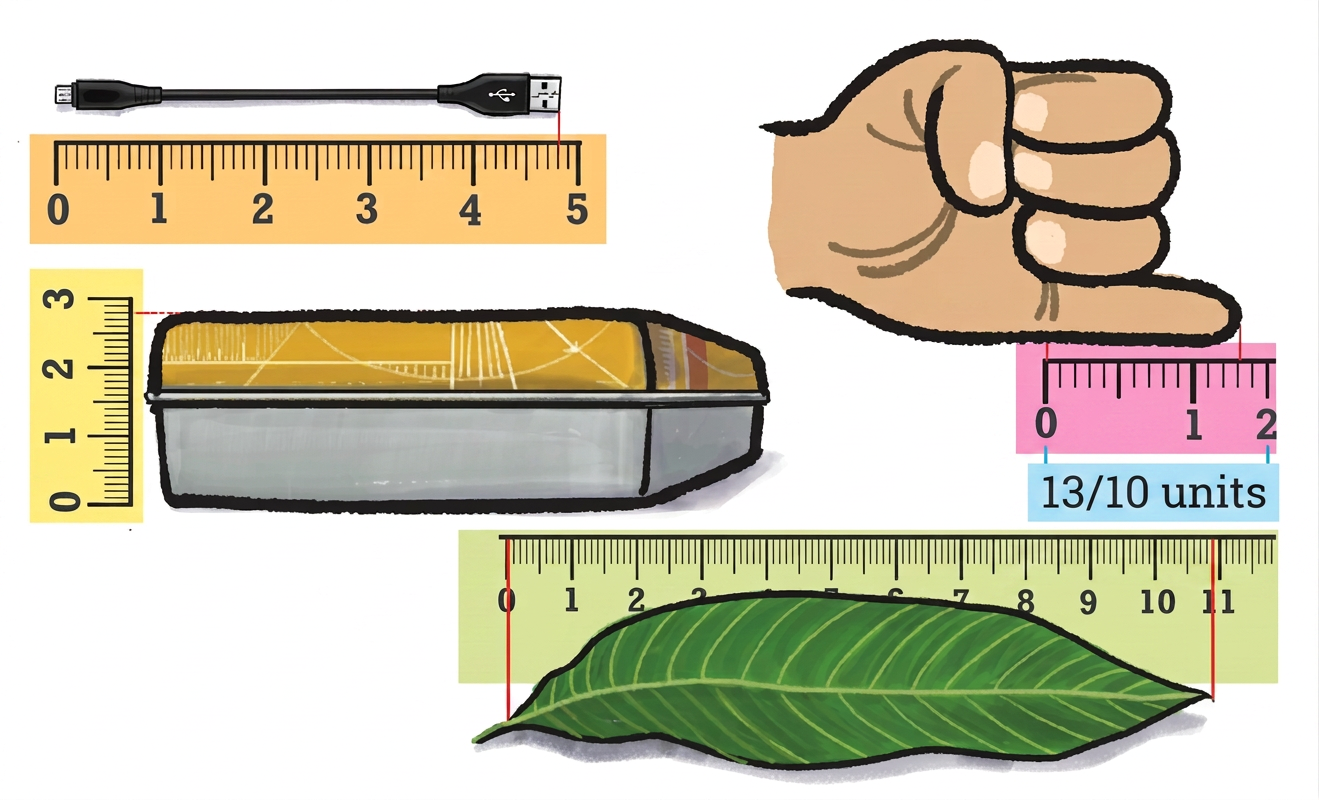
(i) The length of the little finger is 1 and 3/10 units or 13/10 units. (ii) The height of the geometry box is 2 and 8/10 units or 28/10 units. (iii) The length of a leaf is 10 and 9/10 units or 109/10 units.
More questions in IT
In the following figure, screws are placed above a scale. Measure them and write their length in the space provided.
Which scale helped you measure the length of the screws accurately? Why?
What is the meaning of cm (the length of the first screw)?
Context: As seen on the ruler, the unit length between two consecutive numbers is divided into 10 equal parts. To get the length , we go from 0 to 2 and then take seven parts of . The length of the screw is and . Similarly, we can make sense of the length .
Q. Can you explain why the unit was divided into smaller parts to measure the screws?
Measure the following objects using a scale and write their measurements in centimeters (as shown earlier for the lengths of the screws): pen, sharpener, and any other object of your choice.
Write the measurements of the objects shown in the picture:
For the objects shown below, write their lengths in two ways and read them aloud. An example is given for the USB cable. (Note that the unit length used in each diagram is not the same).
Arrange these lengths in increasing order:
(a)
(b)
(c)
(d)
(e)
(f)
(g)
(h)
Arrange the following lengths in increasing order: , , , .
The lengths of the body parts of a honeybee are given. Find its total length.
Head: units Thorax: units Abdomen: units
The length of Shylaja's hand is units, and her palm is units, as shown in the picture. What is the length of the longest (middle) finger?
Context: The length of Shylaja's hand is units, and her palm is units.
Q. Try computing the difference by converting both lengths to tenths.
A Celestial Pearl Danio's length is cm, and the length of a Philippine Goby is cm. What is the difference in their lengths?
How big are these fish compared to your finger?
Observe the given sequences of numbers. Identify the change after each term and extend the pattern:
(a) , , , ______, ______, ______
(b) , , , ______, ______, ______
(c) , , ______, ______, ______, ______
(d) , , ______, ______, ______, ______
(e) , , , ______, ______, ______, ______
(f) , , , ______, ______, ______
What is the length of this smaller part? How many such smaller parts make a unit length?
How many one-hundredths make one-tenth? Can we also say that the length is 4 units and 45 one-hundredths?
Observe the figure below. Notice the markings and the corresponding lengths written in the boxes when measured from 0. Fill the lengths in the empty boxes.
For the lengths shown below write the measurements and read out the measures in words.
In each group, identify the longest and the shortest lengths. Mark each length on the scale.
(a)
(b)
(c)
(d)
(e)
(f)
(g)
Context: What will be the sum of and ? This can be solved in different ways. Some are shown below.
Are both these methods different?
Observe the addition done below for . Do you see any similarities between the methods shown above?
Can we extend this further?
We can ask similar questions about fractional parts:
(a) How many thousandths make one unit? (b) How many thousandths make one tenth? (c) How many thousandths make one hundredth? (d) How many tenths make one ten? (e) How many hundredths make one ten?
Make a few more questions of this kind and answer them.
Can the quantity be written as 42 (skipping the in )?
If yes, how would we know if 42 means 4 tens and 2 units or it means 4 units and 2 tenths?
Make a place value table similar to the one above. Write each quantity in decimal form and in terms of place value, and read the number:
(a) 2 ones, 3 tenths and 5 hundredths
(b) 1 ten and 5 tenths
(c) 4 ones and 6 hundredths
(d) 1 hundred, 1 one and 1 hundredth
(e) and
(f)
(g)
(h) , and
Write these quantities in decimal form: (a) 234 hundredths (b) 105 tenths
Fill in the blanks below (mm <-> cm)
Fill in the blanks below (cm <-> m):
How many mm does 1 meter have?
Can we write ?
Fill in the blanks below (g <-> kg)
Fill in the blanks below (rupee <-> paise)
Name all the divisions between 1 and 1.1 on the number line.
Identify and write the decimal numbers against the letters.