Question 16
It is easy to check if some of these numbers are factors or not without doing long division. Can you find them?
We use special rules to check if a number divides another number without long division.
Let us consider the number 120. We will check if 2, 3, 4, 5, 6, 7, 8, 9, 10 are its factors.
Step 1 — Check for 2
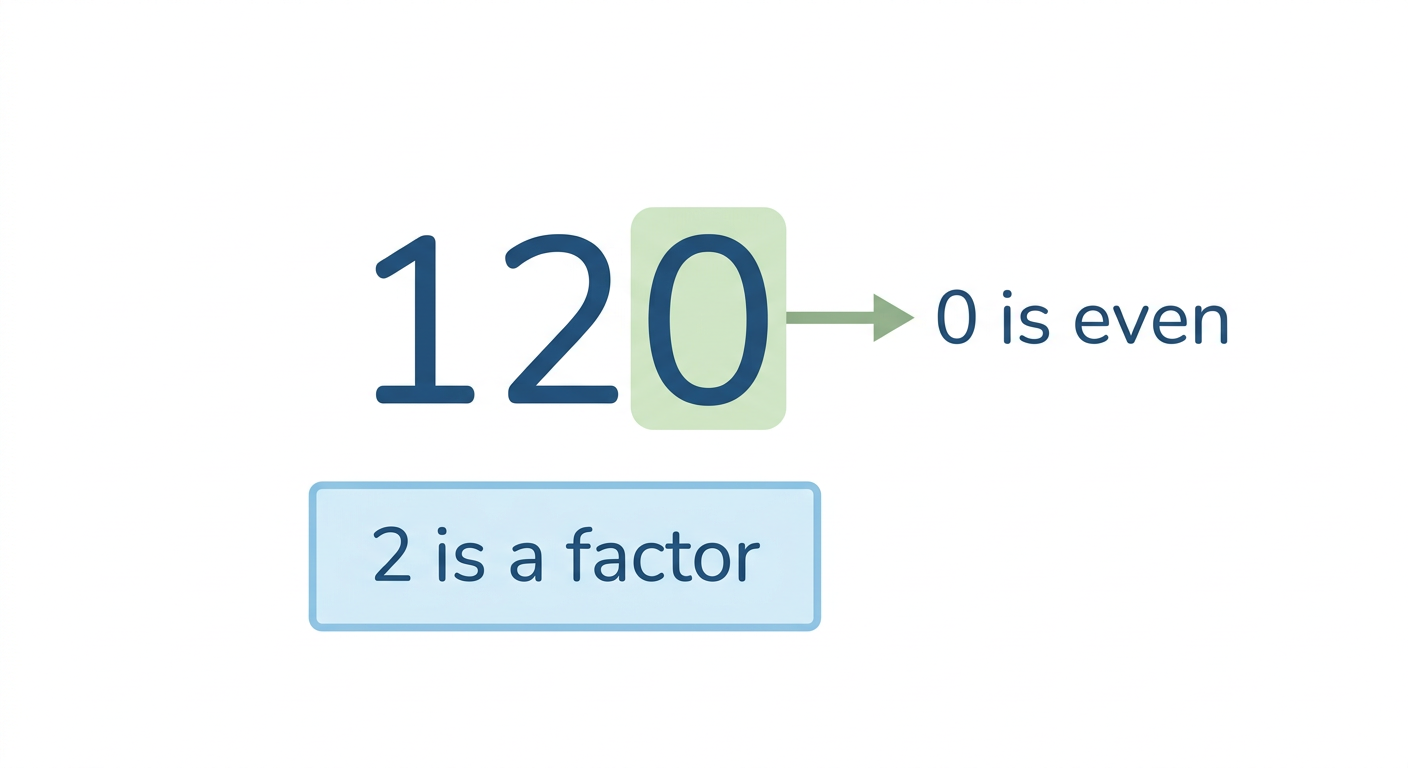
We want to see if 2 is a factor of 120. A number can be divided by 2. Its last digit must be an even number. Even numbers are 0, 2, 4, 6, 8. The last digit of 120 is 0. 0 is an even number. So, 2 is a factor of 120.
Step 2 — Check for 3
We want to see if 3 is a factor of 120. A number can be divided by 3. Its digits must add up to a multiple of 3. The digits of 120 are 1, 2, 0. Let us add these digits.
3 is a multiple of 3. So, 3 is a factor of 120.
Step 3 — Check for 4
We want to see if 4 is a factor of 120. A number can be divided by 4. Its last two digits must form a number. This number must be divided by 4. The last two digits of 120 are 20. We check if 20 can be divided by 4.
20 can be divided by 4. So, 4 is a factor of 120.
Step 4 — Check for 5
We want to see if 5 is a factor of 120. A number can be divided by 5. Its last digit must be 0 or 5. The last digit of 120 is 0. So, 5 is a factor of 120.
Step 5 — Check for 6
We want to see if 6 is a factor of 120. A number can be divided by 6. It must be divided by both 2 and 3. From Step 1, 120 can be divided by 2. From Step 2, 120 can be divided by 3. Both conditions are true. So, 6 is a factor of 120.
Step 6 — Check for 7
We want to see if 7 is a factor of 120. Let us use the divisibility rule for 7. Take the last digit. Double this last digit. Subtract it from the rest of the number. The number is 120. The last digit is 0. Double the last digit: . The rest of the number is 12. Subtract the doubled digit from the rest.
12 cannot be divided by 7. It leaves a leftover. So, 7 is not a factor of 120.
Step 7 — Check for 8
We want to see if 8 is a factor of 120. A number can be divided by 8. Its last three digits must form a number. This number must be divided by 8. The last three digits of 120 form 120. We check if 120 can be divided by 8.
120 can be divided by 8. So, 8 is a factor of 120.
Step 8 — Check for 9
We want to see if 9 is a factor of 120. A number can be divided by 9. Its digits must add up to a multiple of 9. The digits of 120 are 1, 2, 0. Let us add these digits.
3 is not a multiple of 9. So, 9 is not a factor of 120.
Step 9 — Check for 10
We want to see if 10 is a factor of 120. A number can be divided by 10. Its last digit must be 0. The last digit of 120 is 0. So, 10 is a factor of 120.
Answer
(i) 2 is a factor of 120. (ii) 3 is a factor of 120. (iii) 4 is a factor of 120. (iv) 5 is a factor of 120. (v) 6 is a factor of 120. (vi) 7 is not a factor of 120. (vii) 8 is a factor of 120. (viii) 9 is not a factor of 120. (ix) 10 is a factor of 120.
More questions in IT
Find out other such numbers that are multiples of both 3 and 5. These numbers are called ____________________.
Yesterday, we played this game with two numbers. We ended up saying just 'idli' or 'idli-vada' and nobody said just 'vada'! One of the numbers was 4. Oh, what could those numbers be!?
Which of the following could be the other number: 2, 3, 5, 8, 10?
Yesterday, we played this game with two numbers. We ended up saying just 'idli' or 'idli-vada' and nobody said just 'vada'! One of the numbers was 4.
Q. Which of the following could be the other number: 2, 3, 5, 8, 10?
What jump size can reach both 15 and 30? There are multiple jump sizes possible. Try to find them all.
Look at the table below. What do you notice?
In the table,
- Is there anything common among the shaded numbers?
- Is there anything common among the circled numbers?
- Which numbers are both shaded and circled? What are these numbers called?
How many arrangements are possible? Think and find out the different ways how—
- Guna can arrange 12 figs in a rectangular manner.
- Anshu can arrange 7 figs in a rectangular manner.
Observe the number of rows and columns in each of the arrangements. How are they related to 12?
How many prime numbers are there from 21 to 30? How many composite numbers are there from 21 to 30?
In the treasure finding game, treasures are kept on two numbers. Jumpy gets the treasures only if he is able to reach both the numbers with the same jump size. A jump size of 1 is not allowed.
Q. Where should Grumpy place the treasures so that Jumpy cannot reach both the treasures?
In the treasure finding game, a pair of numbers is safe if Jumpy cannot reach both using any jump size other than 1.
Q. Check if these pairs are safe:
a. 15 and 39
b. 4 and 15
c. 18 and 29
d. 20 and 55
Which of the following pairs of numbers are co-prime?
a. 18 and 35
b. 15 and 37
c. 30 and 415
d. 17 and 69
e. 81 and 18
While playing the 'idli-vada' game with different number pairs, Anshu observed something interesting!
- Sometimes the first common multiple was the same as the product of the two numbers.
- At other times the first common multiple was less than the product of the two numbers.
Find examples for each of the above. How is it related to the number pair being co-prime?
Multiply back to see that you get 36 in all four cases.
Using this diagram, can you explain why , no matter which way you multiply 2, 3, and 5?
Let us take 8560. Does it have any factors from 2 to 10 (2, 3, 4, 5, ..., 9, 10)?
It is easy to check if some of these numbers are factors or not without doing long division. Can you find them?
Is 125 a multiple of 10? Will this number appear in the previous sequence? Why or why not?
Can you now answer if 8560 is divisible by 10?
Consider this statement:
Numbers that are divisible by 10 are those that end with '0'. Do you agree?
Explore by listing down the multiples: 5, 10, 15, 20, 25, ... What do you observe about these numbers? Do you see a pattern in the last digit?
What is the largest number less than 399 that is divisible by 5? Is 8560 divisible by 5?
Consider this statement:
Numbers that are divisible by 5 are those that end with either a '0' or a '5'. Do you agree?
The first few multiples of 2 are 2, 4, 6, 8, 10, 12, 14, 16, 18, 20, ... What do you observe? Do you see a pattern in the last digit?
Is 682 divisible by 2? Can we answer this without doing the long division?
Is 8560 divisible by 2? Why or why not?
Consider this statement:
Numbers that are divisible by 2 are those that end with '0', '2', '4', '6' or '8'. Do you agree?
What are all the multiples of 2 between 399 and 411?
Look at its multiples: 4, 8, 12, 16, 20, 24, 28, 32, ...
Are you able to observe any patterns that can be used? The multiples of 10, 5 and 2 have a pattern in their last digits which we are able to use to check for divisibility. Similarly, can we check if a number is divisible by 4 by looking at the last digit?
Can we answer the question by looking at more digits? Make a list of multiples of 4 between 1 and 200 and search for a pattern.
Find numbers between 330 and 340 that are divisible by 4. Also, find numbers between 1730 and 1740, and 2030 and 2040, that are divisible by 4. What do you observe?
Is 8536 divisible by 4?
Consider these statements:
- Only the last two digits matter when deciding if a given number is divisible by 4.
- If the number formed by the last two digits is divisible by 4, then the original number is divisible by 4.
- If the original number is divisible by 4, then the number formed by the last two digits is divisible by 4.
Do you agree? Why or why not?
Find numbers between 120 and 140 that are divisible by 8. Also find numbers between 1120 and 1140, and 3120 and 3140, that are divisible by 8. What do you observe?
Change the last two digits of 8560 so that the resulting number is a multiple of 8.
Consider these statements:
- Only the last three digits matter when deciding if a given number is divisible by 8.
- If the number formed by the last three digits is divisible by 8, then the original number is divisible by 8.
- If the original number is divisible by 8, then the number formed by the last three digits is divisible by 8.
Do you agree? Why or why not?
There are four numbers in this box. Which number looks special to you? Why do you say so?