Question 5
Let's Explore
We can try to solve this problem using a piece of paper. Recall that when a fold is made, it creates a crease which is straight.
Take a rectangular piece of paper and on one of its sides, mark the straight angle AOB. By folding, try to get a line (crease) passing through O that divides into two equal angles.
How can it be done?
Fold the paper such that OB overlaps with OA. Observe the crease and the two angles formed.
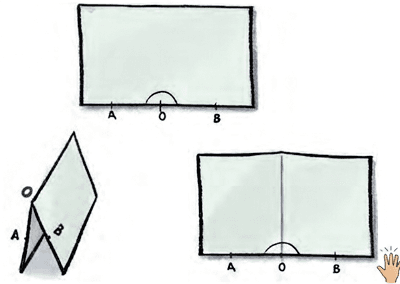
We can divide a straight angle into two equal angles by folding the paper.
Step 1 — Mark the angle
Let us take a rectangular piece of paper. We draw a straight line along one long edge. Let us mark a point O on this line. We mark points A and B on the line. Point O is exactly between A and B. This forms the straight angle AOB. A straight angle measures .
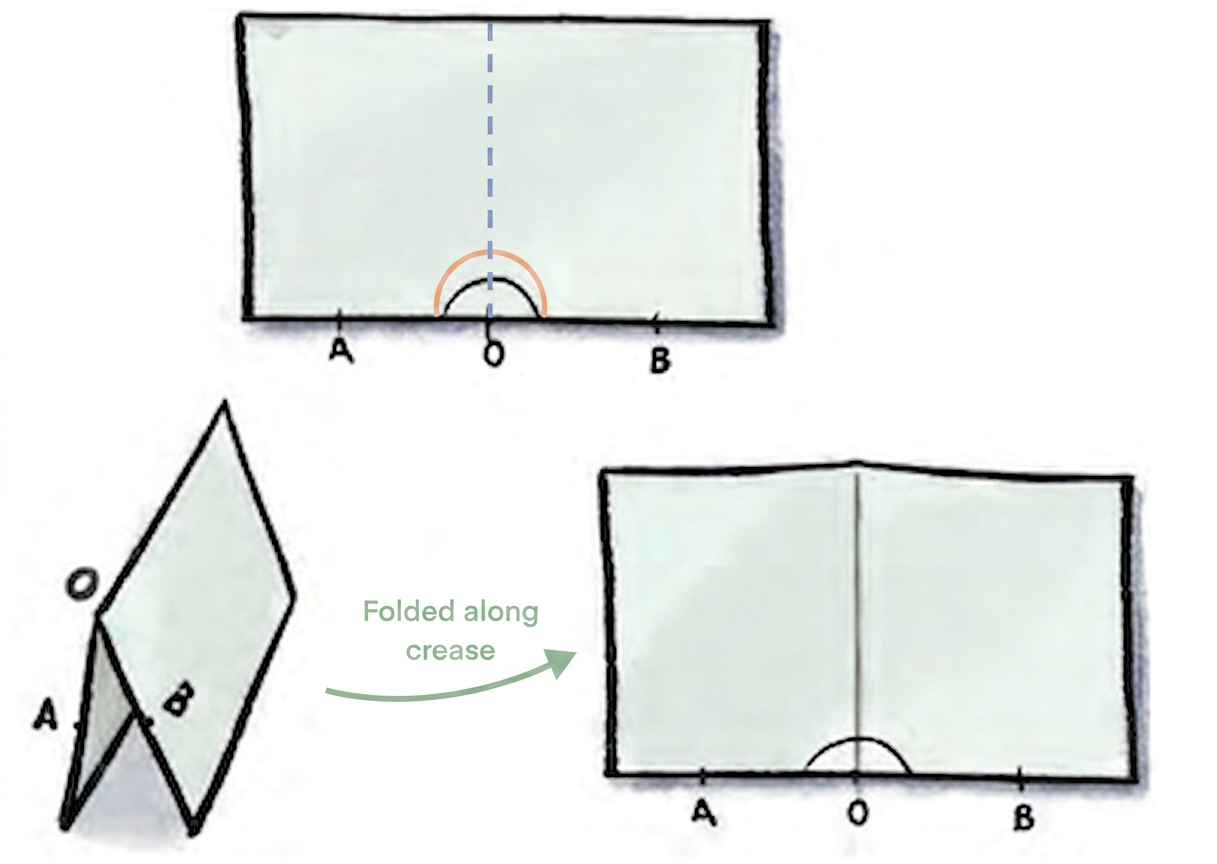
Step 2 — Make the fold
Let us hold the paper carefully at point O. We fold the paper now. We make sure that line segment OB. It lies exactly on top of OA. Point O must stay in its original place. We press down firmly. This makes a clear crease.
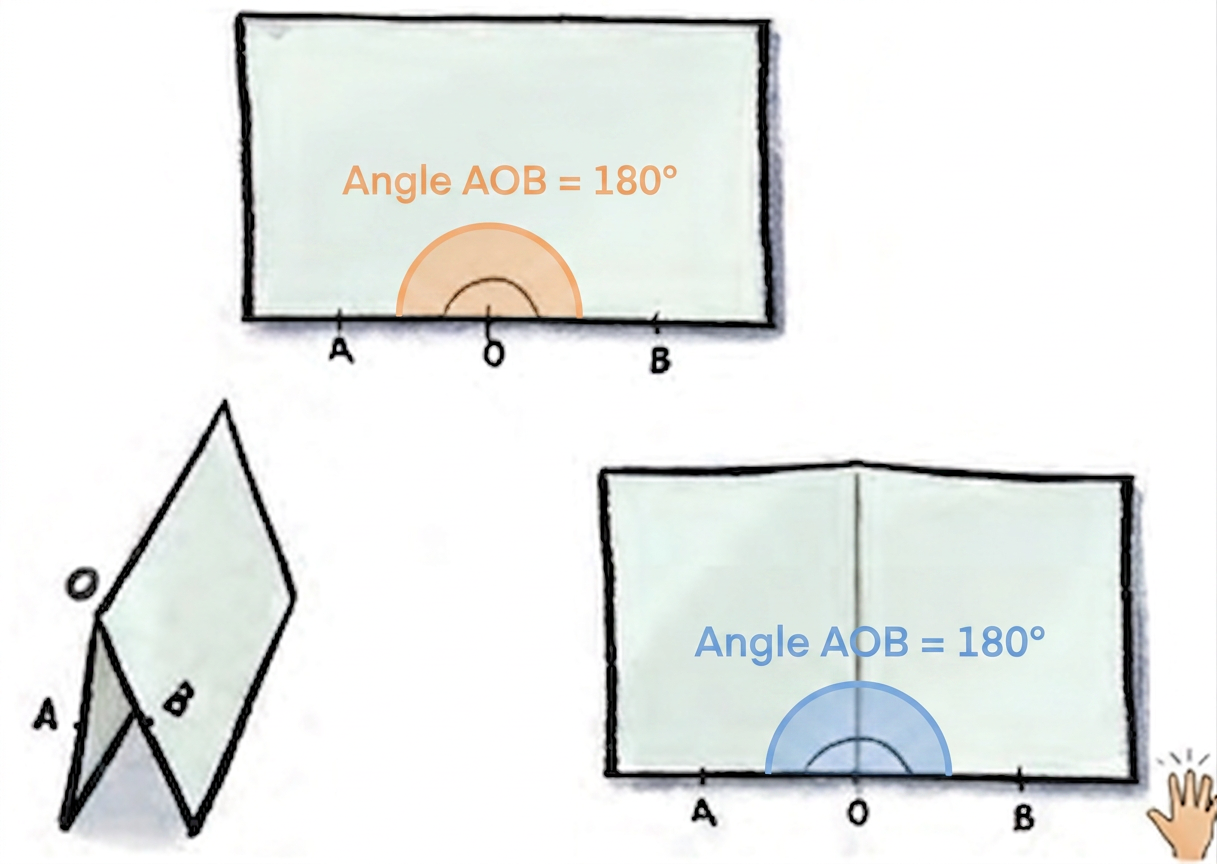
Step 3 — Observe the crease
Let us unfold the paper. We see a new line on the paper. This new line is the crease we made. The crease passes through point O. It divides the straight angle AOB. It forms two new angles at O. Let us call the crease line OC. The two new angles are and . These two angles are exactly equal. Each angle measures . The crease line OC is the angle bisector.
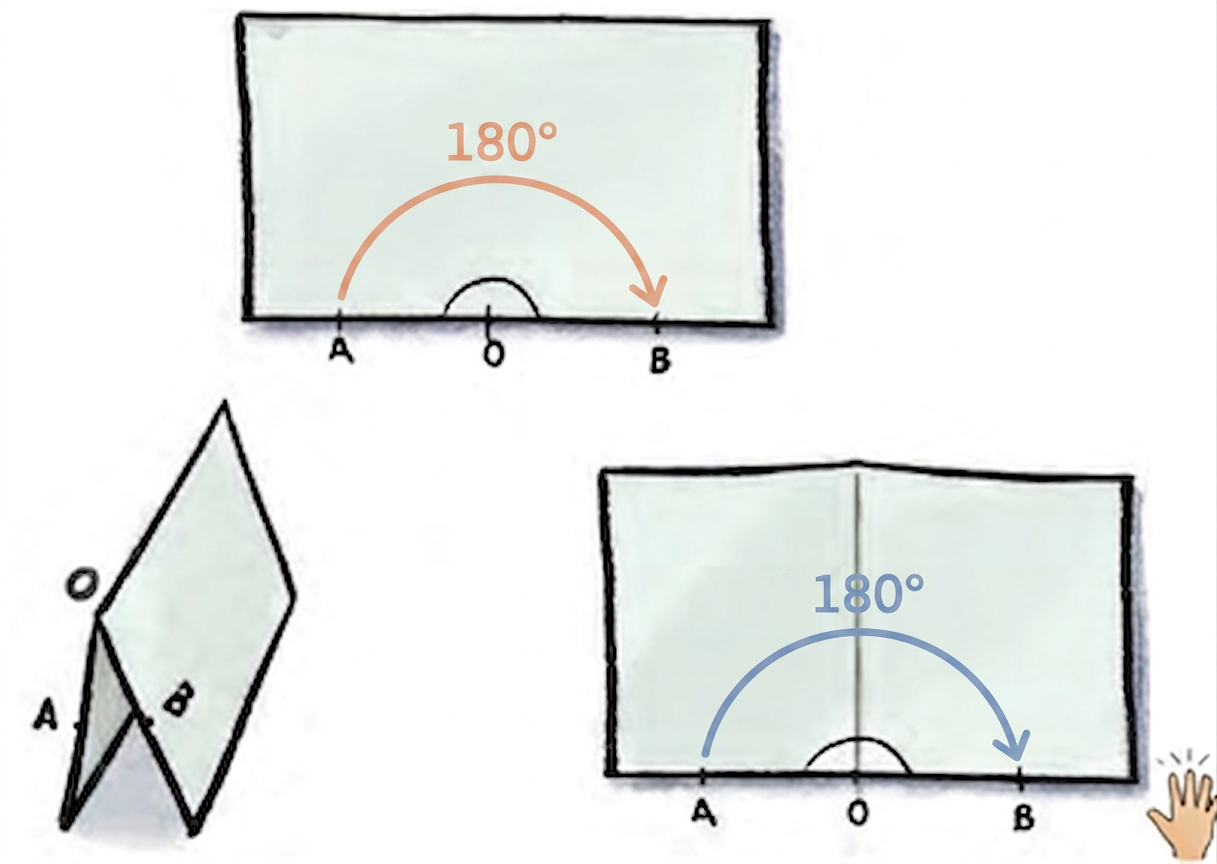
Answer
(i) We mark a straight angle AOB on one edge. (ii) We fold the paper so OB overlaps OA. (iii) The crease divides into two equal angles.
More questions in A
Fold a piece of paper and unfold it. Do you see a crease?
Mark any two points A and B on a sheet of paper. Try to connect A to B by various routes (Fig. 2.1). What is the shortest route from A to B?
2.7 Making Rotating Arms
Make several 'rotating arms' with different angles between the arms. Arrange the angles you have made from smallest to largest by comparing and using superimposition.
Now, shuffle and mix up all the rotating arms. Can you identify which of the rotating arms will pass through the slit?
Let's Explore
We can try to solve this problem using a piece of paper. Recall that when a fold is made, it creates a crease which is straight.
Take a rectangular piece of paper and on one of its sides, mark the straight angle AOB. By folding, try to get a line (crease) passing through O that divides into two equal angles.
How can it be done?
Fold the paper such that OB overlaps with OA. Observe the crease and the two angles formed.
Fold the semi-circular sheet in half as shown in Fig. 2.15 to form a quarter circle.
Fold the sheet again as shown in Figs. 2.16 and 2.17:
When folded, this is of the circle, or of a turn, or of , or of or of = ________.
The new creases formed give us measures of and as shown. Write and at the correct places on the new creases along the edge of the semicircle.
Continuing with another half fold as shown in Fig. 2.18, we get an angle of measure ________
Unfold and mark the creases as OB, OC, ..., etc., as shown in Fig. 2.19 and Fig. 2.20.
Make the paper craft as per the given instructions. Then, unfold and open the paper fully. Draw lines on the creases made and measure the angles formed.
Mind the Mistake, Mend the Mistake!
A student used a protractor to measure the angles as shown below. In each figure, identify the incorrect usage(s) of the protractor and discuss how the reading could have been made and think how it can be corrected.
Let's Play a Game #1
This is an angle guessing game! Play this game with your classmates by making two teams, Team 1 and Team 2. Here are the instructions and rules for the game:
- Team 1 secretly choose an angle measure, for example, 49° and makes an angle with that measure using a protractor without Team 2 being able to see it.
- Team 2 now gets to look at the angle. They have to quickly discuss and guess the number of degrees in the angle (without using a protractor!).
- Team 1 now demonstrates the true measure of the angle with a protractor.
- Team 2 scores the number of points that is the absolute difference in degrees between their guess and the correct measure. For example, if Team 2 guesses 39°, then they score 10 points (49°–39°).
- Each team gets five turns. The winner is the team with the lowest score!
Let's Play a Game #2
We now change the rules of the game a bit. Play this game with your classmates by again making two teams, Team 1 and Team 2. Here are the instructions and rules:
- Team 1 announces to all, an angle measure, e.g., 34°.
- A player from Team 2 must draw that angle on the board without using a protractor. Other members of Team 2 can help the player by speaking words like ‘Make it bigger!’ or ‘Make it smaller!’.
- A player from Team 1 measures the angle with a protractor for all to see.
- Team 2 scores the number of points that is the absolute difference in degrees between Team 2’s angle size and the intended angle size. For example, if player’s angle from Team 2 is measured to be 25°, then Team 2 scores 9 points (34°–25°).
- Each team gets five turns. The winner is again the team with the lowest score.