Question 14
Angles are classified in three groups as shown below. Right angles are shown in the second group. What could be the common feature of the other two groups?
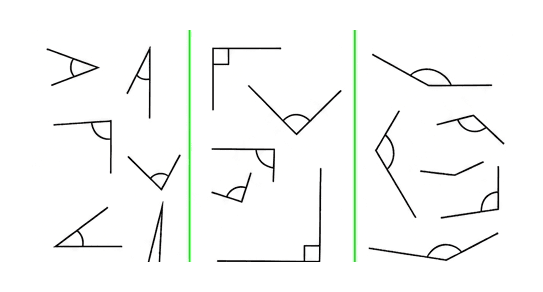
We will look at each group of angles.
Step 1 — Observe the first group
Look at the angles in the first group. These angles are all small. They are smaller than a right angle. We call these acute angles.
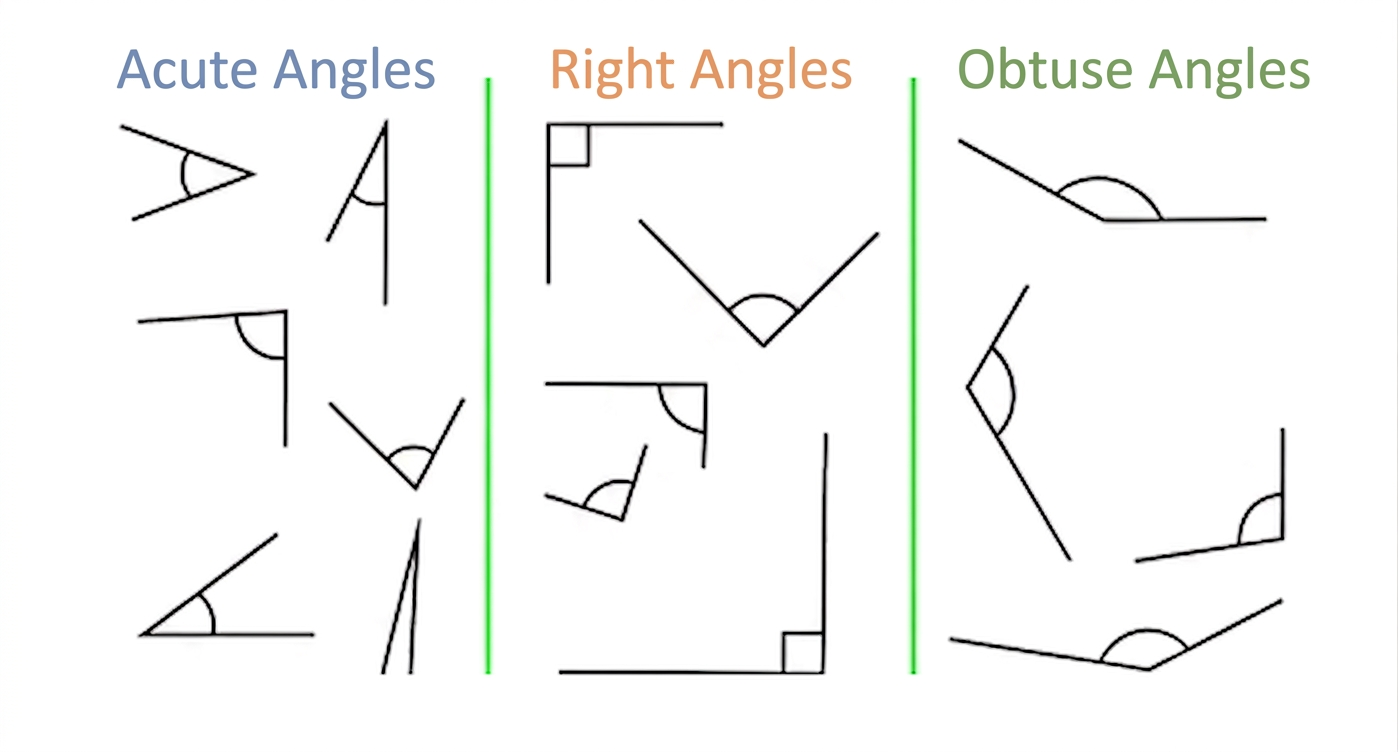
Step 2 — Observe the second group
Look at the angles in the second group. These angles have a square symbol. This symbol means they are right angles. Right angles measure exactly 90 degrees.
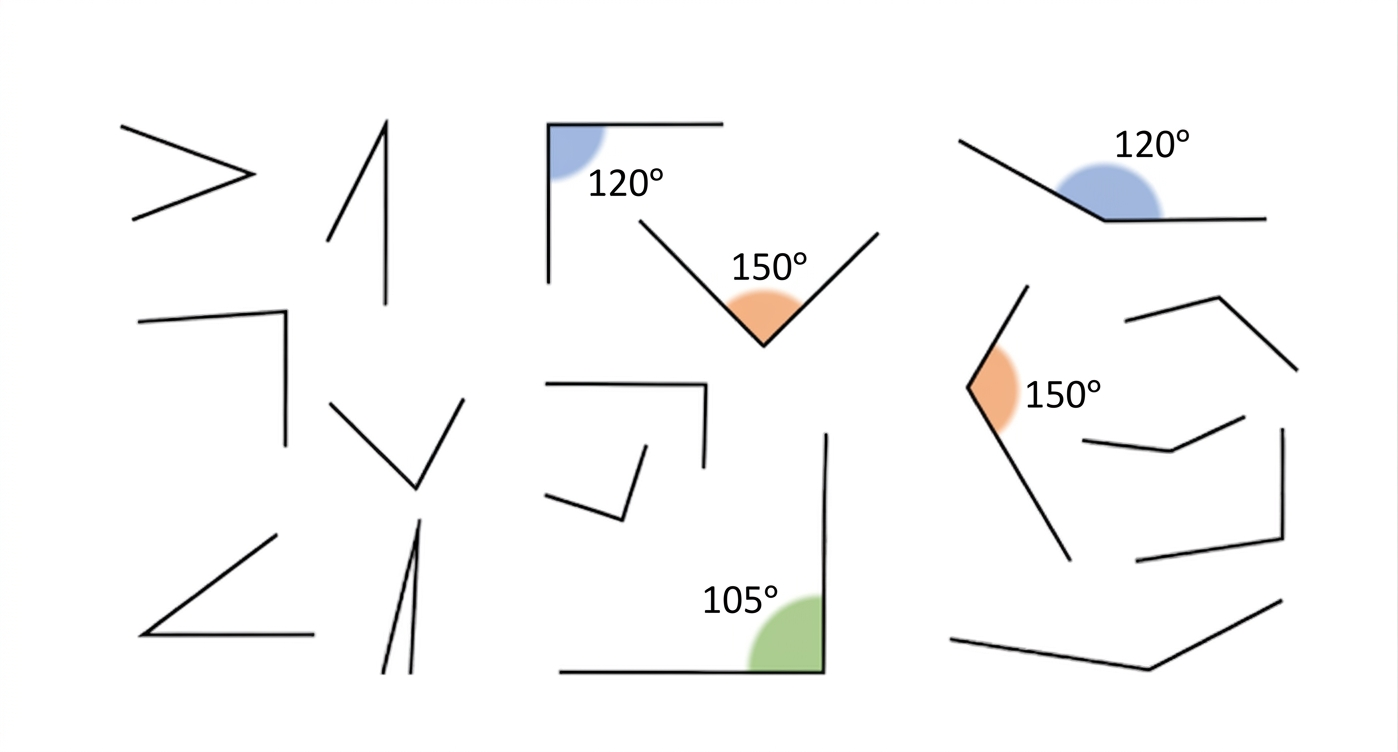
Step 3 — Observe the third group
Look at the angles in the third group. These angles are all wide. They are larger than a right angle. We call these obtuse angles.
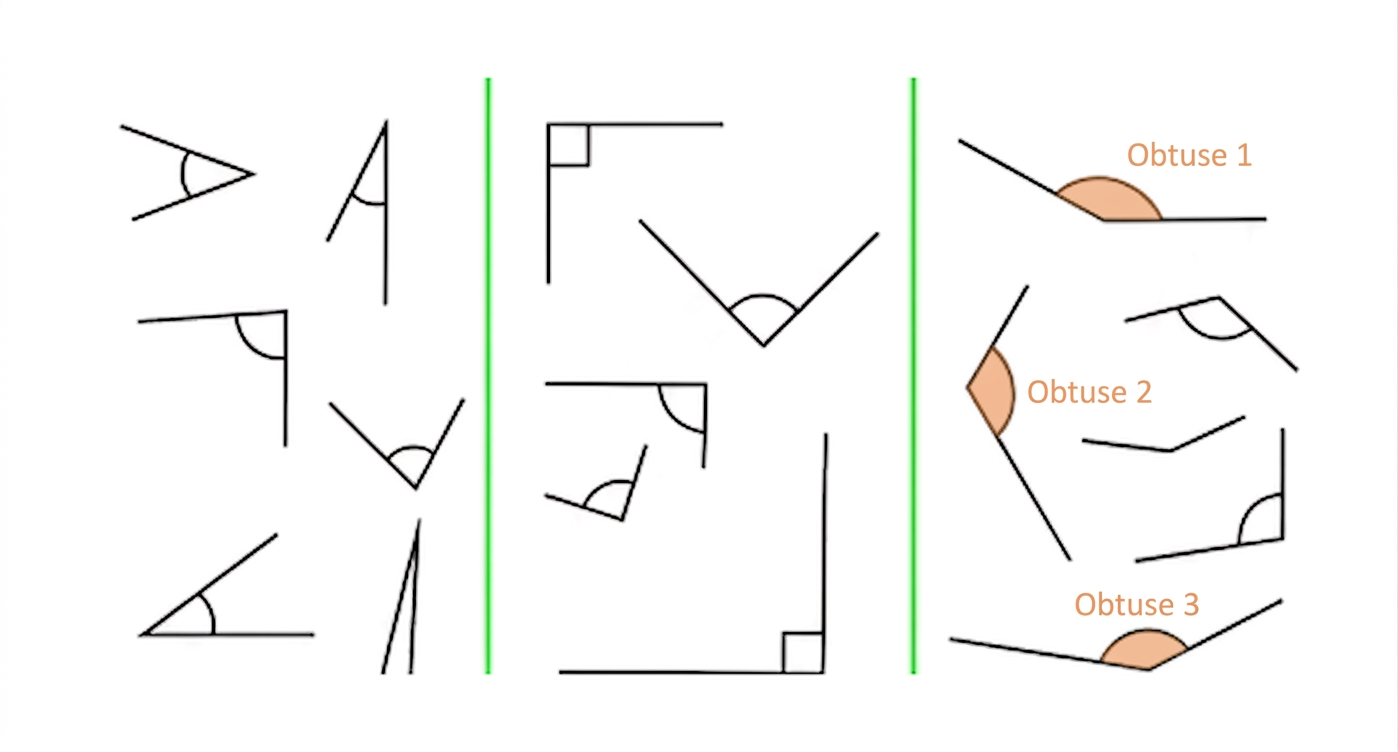
Step 4 — Find the common feature
The first group has acute angles. The third group has obtuse angles. Acute angles are not right angles. Obtuse angles are not right angles. So, this is their common feature. They are not right angles.
Answer
The common feature is that they are not right angles.
More questions in IT
Do you think you can draw a complete picture of a line? No. Why?
Do you see angles being made in each of these cases? Can you mark their arms and vertex?
Which angle is greater—the angle in Case 1 or the angle in Case 2?
In a compass or divider, we turn the arms to form an angle. The vertex is the point where the two arms are joined. Identify the arms and vertex of the angle.
A pair of scissors has two blades. When we open them (or 'turn them') to cut something, the blades form an angle. Identify the arms and vertex of the angle.
Look at the pictures of spectacles, wallet and other common objects. Identify the angles in them by marking out their arms and vertices.
Look at these animals opening their mouths. Do you see any angles here? If yes, mark the arms and vertex of each one. Some mouths are open wider than others; the more the turning of the jaws, the larger the angle! Can you arrange the angles in this picture from smallest to largest?
Is it always easy to compare two angles?
Here are some angles. Label each of the angles. How will you compare them? Draw a few more angles; label them and compare.
Suppose we have a transparent circle which can be moved and placed on figures. Let us place the circular paper on the angle made by the first crane. The circle is placed in such a way that its centre is on the vertex of the angle. Let us mark the points A and B on the edge circle at the points where the arms of the angle pass through the circle.
Q. Can we use this to find out if this angle is greater than, or equal to or smaller than the angle made by the second crane?
Let us place the circle on the angle made by the second crane so that the vertex coincides with the centre of the circle and one of the arms passes through OA.
Q. Can you now tell which angle is bigger?
Which crane was making the bigger angle?
If you can make a circular piece of transparent paper, try this method to compare the angles in Fig. 2.10 with each other.
Is it possible to draw such that the two angles are equal to each other in size?
If a straight angle is formed by half of a full turn, how much of a full turn will form a right angle?
Angles are classified in three groups as shown below. Right angles are shown in the second group. What could be the common feature of the other two groups?
What is the measure of a straight angle in degrees? A straight angle is half of a full turn. As a full-turn is 360°, a half turn is 180°. What is the measure of a right angle in degrees? Two right angles together form a straight angle. As a straight angle measures 180°, a right angle measures 90°.
The circle has been divided into 1, 2, 3, 4, 5, 6, 8, 9 10 and 12 parts below. What are the degree measures of the resulting angles? Write the degree measures down near the indicated angles.
There are two sets of numbers on the protractor: one increasing from right to left and the other increasing from left to right. Why does it include two sets of numbers?
What is the degree measure of AOB?
In Fig. 2.19, we have . Why?
Measure all three angles of the triangle shown in Fig. 2.21 (a), and write the measures down near the respective angles. Now add up the three measures. What do you get? Do the same for the triangles in Fig. 2.21 (b) and (c). Try it for other triangles as well, and then make a conjecture for what happens in general! We will come back to why this happens in a later year.
Let's Explore
In this figure, . What is the measure of ? What is the measure of ?
Hint: Observe that is a straight angle. Hence, the degree measure of of which is covered by . A similar argument can be applied to find the measure of .