Question 2
Give two different examples of pair of
(i) similar figures. (ii) non-similar figures.
We will define similar and non-similar figures with examples.
Step 1 — Similar Figures
Similar figures have the same shape. Their sizes can be different. All corresponding angles are equal. Corresponding sides are in proportion.
Let's look at two equilateral triangles.
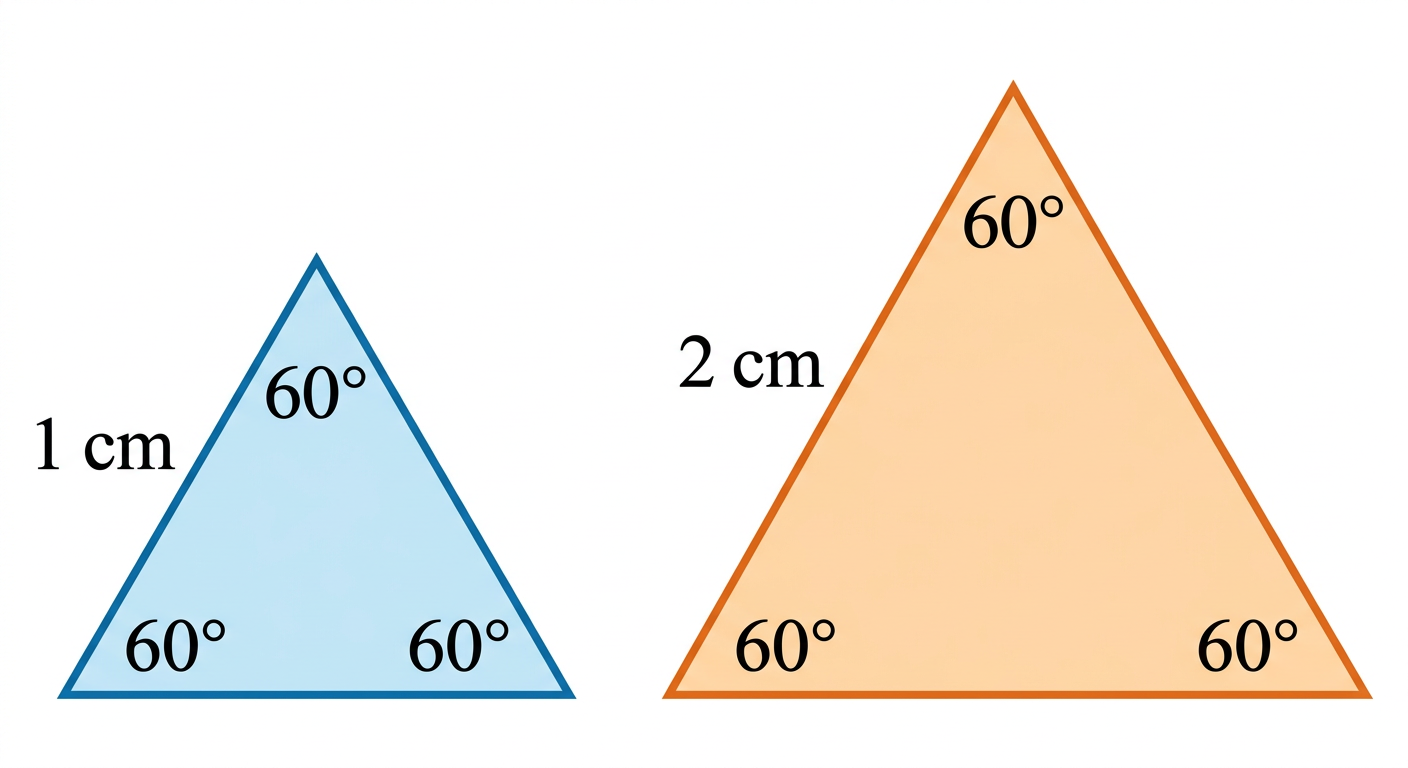
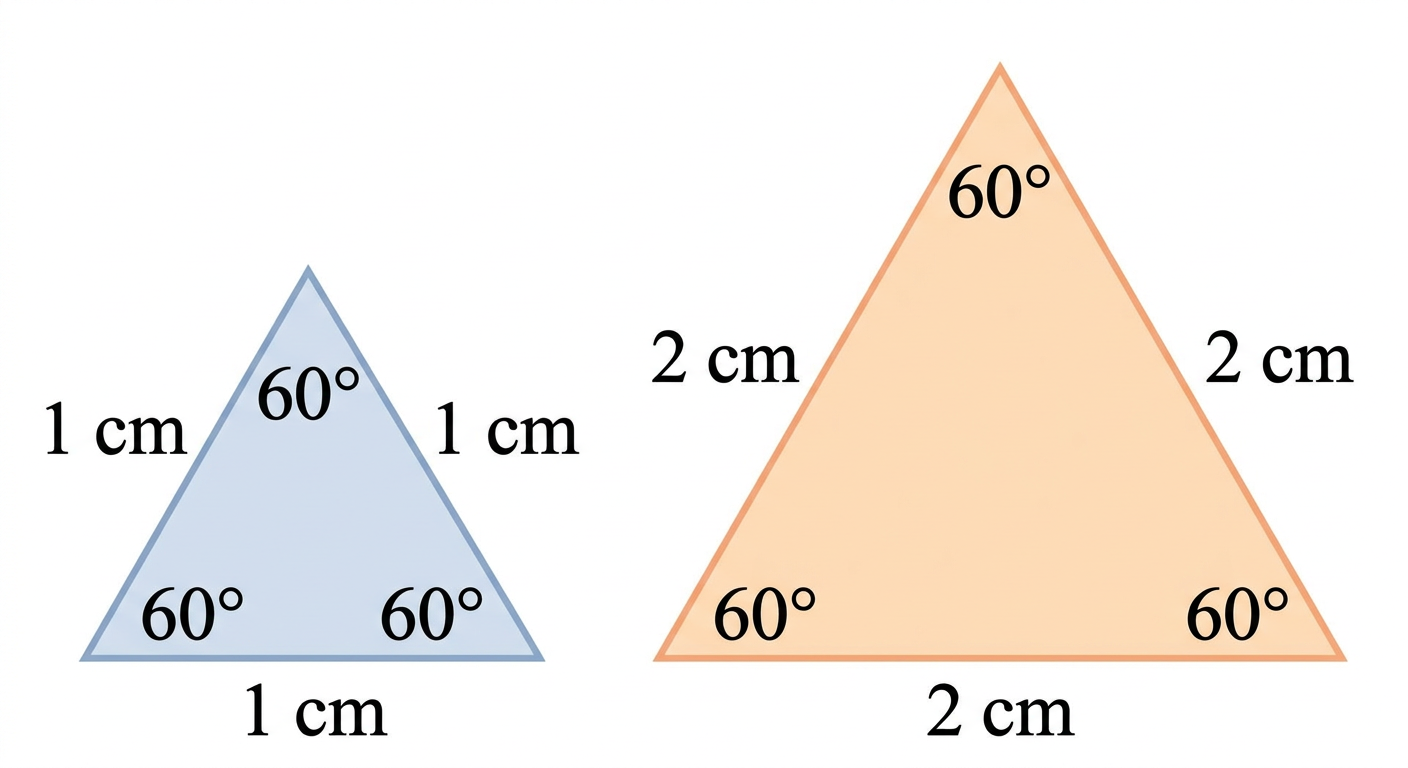
Example 1: Two equilateral triangles. Triangle 1 has side length 1 cm. Triangle 2 has side length 2 cm. All angles in both triangles are 60°. The ratio of their sides is 1:2. They are similar figures.
Let's look at two squares.
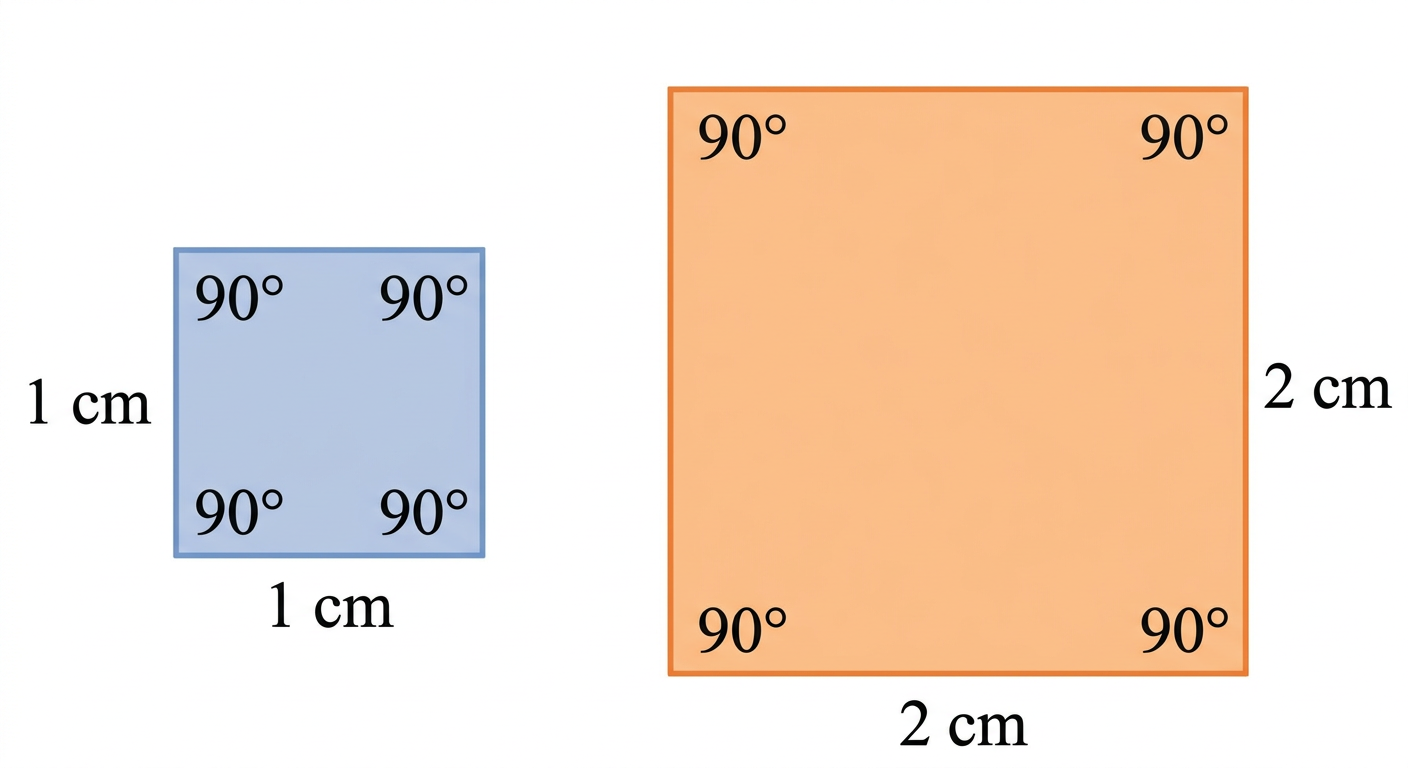
Example 2: Two squares. Square 1 has side length 1 cm. Square 2 has side length 2 cm. All angles in both squares are 90°. The ratio of their sides is 1:2. They are similar figures.
Step 2 — Non-Similar Figures
Non-similar figures do not have the same shape. Their corresponding angles might not be equal. Their corresponding sides might not be in proportion.
Let's look at a trapezium and a square.
Example 1: A trapezium and a square. A trapezium has one pair of parallel sides. A square has four equal sides. Their shapes are very different. They are non-similar figures.
Let's look at a triangle and a parallelogram.
Example 2: A triangle and a parallelogram. A triangle has three sides. A parallelogram has four sides. Their shapes are very different. They are non-similar figures.
Answer
(i) Two different examples of similar figures are:
- Two equilateral triangles with side lengths 1 cm and 2 cm.
- Two squares with side lengths 1 cm and 2 cm. (ii) Two different examples of non-similar figures are:
- A trapezium and a square.
- A triangle and a parallelogram.
More questions in Exercise 6.1
Fill in the blanks using the correct word given in brackets :
(i) All circles are __________ . (congruent, similar)
(ii) All squares are __________ . (similar, congruent)
(iii) All __________ triangles are similar. (isosceles, equilateral)
(iv) Two polygons of the same number of sides are similar, if (a) their corresponding angles are __________ and (b) their corresponding sides are __________ . (equal, proportional)
Give two different examples of pair of
(i) similar figures. (ii) non-similar figures.
State whether the following quadrilaterals are similar or not: