Question 1
Express each number as a product of its prime factors:
(i) 140 (ii) 156 (iii) 3825 (iv) 5005 (v) 7429
We will find the prime factors for each number.
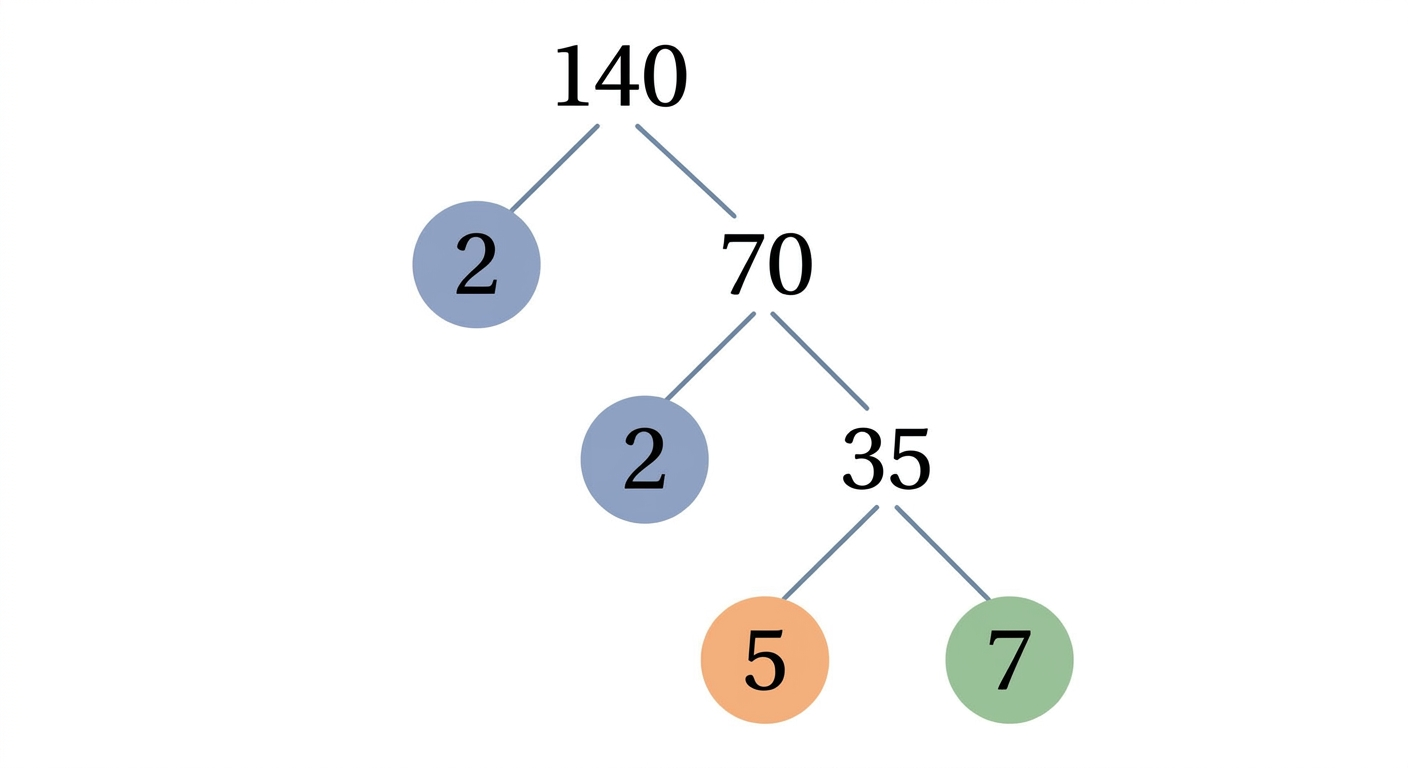
Step 1 — Prime factors of 140
Let's divide 140 by prime numbers. We start with the smallest prime, 2.
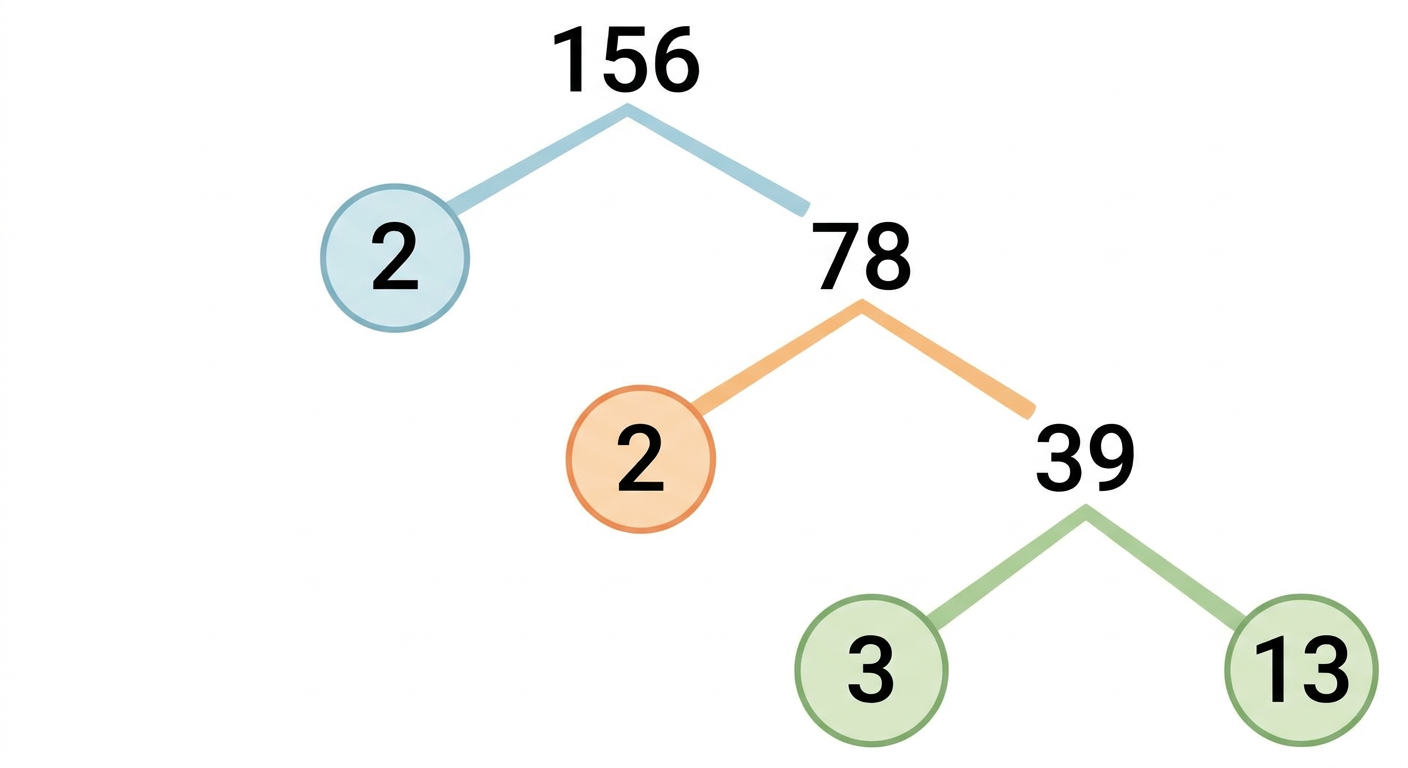
Step 2 — Prime factors of 156
Let's divide 156 by prime numbers. We start with the smallest prime, 2.
Step 3 — Prime factors of 3825
Let's divide 3825 by prime numbers. The sum of digits is 18, so it is divisible by 3.
Step 4 — Prime factors of 5005
Let's divide 5005 by prime numbers. The number ends in 5, so it is divisible by 5.
Step 5 — Prime factors of 7429
Let's divide 7429 by prime numbers. We try prime numbers like 17, 19, 23.
Answer
(i) (ii) (iii) (iv) (v)
More questions in Exercise 1.1
Express each number as a product of its prime factors:
(i) 140 (ii) 156 (iii) 3825 (iv) 5005 (v) 7429
Find the LCM and HCF of the following pairs of integers and verify that LCM × HCF = product of the two numbers.
(i) 26 and 91 (ii) 510 and 92 (iii) 336 and 54
Find the LCM and HCF of the following integers by applying the prime factorisation method.
(i) 12, 15 and 21 (ii) 17, 23 and 29 (iii) 8, 9 and 25
Given that HCF (306, 657) = 9, find LCM (306, 657).
Check whether can end with the digit 0 for any natural number .
Explain why and are composite numbers.
There is a circular path around a sports field. Sonia takes 18 minutes to drive one round of the field, while Ravi takes 12 minutes for the same. Suppose they both start at the same point and at the same time, and go in the same direction. After how many minutes will they meet again at the starting point?