Introduction to Trigonometry | Exercise 8.3

Question 1

Express the trigonometric ratios sinA\sin A, secA\sec A and tanA\tan A in terms of cotA\cot A.

Check your answer with HomiSolve it yourself, then let Homi check your steps and spot mistakes.
Solution

Pythagorean Identities (derived from sin2A+cos2A=1\sin^2 A + \cos^2 A = 1):

1+cot2A=csc2Acsc2Acot2A=11 + \cot^2 A = \csc^2 A \quad \Rightarrow \quad \csc^2 A - \cot^2 A = 1

1+tan2A=sec2Asec2Atan2A=11 + \tan^2 A = \sec^2 A \quad \Rightarrow \quad \sec^2 A - \tan^2 A = 1

Reciprocal relationships:

sinA=1cscA,tanA=1cotA,secA=1cosA\sin A = \frac{1}{\csc A}, \quad \tan A = \frac{1}{\cot A}, \quad \sec A = \frac{1}{\cos A}

We use these to rewrite sinA\sin A, secA\sec A, and tanA\tan A purely in terms of cotA\cot A.

We will use fundamental trigonometric identities to express the ratios.

Step 1 — Express sinA\sin A

Let's start with a basic identity.

We know that csc2Acot2A=1\csc^2 A - \cot^2 A = 1.

We can rearrange this identity.

csc2A=1+cot2A\csc^2 A = 1 + \cot^2 A

Now, let's take the square root.

cscA=1+cot2A\csc A = \sqrt{1 + \cot^2 A}

We also know that sinA\sin A is the reciprocal of cscA\csc A.

sinA=1cscA\sin A = \frac{1}{\csc A}

Let's substitute the value of cscA\csc A.

sinA=11+cot2A\sin A = \frac{1}{\sqrt{1 + \cot^2 A}}

sinA=11+cot2A\boxed{\sin A = \frac{1}{\sqrt{1 + \cot^2 A}}}

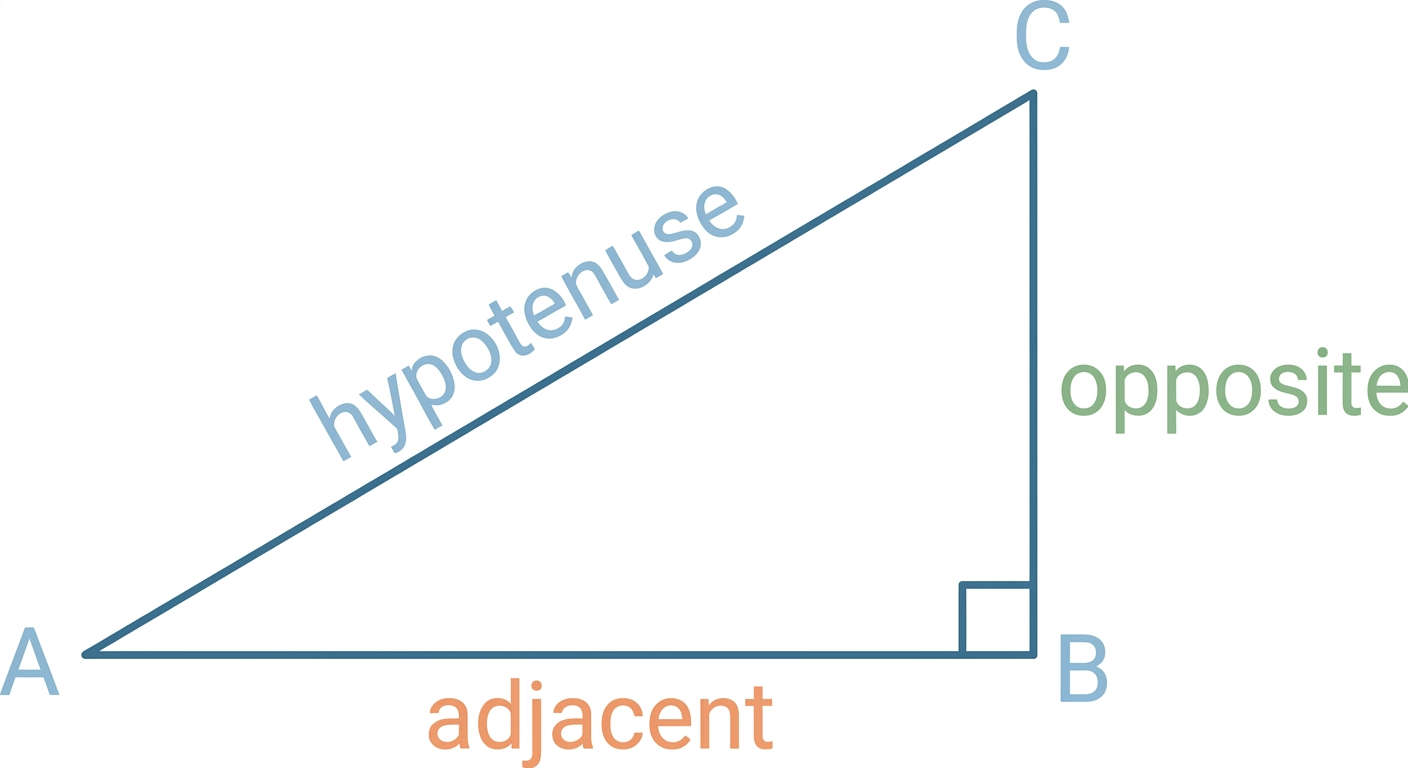
Diagram 1

Step 2 — Express secA\sec A

Let's use another important identity.

We know that sec2Atan2A=1\sec^2 A - \tan^2 A = 1.

We can rearrange this identity.

sec2A=1+tan2A\sec^2 A = 1 + \tan^2 A

We also know that tanA\tan A is the reciprocal of cotA\cot A.

tanA=1cotA\tan A = \frac{1}{\cot A}

Let's substitute this into the identity for sec2A\sec^2 A.

sec2A=1+(1cotA)2\sec^2 A = 1 + \left(\frac{1}{\cot A}\right)^2

Let's simplify the expression.

sec2A=1+1cot2A\sec^2 A = 1 + \frac{1}{\cot^2 A}

Let's combine the terms on the right side.

sec2A=cot2A+1cot2A\sec^2 A = \frac{\cot^2 A + 1}{\cot^2 A}

Now, let's take the square root.

secA=1+cot2Acot2A\sec A = \sqrt{\frac{1 + \cot^2 A}{\cot^2 A}}

We can simplify the denominator.

secA=1+cot2Acot2A\sec A = \frac{\sqrt{1 + \cot^2 A}}{\sqrt{\cot^2 A}}

For acute angles, cotA\cot A is positive.

secA=1+cot2AcotA\sec A = \frac{\sqrt{1 + \cot^2 A}}{\cot A}

secA=1+cot2AcotA\boxed{\sec A = \frac{\sqrt{1 + \cot^2 A}}{\cot A}}

Step 3 — Express tanA\tan A

This is a direct reciprocal relationship.

We know that tanA\tan A is the reciprocal of cotA\cot A.

tanA=1cotA\tan A = \frac{1}{\cot A}

tanA=1cotA\boxed{\tan A = \frac{1}{\cot A}}

Answer

(i) sinA=11+cot2A\sin A = \frac{1}{\sqrt{1 + \cot^2 A}} (ii) secA=1+cot2AcotA\sec A = \frac{\sqrt{1 + \cot^2 A}}{\cot A} (iii) tanA=1cotA\tan A = \frac{1}{\cot A}

More questions in Exercise 8.3

Q1

Express the trigonometric ratios sinA\sin A, secA\sec A and tanA\tan A in terms of cotA\cot A.

Q2

Write all the other trigonometric ratios of A\angle A in terms of secA\sec A.

Q3

Choose the correct option. Justify your choice.

(i) 9sec2A9tan2A=9 \sec^2 A - 9 \tan^2 A = (A) 11 (B) 99 (C) 88 (D) 00

(ii) (1+tanθ+secθ)(1+cotθcosec θ)=(1 + \tan \theta + \sec \theta) (1 + \cot \theta - \text{cosec } \theta) = (A) 00 (B) 11 (C) 22 (D) 1-1

(iii) (secA+tanA)(1sinA)=(\sec A + \tan A) (1 - \sin A) = (A) secA\sec A (B) sinA\sin A (C) cosec A\text{cosec } A (D) cosA\cos A

(iv) 1+tan2A1+cot2A=\frac{1 + \tan^2 A}{1 + \cot^2 A} = (A) sec2A\sec^2 A (B) 1-1 (C) cot2A\cot^2 A (D) tan2A\tan^2 A

Q4

Prove the following identities, where the angles involved are acute angles for which the expressions are defined.

(i) (cosec θcotθ)2=1cosθ1+cosθ(\text{cosec } \theta - \cot \theta)^2 = \frac{1 - \cos \theta}{1 + \cos \theta}

(ii) cosA1+sinA+1+sinAcosA=2secA\frac{\cos A}{1 + \sin A} + \frac{1 + \sin A}{\cos A} = 2 \sec A

(iii) tanθ1cotθ+cotθ1tanθ=1+secθ cosec θ\frac{\tan \theta}{1 - \cot \theta} + \frac{\cot \theta}{1 - \tan \theta} = 1 + \sec \theta \text{ cosec } \theta [Hint : Write the expression in terms of sinθ\sin \theta and cosθ\cos \theta]

(iv) 1+secAsecA=sin2A1cosA\frac{1 + \sec A}{\sec A} = \frac{\sin^2 A}{1 - \cos A} [Hint : Simplify LHS and RHS separately]

(v) cosAsinA+1cosA+sinA1=cosec A+cotA\frac{\cos A - \sin A + 1}{\cos A + \sin A - 1} = \text{cosec } A + \cot A, using the identity cosec2A=1+cot2A\text{cosec}^2 A = 1 + \cot^2 A.

(vi) 1+sinA1sinA=secA+tanA\sqrt{\frac{1 + \sin A}{1 - \sin A}} = \sec A + \tan A

(vii) sinθ2sin3θ2cos3θcosθ=tanθ\frac{\sin \theta - 2 \sin^3 \theta}{2 \cos^3 \theta - \cos \theta} = \tan \theta

(viii) (sinA+cosec A)2+(cosA+secA)2=7+tan2A+cot2A(\sin A + \text{cosec } A)^2 + (\cos A + \sec A)^2 = 7 + \tan^2 A + \cot^2 A

(ix) (cosec AsinA)(secAcosA)=1tanA+cotA(\text{cosec } A - \sin A)(\sec A - \cos A) = \frac{1}{\tan A + \cot A} [Hint : Simplify LHS and RHS separately]

(x) (1+tan2A1+cot2A)=(1tanA1cotA)2=tan2A\left(\frac{1 + \tan^2 A}{1 + \cot^2 A}\right) = \left(\frac{1 - \tan A}{1 - \cot A}\right)^2 = \tan^2 A

← Back to Introduction to Trigonometry