Question 10
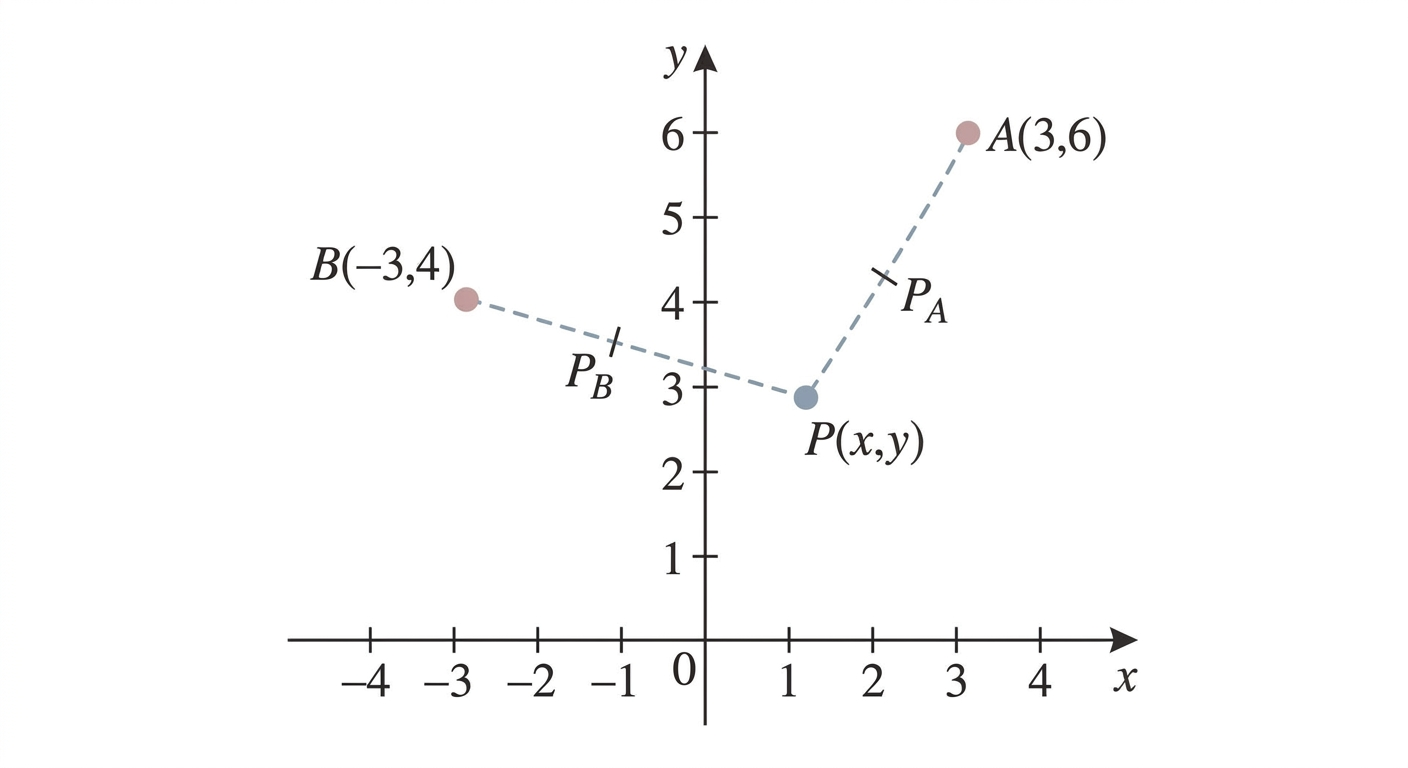
Find a relation between x and y such that the point (x, y) is equidistant from the point (3, 6) and (–3, 4).
Equidistant: A point is equidistant from two other points when its distance from both is exactly equal. So here, the distance from to equals the distance from to .
Distance Formula: The distance between two points and :
We set the two distances equal and simplify to find the relation between and .
Let's find a relation where the distance from point (x, y) to (3, 6) is the same as to (-3, 4).
Step 1 — Set up the distance equation
Let the point be P(x, y). Let the first given point be A(3, 6). Let the second given point be B(-3, 4). The problem states that point P is equidistant from A and B. This means the distance PA must be equal to the distance PB. We use the distance formula: .
Since , we can write:
Step 2 — Square both sides and expand
Let's square both sides of the equation. This removes the square roots.
Now, we expand each squared term using the formula .
Step 3 — Simplify and find the relation
Let's combine the constant terms on each side.
We can cancel and from both sides.
Now, let's move all terms involving x and y to one side. We will move them to the right side to keep the x term positive.
Let's simplify the equation.
We can divide the entire equation by 4 to simplify it further.
We can write this as:
Answer
The relation between x and y is .
More questions in Exercise 7.1
Find the distance between the following pairs of points :
(i) (ii) (iii)
Find the distance between the points and . Can you now find the distance between the two towns A and B discussed in Section 7.2.
Determine if the points and are collinear.
Check whether and are the vertices of an isosceles triangle.
In a classroom, 4 friends are seated at the points A, B, C and D as shown in Fig. 7.8. Champa and Chameli walk into the class and after observing for a few minutes Champa asks Chameli, “Don’t you think ABCD is a square?” Chameli disagrees. Using distance formula, find which of them is correct.
Name the type of quadrilateral formed, if any, by the following points, and give reasons for your answer:
(i)
(ii)
(iii)
Find the point on the -axis which is equidistant from and .
Find the values of for which the distance between the points and is 10 units.
If Q(0, 1) is equidistant from P(5, –3) and R(x, 6), find the values of x. Also find the distances QR and PR.
Find a relation between x and y such that the point (x, y) is equidistant from the point (3, 6) and (–3, 4).