Question 5
A small terrace at a football ground comprises of 15 steps each of which is 50 m long and built of solid concrete.
Each step has a rise of and a tread of . (see Fig. 5.8). Calculate the total volume of concrete required to build the terrace.
[Hint : Volume of concrete required to build the first step = ]
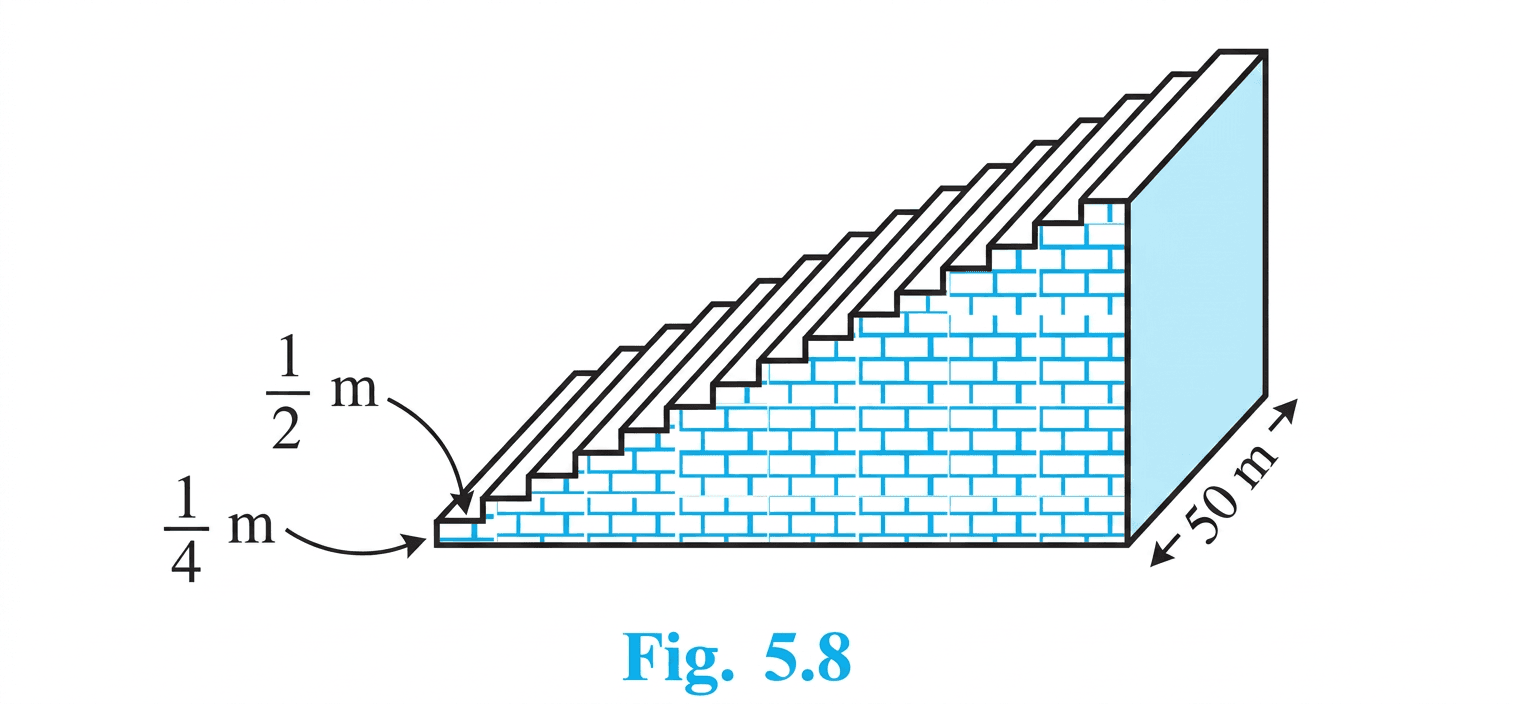
The total volume of concrete is the sum of volumes of individual concrete blocks, which form an arithmetic progression.
Step 1 — Calculate volumes of the first few steps.
We find the volume of concrete for the first step. Then we find the volume for the second step. We will see a pattern.
The length of each step is 50 m. The depth (tread) of each step is . The rise (height) of each step is .
Volume of the first step ():
Volume of the second step ():
Volume of the third step ():
Step 2 — Identify the arithmetic progression.
The volumes of the steps form an arithmetic progression. We identify the first term and the common difference.
The sequence of volumes is . The first term . The common difference .
There are 15 steps in total.
Step 3 — Calculate the total volume.
We use the formula for the sum of an arithmetic progression. The sum of terms is .
Here, , , and .
Answer
The total volume of concrete required to build the terrace is 750 m³.
More questions in Exercise 5.4
Which term of the AP : 121, 117, 113, . . ., is its first negative term?
[Hint : Find for ]
The sum of the third and the seventh terms of an AP is 6 and their product is 8. Find the sum of first sixteen terms of the AP.
A ladder has rungs 25 cm apart. (see Fig. 5.7). The rungs decrease uniformly in length from 45 cm at the bottom to 25 cm at the top. If the top and the bottom rungs are apart, what is the length of the wood required for the rungs?
[Hint : Number of rungs = ]
The houses of a row are numbered consecutively from 1 to 49. Show that there is a value of such that the sum of the numbers of the houses preceding the house numbered is equal to the sum of the numbers of the houses following it. Find this value of .
[Hint : ]
A small terrace at a football ground comprises of 15 steps each of which is 50 m long and built of solid concrete.
Each step has a rise of and a tread of . (see Fig. 5.8). Calculate the total volume of concrete required to build the terrace.
[Hint : Volume of concrete required to build the first step = ]