Question 5
Use proof by contradiction to show that there is no value of for which ends with the digit zero.
Let's use proof by contradiction. We will assume the opposite of what we want to prove.
Step 1 — Assume the opposite
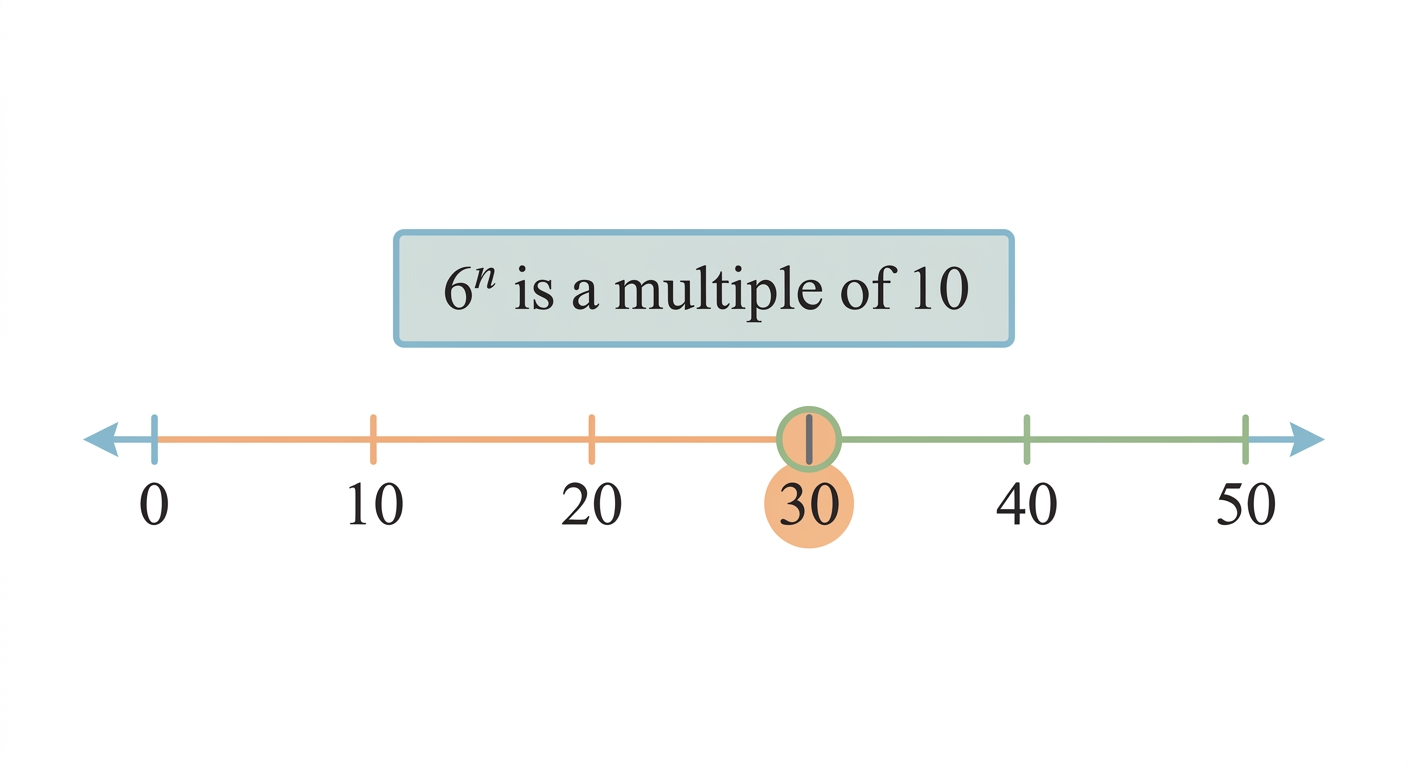
Let's assume that for some natural number , ends with the digit zero. If a number ends with zero, it must be a multiple of 10. So, we can write as 10 multiplied by some integer .
Step 2 — Prime factorization
Let's look at the prime factors of . The number 6 can be written as 2 multiplied by 3.
So, is .
Now, let's look at the prime factors of 10. The number 10 can be written as 2 multiplied by 5.
So, is .
Step 3 — Find the contradiction
From Step 1, we assumed . So, we can write the prime factorizations as equal.
The Fundamental Theorem of Arithmetic says every number has a unique set of prime factors. On the left side, the prime factors are only 2 and 3. The number 5 is not a prime factor of . On the right side, the prime factors include 2, 5, and the prime factors of . For the two sides to be equal, they must have the exact same prime factors. The left side () does not have 5 as a prime factor. The right side () must have 5 as a prime factor. This is a contradiction. The number 5 cannot be a prime factor of . Therefore, our initial assumption must be false.
Answer
There is no value of for which ends with the digit zero.
More questions in A1.6
Suppose , and . Use proof by contradiction to show .
Let be a rational number and be an irrational number. Use proof by contradiction to show that is an irrational number.
Use proof by contradiction to prove that if for an integer , is even, then so is .
[Hint : Assume is not even, that is, it is of the form , for some integer , and then proceed.]
Use proof by contradiction to prove that if for an integer , is divisible by 3, then is divisible by 3.
Use proof by contradiction to show that there is no value of for which ends with the digit zero.
Prove by contradiction that two distinct lines in a plane cannot intersect in more than one point.