Question 6
Given that PQRS is a cyclic quadrilateral and also its diagonals bisect each other. What can you conclude about the quadrilateral?
We will use properties of cyclic quadrilaterals and parallelograms.
Step 1 — Identify the shape from diagonals
We are given that diagonals bisect each other. This is a key property of parallelograms. So, PQRS must be a parallelogram. In a parallelogram, opposite angles are equal. Let's say . Also, .
Step 2 — Use the cyclic property
We are also given that PQRS is cyclic. In a cyclic quadrilateral, opposite angles sum to . So, . From Step 1, we know . Let's substitute this into the equation. Since , then . In a parallelogram, consecutive angles sum to . So, . Since , then . All angles of the quadrilateral are .
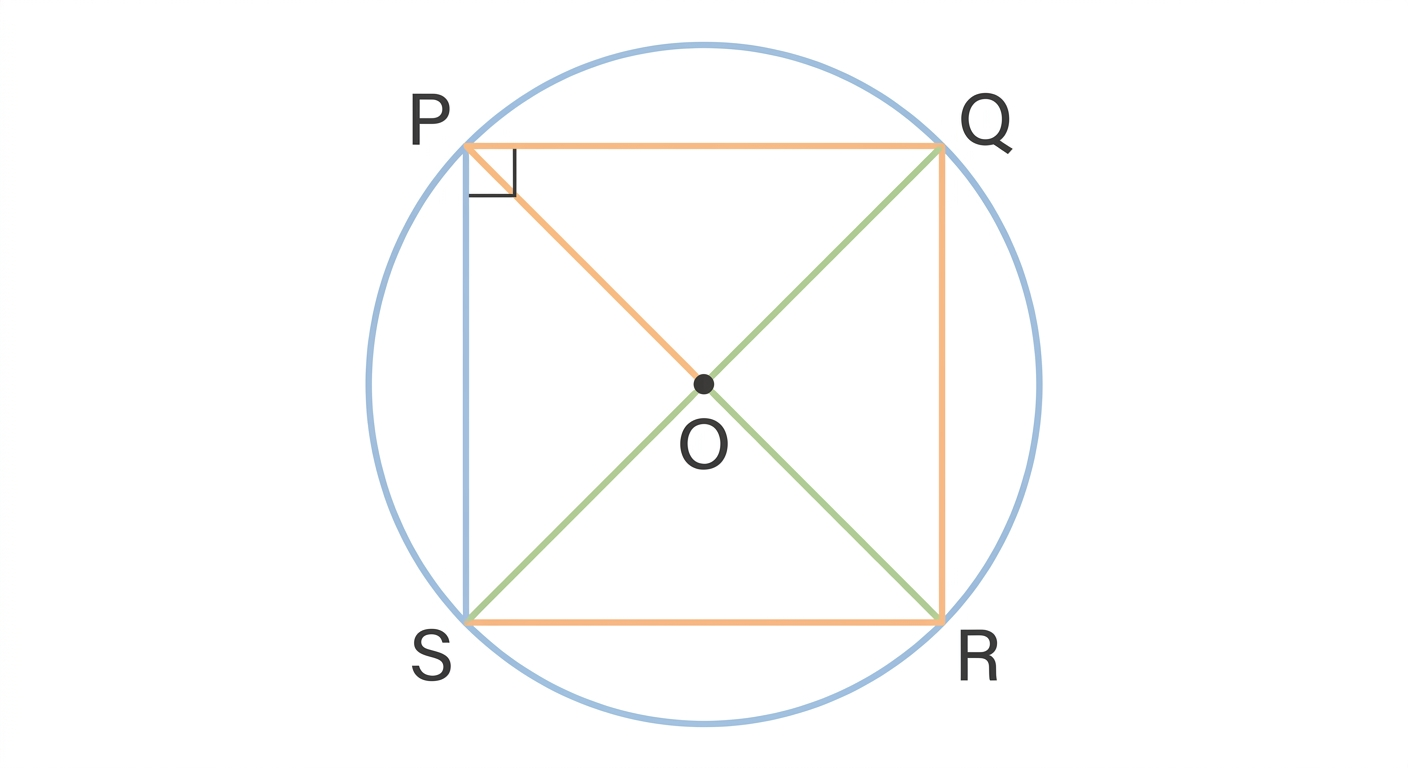
Step 3 — Conclude the quadrilateral type
PQRS is a parallelogram. All its interior angles are . A parallelogram with all angles is a rectangle. Therefore, PQRS is a rectangle.
Answer
The quadrilateral PQRS is a rectangle.
More questions in A1.2
Given that all women are mortal, and suppose that A is a woman, what can we conclude about A?
Given that the product of two rational numbers is rational, and suppose and are rationals, what can you conclude about ?
Given that the decimal expansion of irrational numbers is non-terminating, non-recurring, and is irrational, what can we conclude about the decimal expansion of ?
Given that and , what can we conclude about the value of ?
Given that ABCD is a parallelogram and . What can you conclude about the other angles of the parallelogram?
Given that PQRS is a cyclic quadrilateral and also its diagonals bisect each other. What can you conclude about the quadrilateral?
Given that is irrational for all primes and also suppose that 3721 is a prime. Can you conclude that is an irrational number? Is your conclusion correct? Why or why not?