Question 1
IT'S PUZZLE TIME!
Coin Conjoin
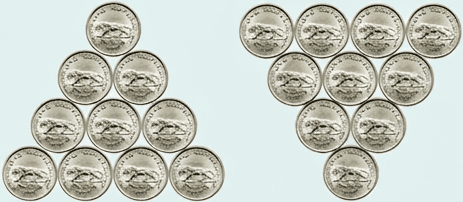
Arrange 10 coins in a triangle as shown in the figure below on the left. The task is to turn the triangle upside down by moving one coin at a time. How many moves are needed? What is the minimum number of moves?
A triangle of 3 coins can be inverted (turned upside down) with a single move, and a triangle of 6 coins can be inverted by moving 2 coins.
The 10-coin triangle can be flipped with just 3 moves; did you figure out how? Find out the minimum possible moves needed to flip the next bigger triangle having 15 coins. Try the same for bigger triangular numbers.
Is there a simple way to calculate the minimum number of coin moves needed for any such triangular arrangement?
A-1
Chapter: DISTRIBUTIVITY AND ALGEBRA
Class: 8 (Class 8)
Category: activity
Question
IT'S PUZZLE TIME!
Coin Conjoin
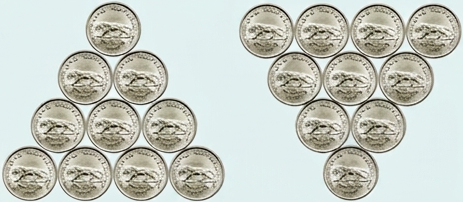
Arrange 10 coins in a triangle as shown in the figure below on the left. The task is to turn the triangle upside down by moving one coin at a time. How many moves are needed? What is the minimum number of moves?
A triangle of 3 coins can be inverted (turned upside down) with a single move, and a triangle of 6 coins can be inverted by moving 2 coins.
The 10-coin triangle can be flipped with just 3 moves; did you figure out how? Find out the minimum possible moves needed to flip the next bigger triangle having 15 coins. Try the same for bigger triangular numbers.
Is there a simple way to calculate the minimum number of coin moves needed for any such triangular arrangement?
Question diagram(s):
The minimum number of moves to invert a triangle of coins is related to the number of rows it has.
Step 1 — Understanding the Pattern
Let us represent the number of rows in a triangle of coins by . The total number of coins in such a triangle is a triangular number, .
We are given some examples:
- For 3 coins, (since ). The problem states 1 move is needed.
- For 6 coins, (since ). The problem states 2 moves are needed.
- For 10 coins, (since ). The problem states 3 moves are needed.
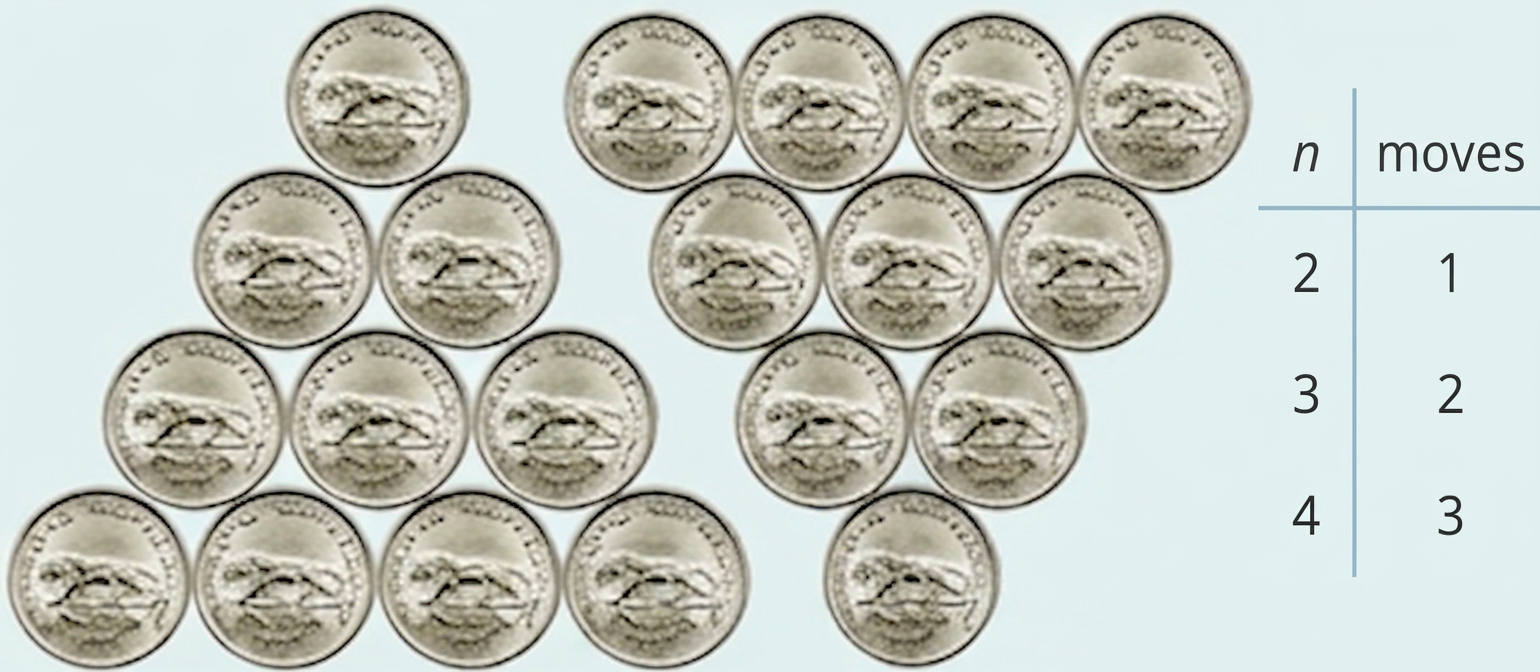
Let us observe the relationship between the number of rows () and the minimum number of moves.
- If , moves = 1.
- If , moves = 2.
- If , moves = 3.
We can see a clear pattern here: the minimum number of moves is always one less than the number of rows. So, the minimum number of moves = .
Let's visualize how these moves work for each case:
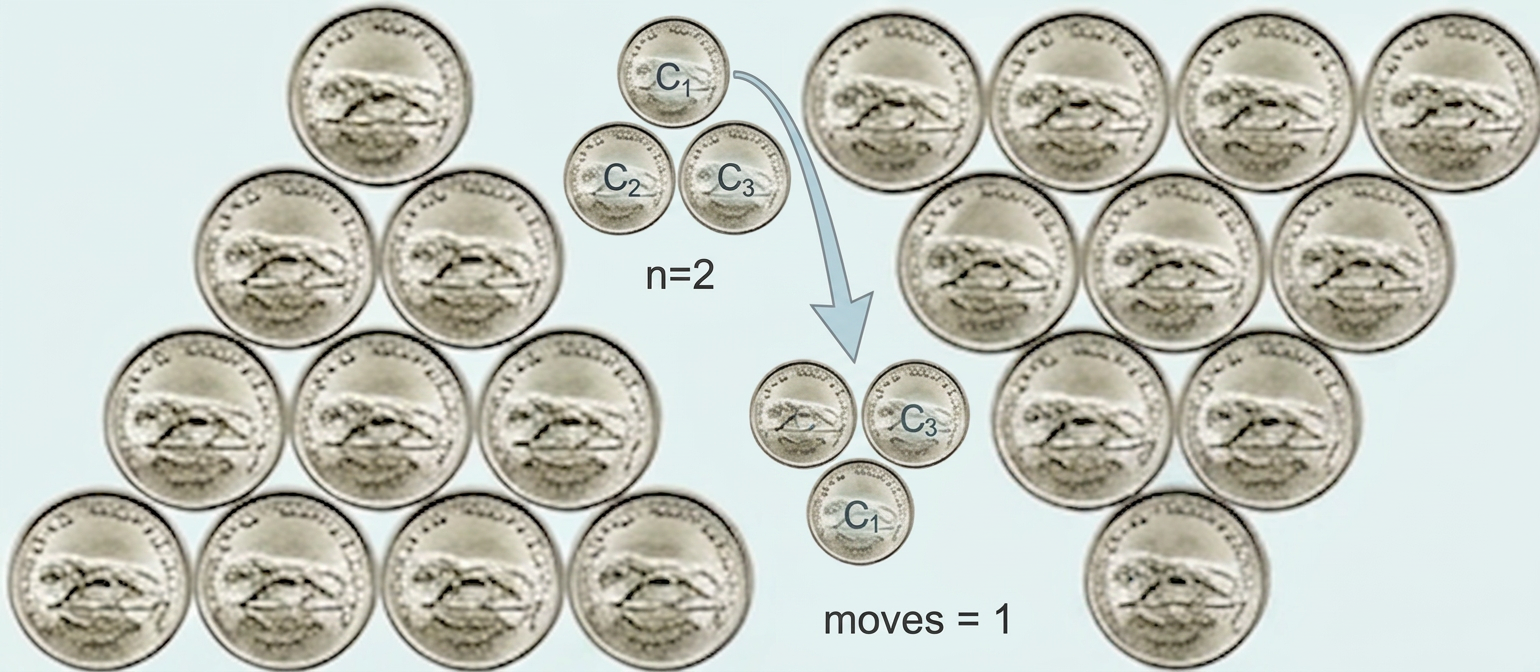
- For 3 coins (n=2):
- Original:
- C1
- C2 C3
- Move C1 (the top coin) to the position below C2 and C3.
- The coins C2 and C3 stay in their places, forming the new top row.
- Resulting inverted triangle:
- C2 C3
- C1
- This requires 1 move.
- Original:
- For 6 coins (n=3):
- Original:
- C1
- C2 C3
- C4 C5 C6
- Move C1 (the top coin) to the position below C4 and C5.
- Move C6 (the bottom-right coin) to the position above C2 and C4.
- The coins C2, C3, C4, C5 stay in their places.
- Resulting inverted triangle:
- C6
- C2 C3
- C4 C5 C1
- This requires 2 moves.
- Original:
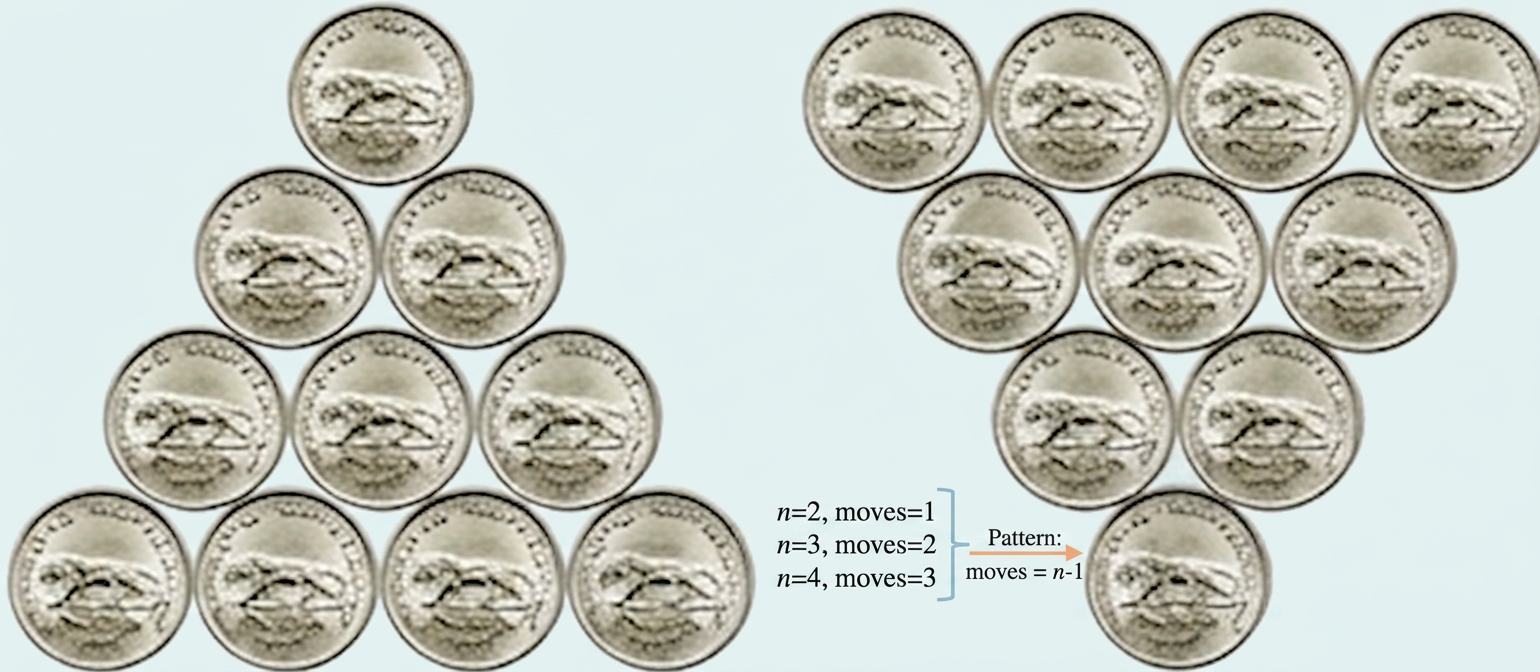
- For 10 coins (n=4):
- Original:
- C1
- C2 C3
- C4 C5 C6
- C7 C8 C9 C10
- Move C1 (the top coin) to the position below C8 and C9.
- Move C7 (the bottom-left coin) to the position above C2 and C4.
- Move C10 (the bottom-right coin) to the position above C3 and C6.
- The coins C2, C3, C4, C5, C6, C8, C9 stay in their places.
- Resulting inverted triangle:
- C10 C4 C2 C7
- . C6 C5 C3
- . . C9 C8
- . . . C1
- This requires 3 moves.
- Original:
The minimum number of moves for a triangle with rows is indeed .
Step 2 — Minimum moves for 15 coins
First, we need to find the number of rows () for a triangle with 15 coins. Let be the total number of coins, so . The formula for the total number of coins is .
Let us multiply both sides by 2:
We need to find a number such that when multiplied by the next consecutive number (), the result is 30. We can try values for : If , . This is too small. If , . This is correct! So, for 15 coins, the number of rows is 5.
Now, we use the pattern we found in Step 1: the minimum number of moves is .
Step 3 — General formula for any triangular arrangement
Let be the total number of coins in the triangular arrangement. Let be the number of rows in this triangle. We know that the total number of coins is given by the formula for triangular numbers:
From Step 1, we found that the minimum number of moves required to invert the triangle is . To find a general formula in terms of , we first need to express in terms of . Let us rearrange the formula for :
Let us move to the right side to form a quadratic equation:
We can solve for using the quadratic formula, which states that for an equation , the solutions for are . Here, , , , and .
Since represents the number of rows, it must be a positive value. So, we take the positive square root:
Now, we substitute this expression for into our formula for the minimum number of moves, which is :
To combine these terms, we find a common denominator:
This formula gives the minimum number of moves needed for any triangular arrangement with coins.
Answer
(i) The minimum number of moves needed to flip the 10-coin triangle is 3. (ii) The minimum number of moves needed to flip the next bigger triangle having 15 coins is 4. (iii) A simple way to calculate the minimum number of coin moves needed for any such triangular arrangement is , where is the number of rows. This can also be expressed as , where is the total number of coins.