Question 1
Chess Puzzles — Non-attacking Queens
Chess is a popular 2-player strategy game. This game has its origins in India. It is played on an chequered grid. There are 2 sets of pieces — black and white — one set for each player. Find out how each piece should move and the rules of the game.
Here is a famous chess-based puzzle. From its current position, a Queen piece can move along the horizontal, vertical or diagonal. Place 4 Queens such that no 2 queens attack each other. For example, the arrangement below is not valid as the queens are in the line of attack of each other.
Now, place 8 queens on this grid so that no 2 queens attack each other!
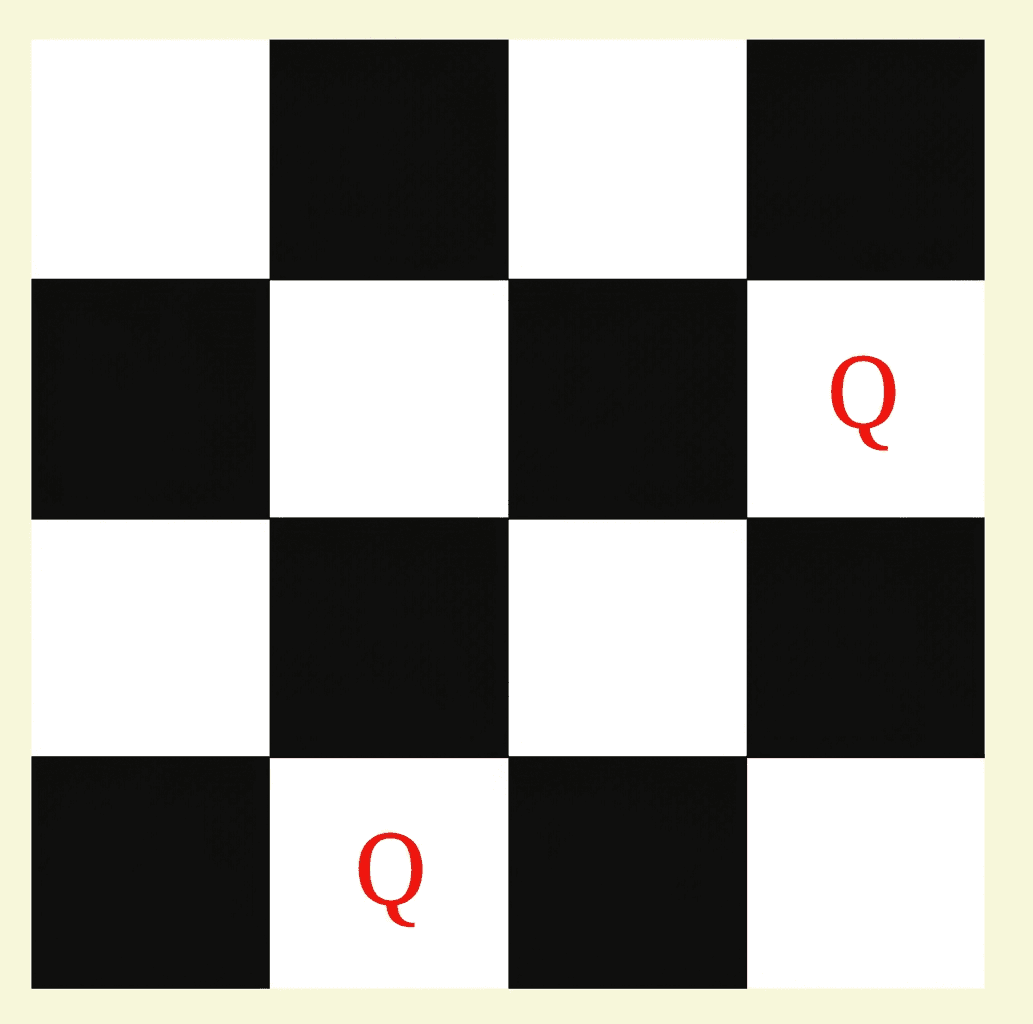

To solve this puzzle, we must place queens so no two queens can attack each other.
Step 1 — Understanding Queen Movement
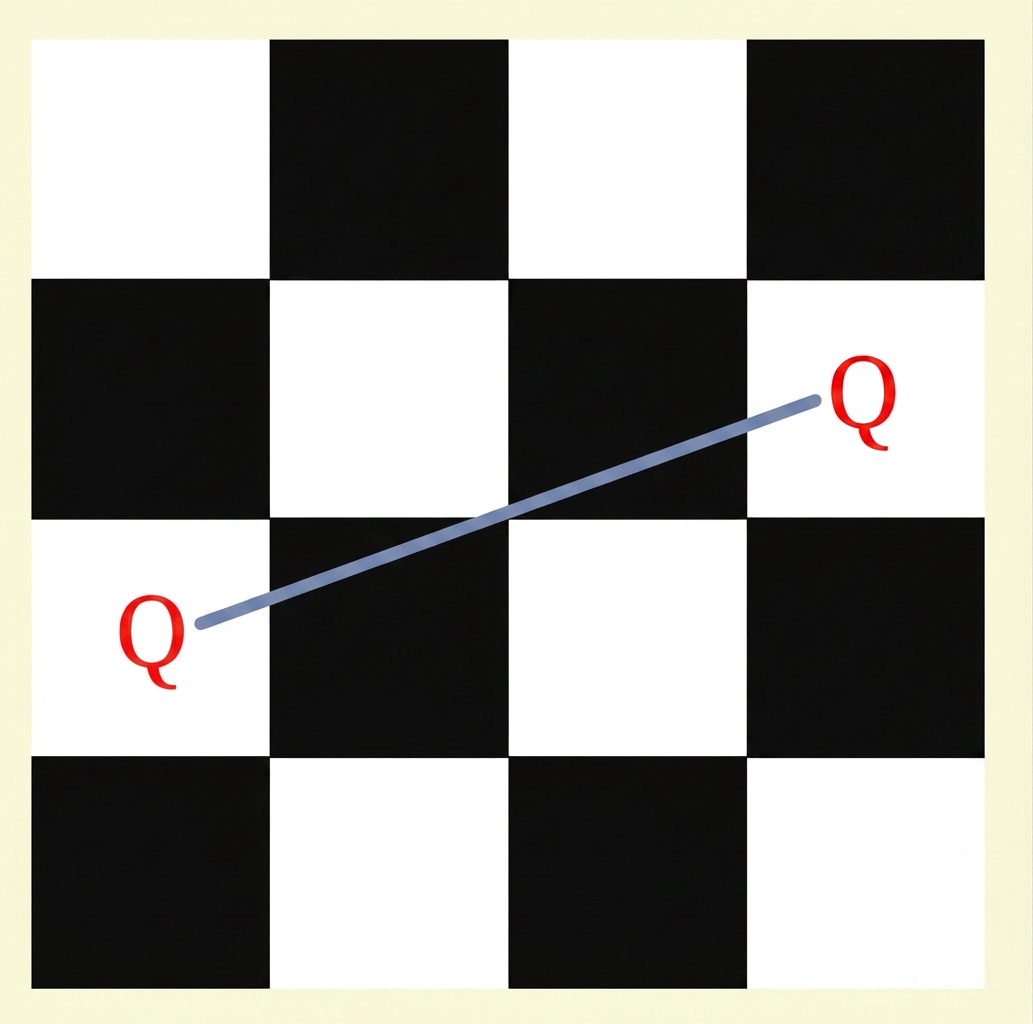
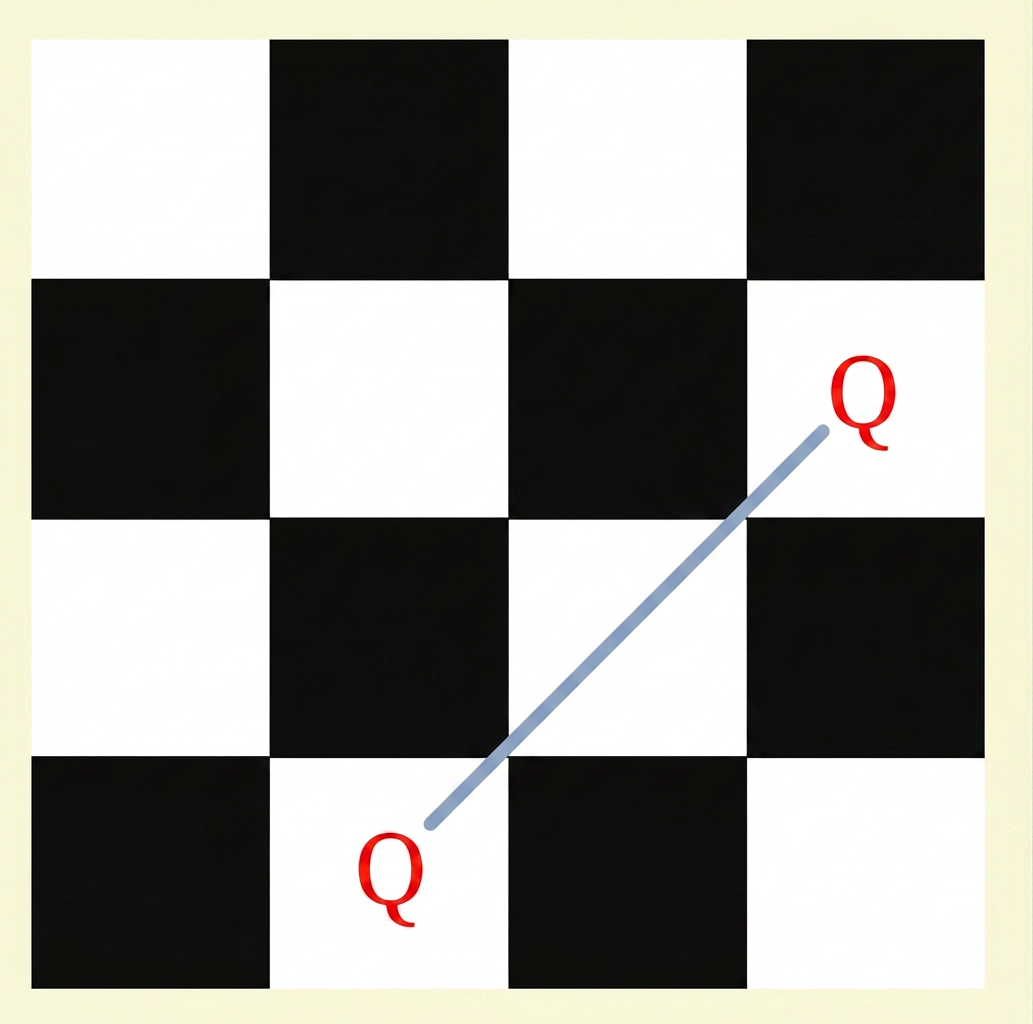
A queen can move in any straight line. This includes horizontal, vertical, and diagonal lines. So, if two queens are on the same row, column, or diagonal, they attack each other. We need to avoid this. The example shows two queens attacking each other. They are on the same diagonal line.
Step 2 — Placing 4 Queens
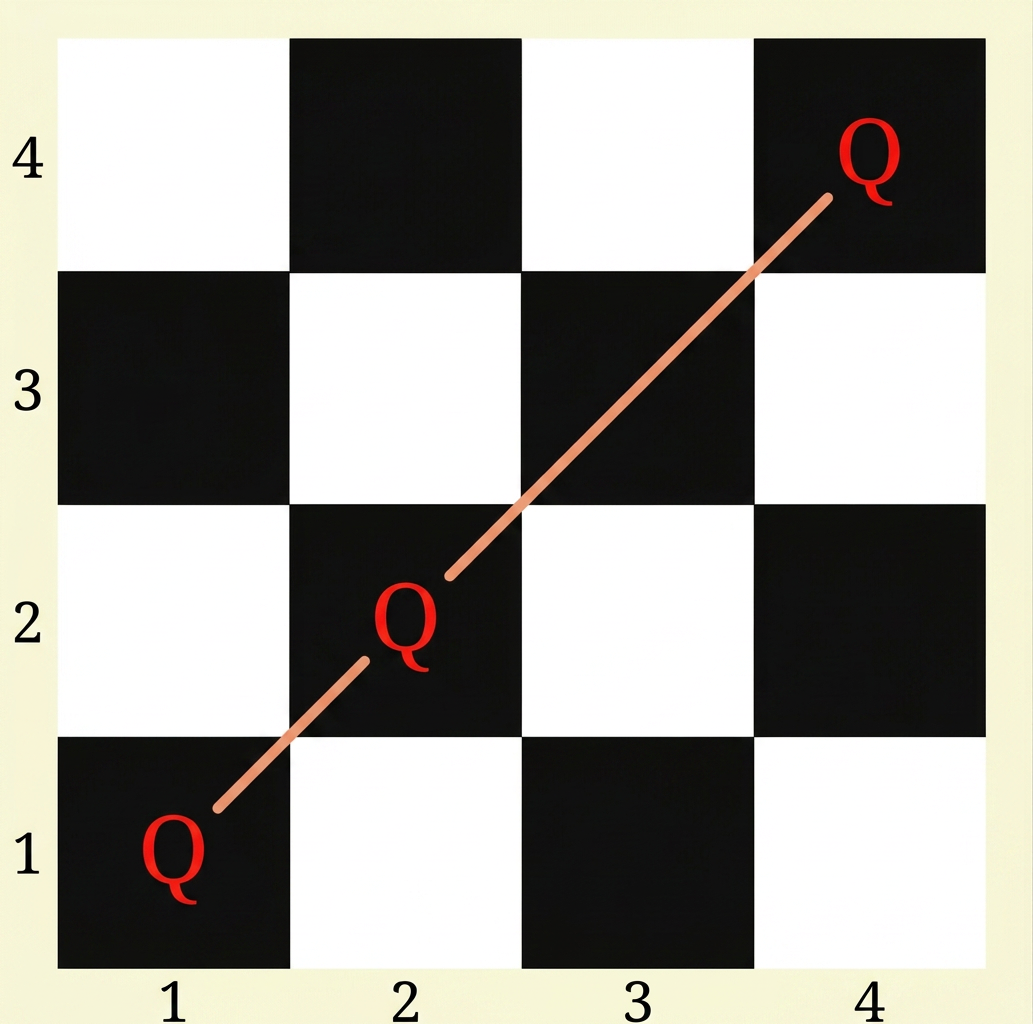
We need to place 4 queens on a grid. No two queens can share a row. So, each queen must be in a different row. Let us place one queen in each row. We also need different columns. And no two queens on the same diagonal. Let us try placing the first queen. We place the first queen at (1, 2). This means row 1, column 2.
Now we place the second queen. It must be in row 2. It cannot be in column 2. It cannot be in (2,1) or (2,3). So, we place the second queen at (2, 4).
Next, we place the third queen. It must be in row 3. It cannot be in column 2 or 4. It cannot be in (3,3). So, we place the third queen at (3, 1).
Finally, we place the fourth queen. It must be in row 4. It cannot be in column 1, 2, or 4. It cannot be in (4,2). So, we place the fourth queen at (4, 3).
Let us check our solution. The queen positions are: All rows are different. All columns are different. Let us check the diagonals. For same-sum diagonals: All sums are different. For same-difference diagonals: All differences are different. So, this is a valid arrangement.
Step 3 — Placing 8 Queens
This puzzle is more complex. There are many possible solutions. Let us find one such arrangement. We place one queen in each row. The columns are chosen carefully. The queen positions are: We can check this solution. No two queens share a row. No two queens share a column. No two queens share a diagonal. This arrangement is a valid solution.
Answer
(i) For the grid, place queens at (1,2), (2,4), (3,1), (4,3). (ii) For the grid, place queens at (1,5), (2,2), (3,4), (4,7), (5,3), (6,8), (7,6), (8,1).